
As India’s aviation market expands, the real race is shifting beyond passenger numbers to the businesses, investments and economic ecosystems taking shape around its airports.
India’s airport story has long been told through passenger numbers, which remain the clearest indicator of how quickly Indians are taking to air travel and have been reinforced by the steady appearance of new terminals and greenfield airports that make aviation a visible infrastructure story.
Yet passenger counts tell only part of what is happening. A subtler transformation is under way in the revenue structures of some larger airports, where retail, food and beverage, advertising, parking, lounges, cargo, ground handling, commercial property and other activities are assuming a much greater role in the economics of the business.
This development warrants closer examination because it is not unfolding uniformly. Some airports have already built substantial commercial activity around aviation operations, while others remain far more dependent on aeronautical revenue. For a country expanding its airport network rapidly, the more useful question is whether India is converging on a single commercial model or whether multiple distinct airport economies are emerging, shaped by passenger volumes, connectivity, catchment areas, traffic mix and the nature of the cities and regions they serve.
The distinction becomes clearer when individual airports are examined instead of treating the sector as a single national entity. Delhi, Mumbai, Bengaluru, Hyderabad, Chennai, Kolkata and Cochin are all major gateways but operate in very different economic environments. Delhi’s role as the national capital’s principal gateway gives it a passenger and business profile that cannot be readily replicated. Bengaluru draws strength from its technology and corporate economy, Chennai from a large industrial and manufacturing base, Cochin from international and tourism links, and Kolkata serves as a gateway to eastern India. Their passenger figures may be comparable, but their economic foundations are not identical.
The Revenue Question
Operator disclosures illustrate why the subject merits attention, although comparisons require caution because revenue categories are not always defined or reported consistently. Cargo, ground handling, commercial property and other activities can be reported separately, and the distinction between non-aeronautical revenue and broader commercial income varies across airports.
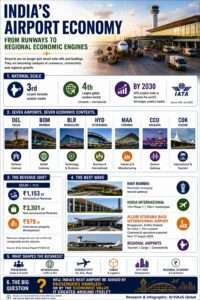
Delhi provides one of the clearest examples of how the business is evolving. Delhi International Airport Limited’s FY25 reporting showed aeronautical revenue of about Rs 1,153 crore, non-aeronautical revenue of approximately Rs 3,301 crore and commercial-property-development revenue of around Rs 979 crore; non-aeronautical activities and commercial property together therefore accounted for roughly 75 percent of operational revenue. The significance lies less in the exact percentage than in what it reveals about a mature metropolitan airport whose economic value extends well beyond aircraft movements and passenger charges.
Contrasts are instructive. GMR Airports reported FY25 aeronautical revenue of about Rs 2,988 crore and non-aeronautical revenue of approximately Rs 5,587 crore across its portfolio, while the younger Manohar International Airport in Goa reported aeronautical revenue near Rs 316 crore and non-aeronautical revenue of around Rs 79 crore.
Such comparisons suggest that commercial maturity does not automatically follow the opening of a terminal; it develops with traffic, passenger behavior, connectivity and the local economic environment. Kolkata offers a further counterpoint, where FY25 figures indicated that aeronautical charges still account for a substantial majority of revenue and the airport remains more dependent on aviation-related income than the mature commercial models seen at some private metropolitan gateways.
Different Paths
Passenger scale clearly matters because a busy airport offers retailers, restaurants, advertisers and other partners a larger and more predictable customer base, and international traffic can create opportunities in duty-free and premium retail. Yet volume is not the sole determinant. The composition of traffic, passenger dwell time, terminal quality, purchasing power in the catchment, connectivity and the ability to develop land and commercial activity around the terminal all shape outcomes.
Age is therefore an incomplete measure of commercial maturity: a relatively young airport with strong passenger growth and an affluent catchment may develop non-aeronautical business quickly, while an older airport with substantial traffic may remain more reliant on aeronautical income. This distinction will become increasingly important as India brings new airports into operation and expands capacity at existing ones.
The national network is beginning to resemble a collection of experiments rather than a single uniform industry. Delhi demonstrates the potential of a mature airport with substantial commercial and property income. Mumbai and Navi Mumbai are building an unusual two-airport metropolitan system whose combined scale could support a much larger aviation and commercial ecosystem. Bengaluru operates within a strong technology and business market; Hyderabad has developed a significant international and corporate catchment; Chennai’s industrial base provides a different economic foundation; Cochin’s tourism and international links give it another orientation; and Kolkata’s aeronautical-heavy profile serves as a useful counterexample to the assumption that passenger scale inevitably produces a highly diversified commercial mix.

The question is not simply whether non-aeronautical revenue is rising across India. The evidence is not yet strong enough to support that claim nationally. The more interesting possibility is that airports are moving along different commercial trajectories, with passenger scale one factor among several that determine how quickly an airport can develop an ecosystem around its core aviation business.
The Commercial Gap
There is considerable scope for Indian airports to increase the value generated from each passenger. A CRISIL Intelligence analysis cited in a 2025 prospectus placed Indian airport aeronautical revenue at roughly $4–5 per passenger and non-aeronautical revenue at around $3–4 per passenger, compared with higher figures for selected global airports. While regulatory and structural differences complicate direct comparison, the broader point remains: India’s passenger traffic is growing rapidly, while the commercial value extracted per passenger still has room to expand.
That explains why operators are looking beyond the terminal. Retail and food outlets inside the terminal generate income, but the larger opportunity may lie in the land and infrastructure around airports. Hotels, offices, logistics facilities, cargo infrastructure, convention centres, entertainment and retail districts, and transport connections can form part of a broader airport economy where surrounding land is strategically valuable.
The model carries risks, however. Commercial development must not interfere with the airport’s basic functions, and the pursuit of passenger spending must coexist with efficient processing, airline operations and reasonable costs. An airport that becomes commercially successful at the expense of the traveller’s experience risks undermining the very customer base that supports its businesses. The more sustainable proposition is commercial activity that strengthens the airport without overwhelming it, while development beyond the terminal creates measurable economic value for the surrounding region; that is the difference between an airport with shops and an airport that functions as an economic ecosystem.
Beyond the Terminal
India’s next generation of airports will test that proposition. Bhogapuram’s Alluri Sitarama Raju International Airport, inaugurated on August 1, 2026 with commercial operations expected to begin in August, has been presented as more than a new aviation facility for the Visakhapatnam region; its longer-term significance will hinge on whether it contributes to tourism, cargo, investment and wider economic development across North Andhra. Navi Mumbai offers a different proposition: with an initial capacity of about 20 million passengers and an ultimate design capacity of around 90 million, it is becoming part of a two-airport system for the Mumbai Metropolitan Region and its success will depend on how effectively it complements Mumbai’s existing airport and supports regional development. Noida International Airport represents another experiment: its initial capacity is substantially smaller than the ultimate masterplan for more than 70 million passengers, so its significance will unfold over years as traffic, airlines and regional demand develop.
These projects illustrate why airport expansion cannot be assessed simply by counting new terminals. An airport can be completed relatively quickly, but the supporting ecosystem takes longer to develop as airlines establish routes, passengers adopt them, businesses locate nearby, tourism grows and logistics networks integrate with the facility. The commercial future of a regional airport may therefore be very different from that of a metropolitan gateway: one may depend on retail and premium services, another on cargo and industrial activity, and a third on tourism and regional connectivity.
The National Test
Private operators are placing greater emphasis on this wider opportunity. Adani Airports announced in June 2026 a first-phase airport-city investment programme of more than Rs 20,000 crore across six airports, covering more than 655 acres and around 22 million sq ft of mixed-use development, with Mumbai and Navi Mumbai accounting for a substantial part of the planned investment. The scale of the proposal illustrates how the airport asset is increasingly considered alongside city-scale commercial and logistical development rather than as a standalone terminal.
This strategy is not unique to one operator; across the industry the boundaries between aviation infrastructure, commercial development, logistics and urban growth are becoming less distinct. The difference is that the opportunity will not be equally available to every airport: a gateway with tens of millions of passengers, strong international traffic and a large metropolitan catchment has advantaged a small regional airport cannot easily reproduce.
That is where the national airport story becomes more nuanced. India may be expanding its network rapidly, but it is unlikely every airport will evolve into the same commercial enterprise. Some will become major passenger gateways with significant retail and property income; others will remain more dependent on aeronautical revenue; and many new airports may take years to reach the traffic levels needed to support substantial commercial activity, leaving smaller regional facilities to contribute mainly through tourism, cargo or industrial connectivity. The challenge is therefore not simply to build capacity but to create the conditions that allow it to be used: passenger demand cannot be manufactured by concrete and glass alone, and airlines, routes, economic activity, tourism and regional connectivity must develop alongside an airport.
The Next Decade
India is entering this phase with an unusual combination of circumstances: passenger traffic is growing, a larger middle class is travelling more frequently, international connectivity is expanding and new airports are being commissioned at a time when tourism, logistics and urbanization are also developing rapidly. That creates considerable opportunity but also complicates cross-airport comparisons. The future performance of Delhi cannot be treated as a template for Bhogapuram, nor can Bengaluru’s technology-driven traffic profile be exported to Cochin or Chennai; Navi Mumbai’s prospects will hinge on its relationship with Mumbai, and Noida’s on how the Delhi-NCR market evolves.
Accordingly, the measure of airport development may shift beyond passenger throughput. Traffic will remain essential, but the economic value generated by that traffic, the commercial activity surrounding the airport and the contribution to the wider regional economy may become equally important indicators. India’s expansion is effectively an experiment involving several different models at once, building new gateways, expanding established ones and creating the possibility of airport-led development on a scale not previously seen in many parts of the country.
Whether those investments ultimately produce thriving airport ecosystems will depend on what happens after the ribbon-cutting ceremonies. The airports that succeed will need passengers but also connectivity, commercial activity, cargo, tourism, investment and a robust economic relationship with the regions they serve. That makes India’s airport story more than a race for passenger records: the numbers will continue to matter, but the larger test is whether the airports being built today can help create the economic activity that sustains them tomorrow.