



Goddess Uma – Daughter of Himavan
Mantra 2.2
तस्मै स होवाचाकाशो ह वा एष देवो वायुरग्निरापः
पृथिवी वाङ्मनश्चक्षुः श्रोत्रं च । ते प्रकाश्याभिवदन्ति
वयमेतद्बाणमवष्टभ्य विधारयामः ॥ २.२॥
tasmai sa hovācākāśo ha vā eṣa devo vāyuragnirāpaḥ
pṛthivī vāṅmanaścakṣuḥ śrotraṃ ca
te prakāśyābhivadanti vayametadbāṇamavaṣṭabhya vidhārayāmaḥ .. 2.2..
He replied, “These Devas are verily the ether, air, fire, water, earth, speech, mind, eye and the ear. They manifesting their power and vaunt said, we hold and sustain this body.
The instruments of experience, jnana indriyas, and instruments of action, karma indriyas, are governed by five elements – space, air, fire, water, earth. The mantra talks of five organs of perception is related to five elements. The elements correspond to each organ:
Ear is space
Nose is air
Eyes is fire
Tongue is water
Touch is earth
The Guru employs a methodology of a story from next mantra onwards. In accordance to this concept, there is a story in the Kenopanishad.
The Gods and demons were fighting. Brahman came and helped the Gods who became victorious. After the victory, the Gods were celebrating, and they attributed the victory to themselves. They forgot the role Brahman played in their victory. Brahman wanted to expose their frail strength. As the Gods were celebrating, up in the sky yonder, suddenly an apparition appeared. Seeing the apparition, the Gods felt that an enemy was still lurking. So Indra, Lord of the Gods, sent the Fire god, Agni, to ascertain the apparition.
Apparition asked: Who are you?
The Fire god said: I am the Fire God
Apparition: What do you do?
Fire God: I destroy everything to ashes.
Apparition placed a straw: Please burn it
Fire God: I could not burn with full force.
Fire god reported to Lord Indra and confessed his incapacity. So Indra sent the wind god, vayu
Apparition asked: Who are you?
Wind God: I am Vayu, the God of winds
Apparition: What do you do
Wind God : I can rip apart anything and destroy anything. I can be a hurricane, a tornado.
Apparition: Can you move the straw?
Wind God: Tried with the speed of a tornado, and nothing happens.
The wind god hastily goes back to Indra and confesses his incapacity. So Indra, the Lord of Gods and senses, came to see the apparition. The moment Indra came, the apparition vanished. Immediately, the beautiful Uma came. Uma is said to be the daughter of Himavan – The Himalayan mountains. Uma represents the scriptures, shastras. Daughter of Himavan means the knowledge of Vedanta is born in the laboratory of the Himalayas. Masters have used the Himalayas as their spiritual laboratory to discover their own Self. The story ends in this section of the Kenopanishad.
Allegorical significance –
The Yaksha, apparition, symbolises Brahman
The Gods symbolise your virtuous qualities
The demons symbolise your vicious qualities
The yaksha appeared after the Gods conquered the demons. Similarly, when the good conquers the rajasic and tamasic negative qualities, that is when your spiritual growth happens. You can recognize Brahman only when you have conquered your negative qualities. Otherwise, you cannot recognise, as you are already a victim of these qualities. But when good overrules the bad, then Brahman enters your life. Your mind becomes calm, and you turn towards God.
The first step of fire god being sent to the apparition – Fire refers to the organ of action. Fire symbolises mechanical rituals. The simplest form to understand God is through mechanical rituals. You approach God through your physical body, which is indicated by the Fire God. Fire God could not identify what the apparition was which means you cannot reach Brahman performing mechanical rituals or through organs of action.
Second, Vayu, the wind God, went to the apparition. Vayu represents the organs of perception. So, Vayu too could not identify the apparition, which means you cannot reach God through the organs of perception as well.
Your eyes cannot see God; you cannot smell or hear God, and so other organs of perception and action cannot reach Brahman. It is that which enables the eyes to see and not what the eyes see, enables the ear to hear and not what the ears hear, enables the mind to feel and not what the mind feels, enables the intellect to conceive, not what is conceived by the intellect. That is God. You cannot see God, smell God, feel God, or understand God. It is that which enables the organs to perceive and act, mind to feel, intellect to conceive.
Indra, the Lord of the senses, represents the mind and intellect. When mind and intellect approach Brahman the apparition disappears because Brahman is not an object of emotion or thought. You cannot feel God or understand God with your mind or intellect. The disappearance of the apparition and the immediate appearance of Uma mean that, when you approach Brahman with devotion, surrender, and spirit of enquiry, you get indirect knowledge of Brahman, which is the shastras.
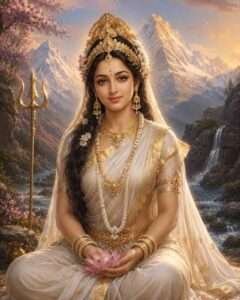
Goddess Uma, the daughter of Himavan, represents where this pure Vedantic knowledge is born in those Himalayan ranges, and the great sages and saints brought that wisdom from the Himalayas to the plains to serve humanity at large. The beauty of Uma is the brilliant, profound, beautiful literature.
Scriptures are the declarations of Brahman or realized souls. To get to the Brahman, you need the scriptural injunctions. The ambassadors of the scriptures are the Gurus. So the onus is on the Gurus to bring out the shastras to the masses and teach them.

