



Sri Subramaniya Swamy Temple, on the shores of the Bay of Bengal in Tiruchendur, Thoothukudi district, Tamil Nadu, is one of the six sacred abodes of Lord Murugan, collectively known as Arupadai Veedu. The temple holds exceptional significance as the sacred place where Lord Murugan is believed to have defeated the powerful Asura Surapadman, restoring peace and righteousness to the universe.
On the auspicious occasion of Kanda Sashti, devotees commemorate this divine victory through fasting, prayers, and the grand Soorasamharam celebration. Unlike most Murugan temples situated on hills, Tiruchendur stands beside the sea, making it unique among the six sacred abodes.
Tiruchendur is an ancient centre of Murugan worship, traditionally believed to be over 2,000 years old. The temple is celebrated in the ancient Tamil literary work Tirumurugatrupadai, composed by Nakkirar during the Sangam literary tradition.
The temple developed over several centuries under different South Indian rulers and patrons. Its present structures reflect successive phases of construction and renovation, while the sacred traditions associated with Lord Murugan have continued for generations.
The presiding deity is Lord Subramaniya Swamy, also worshipped as Senthil Andavar and Tiruchendur Murugan.
The principal deity is traditionally associated with Lord Murugan’s victory over Surapadman. The temple also houses Sri Shanmugar, the six-faced manifestation of Murugan, along with Goddess Valli and Goddess Deivanai.
The divine Vel, the sacred spear Goddess Parvati bestowed upon Murugan, represents wisdom, courage, and the destruction of ignorance.
The temple displays traditional Dravidian architecture, with a magnificent nine-tiered Rajagopuram rising to approximately 157 feet.
Unlike the usual eastern-facing temple towers, the impressive Rajagopuram stands on the western side of the temple complex. The sacred sea forms an important part of the temple’s religious landscape.
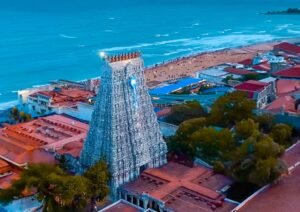
The temple contains spacious mandapams, pillared corridors and beautifully sculpted structures. The sacred Nazhi Kinaru, a freshwater spring situated close to the salty seawater, is another remarkable feature associated with Tiruchendur.
Tiruchendur was historically known as Tiruchir Alaivai, a name associated with the sacred coastal landscape. The temple is praised in Tamil devotional literature, including the hymns of Arunagirinathar.
It is traditionally regarded as the second of Lord Murugan’s six sacred abodes and is especially associated with his role as the divine warrior who defeated the Asuras.
The annual Kanda Sashti festival preserves the temple’s most important religious tradition, bringing together devotees to commemorate Lord Murugan’s victory.
According to the sacred Kanda Puranam, the powerful Asura Surapadman, along with his brothers Tarakasura and Simhamukha, acquired extraordinary powers through severe penance. Blessed with great strength, they began troubling the Devas and disturbing the peace of the three worlds. Unable to withstand their oppression, the Devas approached Lord Shiva and prayed for protection. In response, six divine sparks emerged from Shiva’s third eye and were carried to the sacred Saravana Poigai, where they manifested as six children. Goddess Parvati embraced them together, and they became the six-faced Lord Shanmuga, destined to restore righteousness.
When the time came to confront the Asuras, Goddess Parvati presented Lord Murugan with the divine Vel, a powerful spear representing divine knowledge and Shakti. Murugan proceeded towards Tiruchendur with his celestial army, accompanied by the devoted commander Veerabahu. Before beginning the battle, Murugan sent Veerabahu as an emissary to Surapadman, offering him an opportunity to abandon his arrogance and release the imprisoned Devas. Surapadman rejected the message and refused to surrender. A fierce battle followed between Murugan’s divine forces and the Asura armies. During the course of the conflict, Tarakasura and Simhamukha were defeated, and the remaining forces of Surapadman were gradually destroyed.
On the sixth day, Surapadman himself confronted Lord Murugan in a final battle. Using his magical powers, he assumed several terrifying forms in an attempt to escape defeat. Finally, he transformed himself into a gigantic mango tree standing amidst the ocean, believing that Murugan would be unable to destroy him. However, Lord Murugan hurled his divine Vel towards the tree, splitting it into two halves. One half transformed into a magnificent peacock, while the other became a rooster. Rather than completely destroying Surapadman, the compassionate Lord accepted the peacock as his divine vehicle and the rooster as the emblem on his victorious flag. Thus, even the defeated Asura received divine grace through surrender.
Following the victory, Lord Murugan is believed to have worshipped Lord Shiva at Tiruchendur in gratitude. The Devas rejoiced as peace and righteousness were restored. This divine event became known as Soorasamhara, commemorated every year on Kanda Sashti. The sacred seashore of Tiruchendur is traditionally identified as the place where this great battle reached its conclusion. The following day, Lord Murugan’s divine marriage with Goddess Deivanai is celebrated as Thirukalyanam.
🎉 Festivals & Worship
Kanda Sashti is the most important annual festival at Tiruchendur, observed during the Tamil month of Aippasi, corresponding to the Kartika lunar month.
Devotees undertake six days of fasting, prayers and recitation of the Kanda Sashti Kavasam. On the sixth day, the Soorasamharam ceremony dramatically reenacts Lord Murugan’s victory over Surapadman on the seashore near the templ


