Lakshmanrao Upadhyayula
The sage Vishwamitra, immersed in profound contemplation, invoked the divine powers through sacred hymns dedicated to the Yūpa, the sacrificial altar-pole that stood as a luminous emblem of the eternal covenant between humanity and the celestial worlds. In the measured cadences of Anuṣṭubh and Triṣṭubh chandas drawn from the revered hymns of the Rigveda, the Viśvadevatās were praised as universal guardians who pervade all directions of existence. Herbs sanctified by sacrificial rites, the fervent aspiration of seekers longing for divine communion, the disciplined Adhvaryu priests, clarified butter, and the heavenly Soma together consecrated the Yūpa with sacred power. Whether standing firmly upon the earth or resting symbolically in the nurturing lap of Mother Nature, the Yūpa was invoked as the bestower of prosperity, spiritual radiance, noble thought, and enduring abundance.
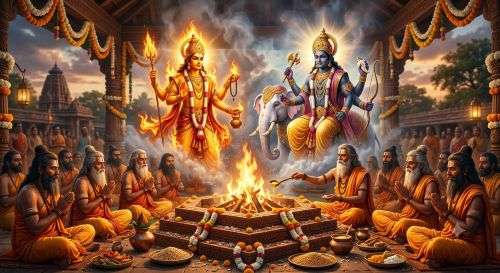
The sacrificial altar arose within the sanctified enclosure of the yajña as a centre of cosmic harmony. The Yūpa stood near the holy kuśa grass and beside the blazing Samidhāgni, facing the eastern direction from which divine illumination emerges. It was not merely a wooden pillar erected for ritual utility, but a living spiritual axis connecting the earthly realm with the celestial planes. The priests prayed that it might grant undiminishing wealth, wholesome vitality, noble cattle, fertile harvests, heroic strength, and resplendent wisdom. The glory of abundance sought through the Yūpa was not confined to material riches alone; it represented the fullness of righteous living, social order, intellectual refinement, and spiritual awakening sustained through sacred discipline.
The Lord of the Forest manifested through the Yūpa upon the elevated and sanctified ground of the yajña precincts. Chosen with precise measurements according to sacred injunctions, the Yūpa reflected the remarkable scientific temperament of Vedic civilisation, where geometry, proportion, ecology, and ritual symbolism were harmoniously united. The wood selected for its construction was examined for purity, strength, and auspicious qualities. The Yūpa provided the symbolic foundation upon which offerings were raised toward the gods, and thus it became the sustainer of sacrificial order itself. Its strong limbs represented firmness in dharma, while its “delicious tongue” symbolised the sacred flames of Agni that consumed offerings and carried them to the celestial realms.
The flames of Agni rose upward like luminous tongues embracing the Yūpa, while the assembled sages invited the sacred pillar to dwell among them as the visible form of divine presence. Among all the products of the forest, no object possessed greater spiritual significance than the Yūpa, for it transformed earthly wood into a bridge toward immortality. It stood not merely in the yajña hall, but in the hearts of wise priests who, through deep meditation and disciplined recitation of mantras, awakened the subtle consciousness hidden within matter itself. The erection of the Yūpa was therefore both an outward ritual and an inward ascent of awareness, revealing the Vedic understanding that the universe is animated by sacred intelligence.
Born originally as a tree rooted in the earth, the Yūpa symbolised the cosmic tree described in Vedic thought, whose roots extend into the heavens while its branches nourish earthly life. Decorated with garlands, cloth, ornaments, and sacred markings, it became the spiritual ornament of the yajña hall. Men adorned themselves alongside the Yūpa, recognising that human life too must be consecrated through purity, discipline, and devotion. The sacrificial arena thus reflected a profound union between humanity, nature, and divinity, where every participant became part of a cosmic act of renewal.
The learned ritual scholars and Adhvaryu priests approached the Yūpa with solemn vows and sacred discipline. They purified it through water, mantras, clarified butter, and ritual gestures, transforming ordinary matter into a vessel of divine energy. The chanting of Vedic hymns reverberated through the sacrificial grounds with measured intonation and phonetic precision, reflecting the scientific mastery of sound cultivated by Vedic seers. These chants were believed not merely to praise the gods but to awaken subtle vibrations that harmonised the human mind with cosmic rhythms. Thus, the consecration of the Yūpa embodied both spiritual devotion and an advanced understanding of acoustics, memory, breath control, and psychological concentration.
Those who possessed an intense longing for the gods, together with the leaders of sacrifice and the disciplined Adhvaryu priests, installed the Yūpa upon the sanctified platform with deep reverence. The sharp axe known as Kuṭhāra had once severed it from the forest tree, yet this act of cutting was not viewed as destruction but as transformation. The luminous piece of wood entered a higher destiny through sacrifice. The Vedic mind perceived that nothing in creation perishes without purpose; rather, all forms evolve through sacred offering. Even the tree, once rooted in the soil, attained spiritual exaltation by becoming the Yūpa that upheld divine worship.
The Yūpa, though cut upon the earth by sharpened axes, rose again through the hands of the Ṛtvijas into a higher form of existence. Installed according to sacred rites, it became the accomplished centre of ritual fulfilment. Every offering tied to the Yūpa symbolically ascended toward the gods, carrying human aspirations into the celestial realms. Through this symbolism, the Vedic sages expressed a profound philosophical truth: sacrifice is the principle through which life itself evolves. The universe continues through mutual offering, interdependence, and transformation. Thus the Yūpa stood as a silent teacher of cosmic reciprocity and sacred responsibility.
When the holy flag-hoisting ceremony was performed, the Yūpa shone brilliantly amidst radiant lamps and sacrificial fires. Its upward form resembled a swan soaring gracefully among celestial flocks, symbolising the liberated soul journeying toward higher truth. The sanctified wood, adorned and uplifted through sacred chants, was believed to traverse heavenly paths through the power of mantra and devotion. The decorated Yūpa appeared resplendent like the shining horns of a divine being, as though the earth herself had blossomed into sacred beauty. Empowered by Vedic hymns, it became a guardian of society, invoked for protection in times of conflict and uncertainty.
The venerable tree from which the Yūpa was fashioned did not lose its greatness through separation. Rather, the first portion cut by the sharp axe attained immortal fortune through sacrificial purpose. The sages envisioned that the tree would be reborn again with hundreds of branches, continuing the eternal cycle of life, offering, and renewal. In the same manner, the branches of Vedic knowledge spread through sacred schools, lineages, and disciples who preserved wisdom across generations. The Yūpa therefore symbolised not only sacrifice, but also continuity of civilisation, ecological reverence, intellectual discipline, and spiritual ascent. It stood as a radiant pillar of Vedic culture, uniting science and spirituality, nature and consciousness, ritual and philosophy, earth and heaven within one eternal vision of harmony.