
Lakshmanrao Upadhyayula
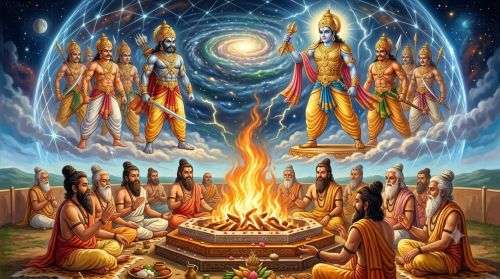
Among the profound hymns of the Rigveda, the sage Vāmadeva invokes Lord Indra in the majestic Triṣṭubh metre, celebrating him as the wielder of the mighty Vajra, the divine protector of the universe, and the upholder of Ṛta, the eternal cosmic order. The hymn unfolds not merely as a eulogy to a victorious deity but as a philosophical reflection on the harmony between nature, divine power, and human welfare. The sacred sacrifice becomes the meeting ground where heaven and earth, the hosts of gods, sages, and worshippers assemble to honour Indra for his immortal feat of slaying Vṛtra, the demon who imprisoned the life-giving waters. Indra stands as the visible embodiment of strength, virtue, prosperity, and divine grace.
The hymn portrays Indra as the eternal guardian who acts with the affection and wisdom of an aged father instructing his son. Encouraged by the celestial hosts, he rises against the destructive powers that threaten the balance of creation. His victory over Vṛtra is not merely a battle between two mighty beings but a symbolic triumph of truth over falsehood, knowledge over ignorance, and order over chaos. Indra becomes the living manifestation of truth, revealing that divine strength is meaningful only when exercised for the welfare of all existence.
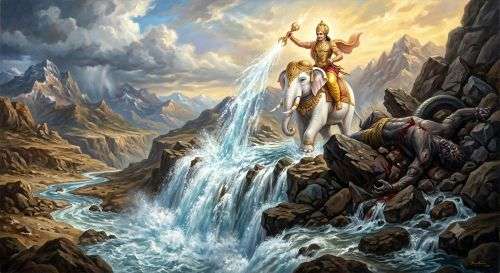
Vṛtra is described as one whose nature is rooted in dissatisfaction, ignorance, and destruction. Though powerful, he possesses only a perishable body and a mind devoid of compassion, noble vision, and spiritual understanding. Having captured the celestial waters, he lay in reckless arrogance, obstructing the prosperity of the worlds. On the sacred full-moon day, Indra’s thunderbolt shattered this tyranny. The destruction of Vṛtra signifies the removal of every force that blocks the natural flow of life, knowledge, and abundance.
The release of the imprisoned waters forms the central vision of this Vedic hymn. Water, in Vedic thought, is far more than a physical substance. It represents life, purity, fertility, wisdom, and divine blessings. By breaking the barriers created by Vṛtra, Indra restores rivers to their natural courses, replenishes lakes and streams, nourishes vegetation, and sustains every living being. The hymn beautifully portrays rivers flowing joyfully under Indra’s command, filling the earth with freshness and transforming barren lands into fertile fields capable of producing abundant food.
The hymn also reflects an astonishing observation of natural phenomena. It speaks of the movement of winds disturbing the waters, the breaking of clouds, the fall of rain, and the birth of rivers. These descriptions reveal the keen scientific temperament of the Vedic seers, who carefully observed the water cycle and expressed it through symbolic language. Vāyu, the wind, agitates the waters; clouds gather in the heavens; Indra breaks them with his thunderbolt, releasing rain upon the earth. While presented through divine imagery, these verses demonstrate an intuitive understanding of atmospheric processes that sustain ecological balance.
The imagery grows even more magnificent as the Maruts, the youthful storm deities, hasten towards Indra like loving children rushing to their mother. United in purpose, they accompany him in his swift chariot to overcome Vṛtra. Their harmonious cooperation illustrates the Vedic ideal that every force of nature functions together in maintaining universal equilibrium. Thunder, lightning, wind, rain, and rivers are portrayed as coordinated expressions of one cosmic intelligence rather than isolated natural events.
The hymn celebrates the Earth as the beloved mother of all beings. By Indra’s grace, rivers such as Turvīti and Vayya flow freely, beautifying the land and sustaining life. The roaring of rivers striking their banks becomes a hymn of prosperity. Their waters irrigate fields, nourish forests, support animals, and provide food for humanity. Thirsty travellers find relief, barren lands blossom into fertile landscapes, and civilisation flourishes wherever these sacred waters reach. The Vedic vision recognises water as the foundation of both material prosperity and spiritual well-being.
One remarkable episode describes Indra rescuing the son of Ugra from the depths of a molehill. Surrounded by destructive worms with protruding tongues, the child had become blind and physically afflicted. Indra destroys the harmful creatures, restores the damaged organs, removes blindness, and grants clear vision. Beyond its literal meaning, this episode symbolises the removal of ignorance, disease, and inner darkness. Divine grace restores both physical health and spiritual insight, enabling one to perceive truth with renewed clarity.
Another profound image speaks of Indra milking the barren cows of the Dasyus. In Vedic symbolism, cows represent wealth, knowledge, nourishment, and rays of illumination. What appeared barren and unproductive becomes a source of abundance through divine intervention. Likewise, the darkness that had concealed the dawn is dispelled. The imprisoned years, clouds, rains, and waters are all released, signifying the restoration of the natural rhythm of time and seasons upon which life depends.
Throughout the hymn, Indra emerges as omniscient and omnipotent, responding to humanity’s deepest aspiration for rain, fertility, and prosperity. The ancient sages recognise that every shower of rain, every flowing river, and every fertile harvest reflects the continuing operation of divine order. Their praise is therefore not mere ritual but an expression of profound gratitude for the forces that sustain existence. Vāmadeva reminds humanity that the blessings of nature should always be received with reverence, responsibility, and humility.
The hymn concludes with an earnest prayer. Just as rivers remain ever full through the gift of flowing waters, may priests, seekers, and all humanity be blessed with nourishment, wisdom, and prosperity. The worshippers invoke Indra, the Lord of the radiant Hari horses, requesting him to accept their Vedic chants with pleasure. They pray for vitality, swiftness, righteous action, and spiritual progress, resolving to compose ever-fresh hymns that glorify the eternal protector whose divine power sustains the universe and whose blessings continue to inspire generations in their pursuit of harmony between nature, humanity, and the Supreme Reality.