Lakshmanrao Upadhyayula
Among the most remarkable hymns of the Rigveda is the profound dialogue between the sage Vāmadeva, Indra, and Aditi. Composed in the majestic Triṣṭubh chandas, this hymn stands apart for its extraordinary philosophical depth. It is not merely a prayer but a dramatic conversation that unfolds even before the birth of the sage. It explores the mysteries of life, the sanctity of birth, divine authority, human inquiry, moral responsibility, and the fearless pursuit of truth. The hymn reveals that the Vedic seers encouraged reasoned questioning alongside unwavering reverence for the cosmic order.
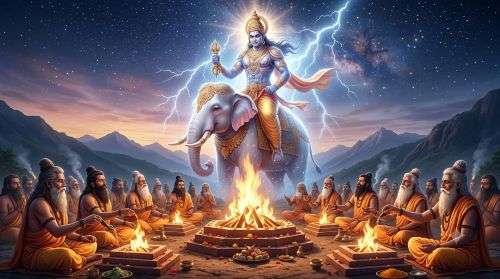
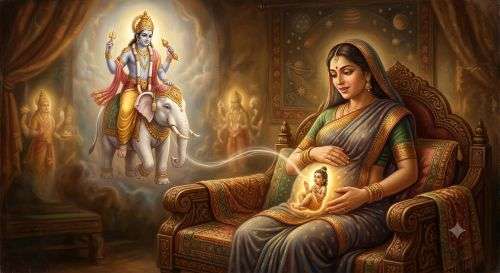
The dialogue begins with Indra declaring that the path of birth through the mother’s womb is sacred, ancient, and eternal. It is the timeless route through which gods, sages, and human beings have entered the world since the beginning of creation. This holy process is not merely biological but an expression of ṛta, the universal cosmic order. Indra urges the unborn Vāmadeva to emerge through this established path, warning him that any deviation could endanger his mother’s life. His words uphold the continuity of nature and the wisdom accumulated through countless generations.
The unborn Vāmadeva, however, responds with astonishing courage and independence. He refuses to accept the conventional path merely because it is ancient. Declaring that he will break through his mother’s side to enter the world, he explains that his destiny is unlike that of ordinary beings. Great tasks await him. He must confront mighty adversaries, engage in profound debates, challenge accepted ideas, and accomplish deeds that others would consider impossible. His determination symbolizes the fearless spirit of inquiry that distinguishes great seekers of truth. Even before birth, he demonstrates that wisdom often begins with the courage to question.
Indra cautions him once again, emphasizing that experiments should never destroy the very life that nurtures them. The mother’s welfare must remain paramount. The dialogue beautifully balances innovation with responsibility. The Vedic vision does not reject experimentation, but insists that it must harmonize with compassion, wisdom, and preservation of life. This subtle balance reflects an advanced ethical understanding that remains relevant in every age.
Vāmadeva then directs his attention toward Indra himself. He recalls the episode in which Indra entered the abode of Tvaṣṭṛ and forcefully obtained the purified Soma. By referring to this controversial act, Vāmadeva boldly questions divine conduct. His words are not spoken out of disrespect but from an uncompromising commitment to truth. The hymn illustrates that even the greatest deity can become the subject of philosophical examination. Such intellectual freedom reveals the remarkable openness of Vedic thought, where inquiry is welcomed rather than suppressed.
The sage further questions why Indra, who remained in Aditi’s womb for such a long period, should be regarded as beyond criticism. Aditi responds with profound maternal wisdom. She explains that Indra cannot be compared with ordinary beings because his birth itself was extraordinary. Emerging in a mysterious and wondrous form, he embodied immense divine potential. Though initially misunderstood, he soon revealed incomparable brilliance, strength, and wisdom. As soon as he was born, he illuminated heaven and earth, transforming creation with radiant energy.
Aditi then invites Vāmadeva to listen to the voices of the rivers. Their flowing waters, resounding like majestic hymns, proclaim the glory of Indra. They celebrate the one who released them from bondage after slaying the mighty Vṛtra. The rivers themselves become living witnesses to divine action. Their uninterrupted flow symbolizes freedom, prosperity, and the restoration of cosmic balance. Nature, in the Vedic vision, participates actively in preserving sacred memory.
The dialogue then touches upon one of the most subtle moral reflections in Vedic literature. After killing Vṛtra, Indra incurred the burden of Brahmahatyā, the sin associated with taking life. The waters compassionately absorbed this burden, manifesting it as foam upon their surface. This symbolic episode teaches that even the mightiest hero is not entirely beyond moral consequence. Actions carry responsibility, and purification requires the cooperation of nature itself. It is a profound meditation on accountability, ecological harmony, and the interconnectedness of all existence.
Vāmadeva continues to recount Indra’s heroic life. He recalls how the demon Kuśava threatened the newborn deity, how the waters protected and nourished him, and how Indra awakened with divine purpose to destroy forces of darkness. He also remembers the demon Vyamsa, who wounded Indra by breaking his jaws. Yet Indra grew stronger, eventually crushing the demon with his irresistible Vajra. These episodes portray resilience as the defining quality of divine greatness. True strength is forged not in comfort but through adversity.
The hymn celebrates Indra as ancient yet ever youthful, unconquerable yet compassionate, self-powered yet devoted to sustaining the universe. He is praised as the fulfiller of noble aspirations, the inspirer of courage, the source of vitality, and the embodiment of irresistible energy. His power is presented not merely as physical might but as the dynamic force that sustains cosmic harmony.
Another deeply moving exchange occurs when Aditi observes that Agni and certain other gods appear to neglect Indra. This maternal concern reveals the emotional dimensions of divine relationships. Indra then addresses Viṣṇu as his trusted companion, requesting his assistance in the battle against Vṛtra. The hymn thus portrays divine cooperation rather than rivalry, emphasizing that cosmic victory is achieved through unity of purpose.
The dialogue also contains enigmatic reflections upon Indra’s relationship with his father and the circumstances surrounding his rise to supreme power. These verses have long inspired diverse interpretations among Vedic scholars. Rather than presenting simple historical events, they symbolize the transcendence of old limitations and the emergence of new creative energies within the cosmos. The questions themselves invite contemplation rather than dogmatic certainty.
One of the hymn’s most touching moments recalls a period of extreme hardship when even dog flesh became the only available food. It speaks of humiliation, hunger, and human suffering before Indra bestowed abundance and life-giving waters. These verses remind readers that divine grace often reveals itself after periods of profound struggle. Prosperity becomes meaningful only when one has experienced deprivation.
Throughout the hymn, Aditi emerges as the eternal mother who not only gives birth to Indra but continually nurtures and protects him. She represents infinite compassion, creative energy, and the sustaining power of the universe. Her presence transforms the dialogue into a timeless reflection on motherhood as both biological and cosmic.
The conversation between Vāmadeva and Indra ultimately ends not in conflict but in understanding. The fearless sage who initially challenged divine authority gradually recognizes Indra’s immeasurable greatness through reason, observation, and reflection. His transformation demonstrates that genuine wisdom arises not from blind acceptance nor from stubborn denial, but from sincere inquiry guided by humility. The hymn therefore presents questioning as a sacred path leading toward deeper realization.
This remarkable Rigvedic dialogue also reveals an early scientific temperament. Vāmadeva examines accepted beliefs, demands logical explanations, evaluates evidence drawn from nature, and questions even the highest authority. Indra, rather than silencing inquiry, responds with reason, experience, and ethical concern. The flowing rivers, the symbolism of birth, the consequences of action, and the restoration of ecological balance all reveal a civilization deeply committed to observation, causality, and intellectual honesty.
The hymn thus stands as one of the finest philosophical treasures of the Rigveda. It unites spirituality with rational inquiry, devotion with fearless questioning, and cosmic symbolism with ethical reflection. The unborn Vāmadeva’s determination, Indra’s majestic responses, and Aditi’s boundless maternal wisdom together illuminate a vision in which truth is approached through courage, compassion, disciplined reasoning, and reverence for the eternal order that sustains all creation.