


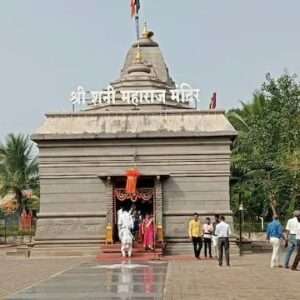
Shri Kshetra Nastanpur Shani Maharaj Temple is an ancient and sacred shrine dedicated to Lord Shanidev, situated about 18 km from Nandgaon in Maharashtra. The temple is traditionally regarded as a Swayambhu Shani Kshetra and is an important centre of Lord Shanidev worship in Maharashtra.
According to local belief, Lord Rama himself established the Shani idol here during his search for Goddess Sita. The temple is particularly revered by devotees seeking relief from Shani Dosha and Sade Sati.
The temple is traditionally believed to date back to the Treta Yuga, during the period of Lord Rama. The shrine has undergone renovations while preserving its ancient worship traditions.
The presiding deity is Lord Shani Maharaj, worshipped as a self-manifested form. The idol is approximately 35 inches tall and 28 inches wide, with four arms. Three hands hold weapons, while the fourth is raised in blessing. The deity is depicted seated on a bird, traditionally described here as a cuckoo, with a crown representing the rays of the Sun. The idol faces east towards the rising Sun, a distinctive feature of this shrine.
The renovated temple has an east-facing sanctum and a spacious prayer hall. The sacred idol of Shanidev is installed in the Garbhagriha, with silver Padukas placed before it. Small shrines dedicated to Lord Ganesha and Lord Hanuman are also found within the temple premises.
Nastanpur was traditionally known as Nashratpur and is associated with the ancient Dandakaranya forest region. The temple is considered an important centre of Shani worship in northern Maharashtra. Local traditions also associate the shrine with King Nala, King Vikramaditya, the Pandavas, and several saints.
According to the traditional Sthalapurana, during the Treta Yuga, when Ravana abducted Goddess Sita from Panchavati, Lord Rama and Lakshmana travelled through the dense forests of Dandakaranya searching for her.
During their journey through the forest, Lord Rama and Lakshmana visited the ashram of Sage Agastya, who welcomed them and listened as Lord Rama explained how Ravana had abducted Goddess Sita.
After listening to Rama, Sage Agastya explained that he was passing through a difficult period associated with Shani’s Sade Sati. The sage advised that, before confronting Ravana, Lord Rama should worship Lord Shanidev to overcome the unfavourable planetary influence.
Accepting the sage’s guidance, Lord Rama and Lakshmana continued their journey through the forest.
By evening, they reached a place called Nashratpur, now known as Nastanpur. As the forest ahead was extremely dense and darkness was approaching, they decided to spend the night there.
Lord Rama regularly performed his Sandhyavandana prayers three times a day. When the time for his evening prayers arrived, he began worshipping Surya Bhagavan, offering water as Arghya to the setting Sun.
At that sacred moment, according to the legend, Surya Bhagavan placed an idol of his son, Lord Shanidev, into Rama’s joined palms.
Recognising this as a divine blessing, Lord Rama reverentially received the idol and installed it at the very place where he was performing his prayers.
He then performed special prayers to Lord Shanidev, establishing the sacred idol at that place, which later came to be revered as Shri Kshetra Nastanpur Shani Maharaj Temple.
It is believed that, pleased with Rama’s devotion, the celestial beings showered flowers from the heavens, blessing the sacred installation.
The following morning, after completing his worship, Lord Rama continued his journey in search of Goddess Sita.
Devotees believe that the same sacred idol installed by Lord Rama continues to be worshipped at Nastanpur, making the shrine particularly significant in the local Shani tradition.
Another tradition connects the temple with the celebrated mathematician Bhaskaracharya and his daughter Lilavati. It is believed that when Bhaskaracharya suffered from mental confusion, his daughter brought him to this sacred place and prayed to Shanidev. Pleased with their devotion, Shanidev is said to have restored his well-being. Local belief also associates this place with Bhaskaracharya’s famous work Lilavati, although this connection has not been historically established.
Shani Amavasya is the most important occasion celebrated at the temple, attracting large numbers of devotees. Special Abhishekam, prayers, decoration of the deity and processions are conducted. Shani Jayanti and Saturdays, particularly during the month of Shravan, are also significant. Devotees offer prayers seeking protection from difficulties, relief from Sade Sati and blessings for peace and prosperity.

