



There is a lesson in the latest Madras High Court intervention in Tamil Nadu that Hindu devotees and civil society activists across Bharat would do well to understand: when citizens decide to defend their constitutional and religious rights through the courts, even entrenched political interests cannot indefinitely stand in their way. What political parties may avoid for electoral considerations, an ordinary citizen can pursue through the power of the law. The latest episode involving the Periyar statue near the ancient Brahma Sira Kandeeswarar Temple at Kandiyur in Thanjavur district is a case in point.
The Madurai Bench of the Madras High Court has directed the Thanjavur District Collector to safely relocate the statue of E.V. Ramasamy, popularly known as Periyar, to another location within four weeks. The direction followed a writ petition filed by Rama Ravikumar, who questioned the installation of the statue near the temple and the absence of permission from the Hindu Religious and Charitable Endowments (HR&CE) Department. What makes this development particularly significant is the citizen-led process that preceded it. Ravikumar reportedly used the Right to Information Act to obtain official records, which indicated that the department had not granted permission for the installation. He subsequently approached the authorities and, when the issue remained unresolved, moved the High Court.
The case also brings out the importance of distinguishing political claims from documentary evidence. During the proceedings, the Tahsildar reportedly informed the court that the statue stood on government poramboke land and had been shifted to its present location during road-widening work. The temple administration, however, maintained that the site belonged to the temple and that objections had been raised when the statue was installed. The High Court’s direction to relocate it provides an administrative resolution to the immediate controversy, while the precise legal status of the land must be understood in the light of the proceedings.
The issue, nevertheless, raises a larger question. Why should the surroundings of a place of worship become an arena for political assertion? The inscription beneath the statue, attributed to Periyar’s atheistic speeches, explicitly rejects the existence of God and ridicules those who worship Him. Periyar was entitled to his ideological convictions and freedom of expression. But the freedom to propagate atheism cannot automatically translate into an unrestricted right to place political or ideological symbols on land belonging to a religious institution or immediately adjoining its premises. The same principle must apply to every faith and every place of worship.
This is not about denying Periyar his place in Tamil Nadu’s political and social history. Nor should it be reduced to a confrontation between Dravidian ideology and Hindu sentiment. It is about respecting institutional boundaries, religious sensibilities and the rule of law. A temple is not merely another piece of public property. It is a living religious institution sustained by the faith, offerings and traditions of generations of devotees. Its property must be protected from unauthorised occupation and arbitrary use, irrespective of the political identity of the beneficiaries.
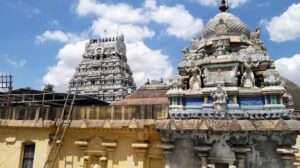
The Tamil Nadu Hindu Religious and Charitable Endowments Act, 1959, provides statutory mechanisms for dealing with encroachments on religious institutional properties. Sections 78 and 79 prescribe procedures for identifying and removing encroachments. These provisions are not ornamental clauses; they exist to protect religious endowments and ensure that properties dedicated to temples serve their intended purposes. The responsibility of enforcing them rests with the authorities entrusted with temple administration. <cite>
But perhaps the most important message from Kandiyur is the emergence of individual rights activism. Ravikumar did not have to command a political party, head a religious organisation or mobilise thousands of people to bring the issue before the judiciary. He used an RTI application, official correspondence and a writ petition. That is precisely how constitutional democracy is expected to function.
In my view, Hindu society needs more such informed, disciplined and legally conscious citizens. There is no need to wait for political parties to discover religious issues when electoral calculations permit. Nor should genuine grievances be left to simmer until they spill onto the streets. Document the violation, seek information, approach the competent authorities and, where necessary, knock on the doors of the judiciary. Lawful activism is far more effective and sustainable than emotional protests.
It is equally important that such activism remains evidence-based, peaceful and respectful of the rights of others. The objective should never be to silence a different ideology but to ensure that the same constitutional standards apply to everyone. If a church, mosque or any other religious institution faces a comparable violation of its property rights, the same legal protection must be available.
The Kandiyur episode may appear to be a local dispute over a statue. Its larger significance lies in what one determined citizen has demonstrated. Politicians may calculate, governments may procrastinate and bureaucracies may look the other way. But a citizen who knows his rights, gathers evidence and pursues the constitutional remedy can make the system respond.
Hindu rights activism must grow — not through confrontation, but through constitutional awareness, legal intervention and fearless civic participation. Democracy is not the exclusive preserve of politicians. Sometimes, the most consequential political statement is made not from a public platform but through a simple writ petition.


