



Asvatthāma, though inwardly consumed by grief and indignation, spoke with remarkable composure. Addressing Duryodhana, he observed that it was not fitting for warriors to proclaim beforehand what they intended to accomplish in battle. Such declarations often appeared as empty boasts and unnecessary speech. Yet the unbearable humiliation inflicted upon his father scorched his heart like an unquenchable fire. The anguish raging within his mind compelled him to speak openly. It was this burning sorrow, rather than vanity, that led him to reveal the measure of his power.
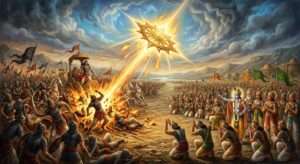
Turning to Duryodhana, he continued, “Know that my words shall not prove fruitless. My revered father, through profound meditation upon Lord Narayana, obtained a celestial weapon of immeasurable might. That divine missile, known as the Narayanastra, was entrusted to me. It does not distinguish between those destined to perish and those destined to survive. Once unleashed, it sweeps through hostile ranks with irresistible force and destroys enemies in an instant. Victory then becomes inevitable. Wait and behold its power.”
Hearing these words, Duryodhana, Duḥśāsana, and the Kaurava commanders were filled with renewed confidence. Conches blared, trumpets sounded, and mighty lion-like roars echoed through the battlefield. Kettle drums, tabors, and war instruments thundered with such intensity that their reverberations seemed to spread across the heavens themselves. The fourfold army advanced toward the Pandavas. The earth groaned beneath the weight of elephants, horses, chariots, and infantry. Clouds of dust rose into the air as hooves struck the ground. The swift movement of chariot wheels and the pounding of countless beasts created a spectacle resembling a great earthquake.
Sanjaya narrated these events to Dhṛtarāṣṭra, saying, “O King, both your forces and the armies of the Pandavas have sprung into action.” Dhṛtarāṣṭra then inquired, “When our warriors, filled with joy and enthusiasm, advanced toward battle, how did the sons of Pāṇḍu respond?”
Sanjaya replied, “The Kaurava host moved forward with overwhelming zeal. Seeing this, Dharmarāja Yudhiṣṭhira and his brothers encouraged their own forces and prepared themselves for combat. Yudhiṣṭhira then spoke to Arjuna, saying, ‘When Droṇācārya fell, the Kuru army was scattered and disheartened. Yet now they return with astonishing vigor and determination. What is the cause of this sudden transformation? Their war cries shake the space between heaven and earth. It almost appears as though Indra himself, angered by the death of Droṇa, has come to aid the Kauravas.’”
Arjuna answered with grave understanding. “O Dharmarāja, do not be troubled by these signs. Aśvatthāma has learned that his father was seized by the hair and slain after being deceived. Can such humiliation be endured by a devoted son? He is no ordinary warrior. He possesses mastery over celestial weapons, immense physical strength, unyielding pride, extraordinary courage, and unmatched valor. These qualities are known not only to us but to the entire world. When he rises in wrath, few can withstand him. At the moment of his birth, he neighed like Indra’s celestial horse, Uccaiḥśravas. The earth trembled, and a divine voice proclaimed that he would be renowned throughout the world as Aśvatthāma. All who were present witnessed that wonder. His very name fulfilled the prophecy attached to his birth.”
Arjuna then turned his gaze toward Yudhiṣṭhira and spoke with painful honesty. “O King, until this day you were untouched by falsehood. When Droṇācārya sought confirmation regarding the death of Aśvatthāma, it was to you that he turned. He trusted you because you were the embodiment of truth, virtue, and discipleship. Yet his trust was betrayed. When you declared that Aśvatthāma was dead, he accepted your words without doubt. By relying upon your testimony, he laid down his arms. Tell me, is a kingdom gained through such deception truly worthy of glory? Will wealth acquired in this manner flourish? What more need be said? Before the eyes of the world, we have diminished our honor, and righteousness itself seems to have turned away from us.”
With sorrow in his voice, Arjuna continued, “I ran toward Droṇācārya, crying aloud in an attempt to prevent this tragedy. Yet Dṛṣṭadyumna, disregarding all restraint, seized him by the hair and severed his head. The consequences for righteousness were not considered. That act belonged to Dṛṣṭadyumna alone. Now Aśvatthāma burns with grief over his father’s unnatural death. His fury has risen like a raging fire. Will he not seek vengeance upon Dṛṣṭadyumna? He advances toward us, gathering every force at his command. We must soon face the full weight of his assault. Can anyone among us truly protect Dṛṣṭadyumna from his wrath?”
These words stirred Bhīma’s anger. Unable to tolerate Arjuna’s lamentation, he replied sharply, “Brother, your speech resembles that of ascetics dwelling in forest hermitages rather than warriors standing amid battle. It is evident that the death of our preceptor still troubles your heart. Yet the law of kingship recognizes no bonds of father and son upon the battlefield. If you condemn strategic deception, then what of the Kauravas? Was their conduct righteous when they ruined us through deceitful gambling? Have you forgotten the sufferings inflicted upon Draupadī? Have you forgotten the countless hardships we endured? Whatever means we have employed in this struggle cannot stain us with sin, for we fight against profound injustice. While our enemies rush toward us and our warriors prepare eagerly for battle, your discouraging words only deepen our wounds. Such speech does not suit this moment.”
Bhīma’s voice grew stronger. “Duryodhana and his allies know my strength, and I know theirs. I shall not spare them. My arrows, mace, and weapons will bring them to ruin. Do you truly believe I shall allow them to escape?”
Then Dṛṣṭadyumna himself addressed Arjuna. “Warriors lacking celestial weapons and divine power are being destroyed mercilessly by Droṇa’s astras. If he possessed compassion, would he have inflicted such devastation? Was he unwavering in righteousness? Consider also that I was born for a singular purpose—to slay Droṇa. That destiny was ordained before my birth. Why then do you accuse me? You yourself struck down Bhagadatta, a cherished friend of your father, and brought down the venerable Bhīṣma. Were those acts sinful? If it is righteous for you to kill mighty warriors who oppose you, why is it wrong for me to slay the enemy destined for my hand?”
He continued, “Dharmarāja did not abandon truth, nor did I violate dharma. Why then do you direct your accusations toward me? The preceptor who chose partiality and deception ultimately met his fate. The path to victory now lies open before us. Therefore, cast aside grief and conquer the enemy. That is your foremost duty.”
Listening to these words, Dhṛtarāṣṭra asked Sanjaya, “Dṛṣṭadyumna committed a terrible deed and now seeks to justify it. How could those present endure such speech? Surely they were enraged. Tell me what followed.”
Sanjaya replied, “Arjuna gazed upon Dṛṣṭadyumna with eyes filled with tears and anger. Yet before he could answer, Sātyaki erupted in fury. Krishna and Yudhiṣṭhira remained silent, their heads lowered in sorrow and shame. Sātyaki thundered, ‘Dṛṣṭadyumna, you disgraced Droṇācārya and now defend your unrighteous conduct. Your tongue remains intact only because you stand among the sons of Dharma. Cross the limits of propriety further, and I shall silence you forever. Śikhaṇḍi was born to bring about Bhīṣma’s fall, yet Arjuna assisted him only upon the command of Dharmarāja and with Bhīṣma’s own consent. There was honor in that act. But you and Śikhaṇḍi have stained the noble lineage of Pañcāla and diminished its glory.’”
Dṛṣṭadyumna listened and then smiled. “O Sātyaki, your memory is remarkably selective. Do you imagine the world has forgotten Bhūriśravā? After Arjuna severed his arm, you slew him while he sat in meditation. Was that righteousness? One who ignores his own faults should not hasten to expose those of others. Bhūriśravā had cast you down and stood ready to end your life. Where then was your celebrated prowess? Later, when he renounced combat and embraced death through fasting, you struck him down. If there is no fault in that act, why do you condemn me for killing Droṇa? Instead of praising my victory over a warrior whom none could overcome, you seek to denounce me. What justice is there in such reasoning?”
His tone hardened. “Your words are provoking needless anger. If you continue this reckless speech, I shall break your head. Yet why should we quarrel among ourselves? Our purpose is one. We are bound together by duty. Let us set aside resentment and face the Kaurava army united. The enemy surges toward us even now. Let us fight together and drive them back. Forget what has passed between us.”
Sanjaya concluded his narration with profound reflection. In the clash of opinions surrounding the death of Droṇācārya, the subtle and elusive nature of dharma revealed itself. Every participant viewed the event through a different lens of duty, loyalty, justice, and necessity. The debate demonstrated that righteousness is rarely simple, for each action carries many dimensions. The wisdom of leadership lies not merely in judging individual acts but in discerning harmony amid conflicting truths. Thus, upon the field of Kurukṣetra, where weapons flashed and destinies unfolded, the deeper battle was not only for victory but also for the understanding of dharma itself.

