



The Supreme Court must defend fundamental rights without weakening the State’s duty to maintain public order. There comes a point when judicial observations, however well-intentioned, deserve to be questioned as forcefully as executive excesses. The Supreme Court of Bharat is the ultimate guardian of the Constitution, but its observations cannot be beyond public scrutiny. When a bench headed by Chief Justice of India Surya Kant questions the police response to a potentially disruptive political mobilisation, citizens are entitled to ask: are we examining only the rights of protesters, or also the rights and safety of an entire city or nation? This is neither disrespectful nor partisan. It goes to the heart of constitutional balance. The Supreme Court was right to question sweeping restrictions on Delhi Metro and railway services ahead of the October 10 protest called by the Cockroach Janta Party (CJP). Shutting down 57 Metro stations and disrupting essential transport could impose disproportionate hardship on millions. The Court’s insistence on regulation rather than blanket shutdowns has a sound constitutional basis. But why should the debate end there? Is the same constitutional sensitivity being extended to the State’s obligation to prevent disorder, protect public property and safeguard citizens who have no intention of participating in political confrontations? Fundamental rights are not a one-way street. The right to protest is fundamental, but it is not a licence to defy lawful restrictions, paralyse a capital or intimidate public servants. Nor does a political organisation acquire immunity from preventive action merely by invoking democracy. Delhi Police had to anticipate crowd movements, manage security risks and prevent potential disorder. More than 20,000 police and paramilitary personnel were deployed, according to published reports. Some restrictions may have been excessive; if so, they deserve scrutiny. But it is equally simplistic to presume that every preventive measure was arbitrary or every detention unlawful without examining the facts and legal grounds. The Court is entitled to demand accountability. It should also insist on specificity. Which restrictions were disproportionate? Which detentions lacked legal justification? Which police actions violated established procedure? Scrutiny grounded in evidence would provide clarity. Undifferentiated criticism risks sending the wrong message to those entrusted with maintaining public order.
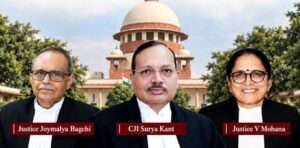
More troubling is the apparent imbalance in the public discourse surrounding alleged misconduct during political protests. If reports of physical intimidation or attacks on women police personnel are substantiated, they must be condemned unequivocally. A uniform does not strip a woman of her dignity or constitutional protection. And when allegations concern a responsible Leader of the Opposition in the Lok Sabha, should they not invite equally serious scrutiny? Here is the uncomfortable question for the CJI and his two learned colleagues: if alleged incidents were committed in public view, reportedly captured on television and covered by the media, why did the Court’s observations not address them with comparable urgency? Is that an unreasonable question to ask of the highest judicial authority? Judicial criticism of police action is legitimate; so is the expectation that alleged misconduct by political leaders and protesters should not escape comparable scrutiny. There is another uncomfortable dimension. The controversial nomenclature of the CJP and the uproar over references to young Indians as “cockroaches” have further lowered the tone of public discourse. Whatever the intention behind such language, dehumanising young citizens is indefensible as it was made by the same CJI, who later chose to give clarification. Equally, political provocation or claims of victimhood cannot become a shield against lawful regulation. The Supreme Court must guard against any perception that the grievances of politically vocal groups receive disproportionate attention while the anxieties of ordinary citizens take a back seat. Perception alone does not establish judicial bias. But public confidence depends on the clarity, consistency and balance of judicial reasoning. The Constitution protects dissent. It also demands respect for the rule of law. Police must not crush peaceful protest; protesters must not hold an entire city hostage. The judiciary must scrutinise both sides without fear or favour. Who, then, wants anarchy? Certainly not the ordinary citizen who needs to reach work, attend court, get to a hospital or live without intimidation. The judiciary does not weaken its authority by acknowledging that preventive policing can be necessary. Nor does it strengthen liberty by treating the State’s security concerns with suspicion while examining restrictions on protesters with exceptional urgency. The judiciary must be fearless in checking executive excess. It must be equally fearless in defending lawful authority against political disorder. That is not a demand for judicial silence. It is a demand for judicial balance. And when the country’s highest court speaks, the public is entitled to expect precisely that.

