There is a popular tendency to speak of history as though the South merely watched helplessly whenever invading armies swept across the Deccan. That narrative does a grave injustice to the people who fought, resisted, and reclaimed their homeland. The story of the Telugu people in the fourteenth century is one of the most striking examples of resilience in Indian history.
When the Deccan faced the threat of annihilation following the fall of the Kakatiya capital Warangal, Telugu chiefs did not simply surrender to fate. They regrouped, forged alliances and launched a determined counter-offensive. Within barely 13 years, they transformed a devastated political landscape into the foundation for one of the greatest empires of medieval India.
The first major assault on Warangal by Ulugh Khan, around 1321–22 CE, did not achieve its objective. Telugu Nayaks, including the Gosangi or Velugoti Nayaks, resisted the siege and defeated Malik Nemal. In the ensuing action, Ulugh Khan’s royal treasury was reportedly plundered. It was a powerful demonstration that resistance had not been extinguished.
The second campaign, around 1323, was more successful. Warangal fell and the Kakatiya kingdom collapsed. Gannama Nayak, a Telugu chief who was converted and later known as Malik Maqbul, was appointed governor. Yet the fall of a kingdom did not mean the death of resistance.
Quite the contrary.
By about 1325, Telugu chiefs began organising a remarkable reclamation movement. Musunuri Kapaya Nayaka, Induluri Rudradeva, Recherla Singama, Musunuri Prolaya Nayaka, Toyyeti Anavota, Prolaya Vema Reddy, the Manchikonda chiefs and several other Nayaks joined hands. The Vilasa grant, generally dated to around 1330, records the coming together of a formidable alliance of 75 Nayaks.
This was not an isolated rebellion. It was a coordinated three-wave reclamation of Telugu territories.
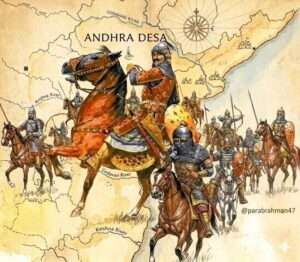
The first wave swept across the coastal region. Around 1328, Musunuri Prolaya Nayaka liberated large parts of the Krishna-Godavari delta and territories extending towards Khammam, while Manchikonda Ganapati Nayaka reclaimed the region from Rajahmundry towards Simhachalam.
The second wave moved south and west between roughly 1329 and 1334. Prolaya Vema Reddy recovered Palnadu and territories stretching from Srisailam towards Ahobilam. Araviti Somadeva pushed towards Kurnool and Raichur, while Recherla Singama reclaimed southern Telangana.
Then came the decisive third wave.
Around 1336, Musunuri Krishna Nayaka marched against Warangal itself and defeated the occupying governor. The capital that had fallen to the invaders was reclaimed by Telugu resistance.
The scale of this achievement deserves to be remembered. It took approximately 13 years from the fall of Warangal to its reclamation.
Thirteen years.
That was enough time for a defeated people to regroup, build an alliance, raise armies, reclaim territory and recover their capital.
The titles adopted by the victorious Telugu chiefs reflected the confidence of the age. Prolaya Vema Reddy assumed the evocative title Mlecchābdhi-Kumbhodbhava, while Krishna or Kapaya Nayaka was hailed as Āndhradeśādhiśvara and Āndhra Suratrāṇa, according to the Kaluvacheru grant associated with Queen Anitalli/Anantalyambika.
But the story did not end with the restoration of Telugu power. It helped shape the political destiny of the entire South.
The Kakatiya administrative and military tradition, including its Nayaka system, did not disappear. Harihara and Bukka, associated with the Kakatiya treasury administration, emerged as key figures in the political reorganisation of the South. Their subsequent establishment of Vijayanagara, with the intellectual and spiritual influence of Vidyaranya of Sringeri, marked the beginning of an empire that would become the great bulwark of southern India.
The Amara-Nayaka military framework would provide Vijayanagara with an enduring military structure, while the earlier Telugu resistance demonstrated something equally important: political collapse need not mean civilisational surrender.
This is why the fourteenth-century Telugu experience deserves far greater recognition.
The lesson is not that Telugus alone defended the South, nor should history be reduced to a simplistic contest between communities. The resistance involved several regional powers and personalities, and historical claims must always be examined against contemporary inscriptions and scholarly evidence.
But one fact stands out unmistakably: Telugu resistance after the fall of the Kakatiyas was neither passive nor insignificant.
The people and chiefs of the region were battered, their capital was occupied and their political order shattered. Yet they rose again.
In barely 13 years, they turned defeat into resistance, resistance into reclamation, and reclamation into a political revival that helped prepare the ground for Vijayanagara.
So, who says Telugus never showed grit and resilience?
History itself provides the answer.
They did not merely survive the storm. They rose from its ashes—and helped build the fortress that would guard the South.