Lakshmanrao Upadhayula
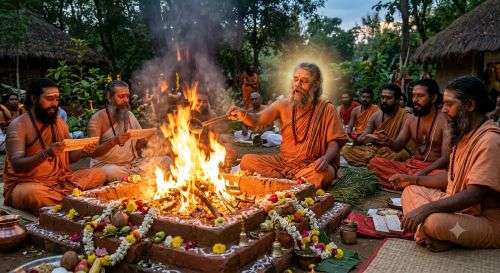
Sage Vishwamitra, one of the most illustrious seers of the Vedic age, offers profound prayers to the divine powers celebrated in the Jagati and Trishtubh metres of the Rigveda. In these sacred hymns, he invokes the Creator, Brahma, the all-pervading Vaiswanara Agni, and the mighty Maruts. Standing in the noble lineage of Kusika, the sage speaks not merely for himself but for an entire tradition of seekers who aspire to attain prosperity, wisdom, and spiritual illumination. Having gathered the sacred oblations and performed the prescribed rites, the seers discover within themselves the hidden power of Vaiswanara Agni, the universal fire that resides both in the cosmos and within the human heart. With humility, purity, and unwavering devotion, they invite this divine presence through the chanting of sacred Vedic hymns.
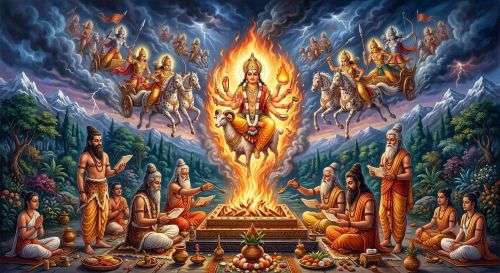
Vaiswanara Agni is celebrated as the guardian of truth and the knower of all existence. Nothing remains concealed from his divine vision. He is the witness of all actions, the receiver of sacrificial offerings, and the bestower of the fruits of yajña. Riding upon his radiant celestial chariot, he approaches the sacrificial ground in response to the sincere invocation of the worshippers. The sages invite him to accept their offerings, remove obstacles, and ensure the successful completion of the yajña undertaken by the patrons. They welcome him as the pure one, the lord of sacrifice, the brilliant divine guest, the swift messenger between heaven and earth, and the sacred fire worthy of reverence by gods and humans alike.
The Vedic imagery beautifully compares the growth of Agni to that of a young horse nourished by its mother. Just as a foal thrives through maternal care, the sacred fire flourishes through the holy grasses, offerings, and devotional acts of the sacrificers. Agni, ever vigilant among the gods, is requested to grant noble horses, robust vitality, enduring strength, and abundant prosperity. His blessings are not confined to material wealth alone but extend to intellectual brilliance, moral strength, and spiritual advancement. Through his grace, life becomes harmonized with cosmic order and divine purpose.
The hymns further portray the intimate association between Agni and the Maruts. The fiery energies of Agni move together with the vigorous hosts of the Maruts, the divine powers governing storms, winds, and atmospheric forces. The Maruts join their mighty companions and celestial vehicles, traversing the heavens with irresistible energy. Omniscient and free from malice, they shake mountains and stir the clouds. Their movements symbolize the dynamic processes of nature through which the atmosphere is purified, clouds are gathered, and life-giving rains are released. Agni himself is depicted as working in harmony with these forces, demonstrating the interconnectedness of all cosmic phenomena.
The Maruts are luminous and formidable. They are radiant manifestations of natural power, clothed in brilliance and adorned with celestial splendor. The sages pray for their gracious presence and protection. In their rain-bearing forms, they neigh like spirited horses and roar like lions across the sky. Their thunder reverberates through heaven and earth, while their showers nourish the land with precious waters. The hymns celebrate these divine powers not merely as mythological beings but as sacred representations of the atmospheric forces that sustain life upon the earth.
Again and again, groups of worshippers unite in prayer, chanting hymns that glorify the brilliance of Agni and the strength of the Maruts. Their devotion is collective, disciplined, and purposeful. The Maruts are described as possessing spotted horses and spotted deer, symbols of beauty, agility, and natural vitality. Their wealth never diminishes, for it arises from the inexhaustible abundance of nature itself. The brave and valiant Maruts are respectfully invited to accept the offerings placed within the sacred precincts of the yajña and to bless the participants with prosperity, harmony, and protection.
In a remarkable mystical revelation, Agni himself speaks as the embodiment of ultimate reality. He declares that by birth he knows every being that has come into existence. He is the manifestation of eternal truth and the inner essence of all sacrificial offerings. Clarified butter and divine light become his eyes, while the nectar of immortality flows through his being. Empowered by the vital forces of air, solar radiance, and cosmic energy, he measures the vastness of space and purifies all that exists. In this sublime vision, Agni transcends his role as physical fire and reveals himself as the universal consciousness that permeates creation.
Through profound inner vision, Agni recognizes the beauty hidden within existence. He assumes the forms of fire, wind, and sunlight, demonstrating the unity underlying diverse natural phenomena. He sanctifies wisdom, illuminates understanding, and beautifies himself through his own radiant blaze. Instantly, he surveys both heaven and earth, perceiving the totality of creation. Like countless streams flowing unobstructed toward the ocean, his energy moves freely throughout the universe, sustaining life and maintaining cosmic order.
As the wise ruler and integrator of sacred hymns, Agni emerges from the nurturing lap of his cosmic parents, Earth and Heaven. These two great realms support all life and serve as the foundation of spiritual realization. Vishwamitra and his revered teachers enrich this sacred tradition through their insights, preserving and transmitting divine knowledge for future generations. Their prayers seek not merely personal gain but the complete development of human potential. They aspire to become whole human beings whose thoughts, actions, and aspirations remain aligned with truth and righteousness.
The Vedic vision recognizes that the stream of thought is endless. Yet noble thoughts require discipline and responsibility. Beneficial thoughts uplift both the individual and society, while harmful thoughts possess the power to damage the innocent and the guilty alike. Therefore, the Vedic seers consistently seek protection from destructive influences that arise within the human mind and in society. Their prayers reveal a deep awareness of psychology, ethics, and the consequences of human behavior. They understood that inner harmony forms the basis of outer harmony.
The seer approaches reality with a disciplined code of conduct. He enters into the situation he seeks to understand and carefully decodes its deeper meaning. His observations are not clouded by personal excitement, prejudice, or emotional exaggeration. He possesses the responsibility to observe, understand, and report truthfully. He is not authorized to distort reality through fantasy or embellishment. This commitment to objective observation reveals the remarkably scientific temperament of the Vedic sages. Their quest was not blind belief but enlightened understanding rooted in direct experience, disciplined inquiry, and contemplative insight.
The observations of the seers often penetrate to the inner essence of the phenomena they study. Whether examining nature, human conduct, health, food, cleanliness, education, or social order, they seek underlying principles rather than superficial appearances. Their teachings emerge from careful observation, reflection, and verification. For this reason, many Vedic guidelines possess both spiritual depth and practical wisdom. They demonstrate an integrated vision in which science, ethics, spirituality, and daily living are harmoniously united.
Thus, the hymns of Vishwamitra reveal far more than ritual devotion. They present a grand vision of the universe as an interconnected reality sustained by divine intelligence and natural law. Agni symbolizes consciousness, transformation, and knowledge, while the Maruts represent the dynamic forces of nature that maintain balance and vitality. Together they teach humanity to cultivate reverence, wisdom, discipline, and responsibility. Through such understanding, human beings may rise toward completeness, harmonizing their inner lives with the cosmic order and participating consciously in the sacred rhythm of existence.