

The French astrologer Nostradamus acquired enduring fame for prophecies that generations have interpreted through the lens of subsequent events. But what happens when a geopolitical magazine’s annual forecast appears, in retrospect, to echo political turmoil unfolding months later? Is it coincidence, perceptive forecasting, or simply the human tendency to connect the dots after the event? The question deserves scrutiny, particularly when Bharat’s democratic institutions and geopolitical choices are involved.
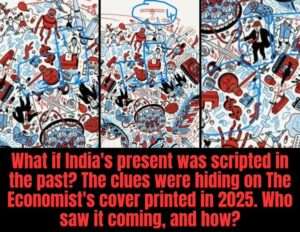
The Economist’s The World Ahead 2026, unveiled on November 10, 2025, offered its assessment of the forces likely to shape the coming year. Its imagery has now attracted renewed attention amid October 2026’s political confrontations in Delhi. A circulating interpretation draws parallels between ballot imagery and allegations of voter deletions, military symbolism and security deployments, a satellite and technological geopolitics, and a fractured judicial gavel and mounting pressure on the judiciary.
The parallels are striking to those who see them. But do they establish that somebody scripted Bharat’s present turbulence in advance? Not necessarily. Symbolism can provoke questions; it cannot, by itself, prove a conspiracy. That distinction is essential if legitimate concerns about foreign influence and institutional stability are to be taken seriously. Nevertheless, one cannot entirely rule out such possibilities, given historical instances in which forces associated with figures like George Soros and agencies such as the CIA have been accused of scripting or executing geopolitical interventions.
The Ballot and the Battlefield
Consider the ballot. Opposition parties have intensified their campaign against the Special Intensive Revision (SIR) of electoral rolls, alleging wrongful deletions and demanding the resignation of Chief Election Commissioner Gyanesh Kumar. The Election Commission’s procedures and the opposition’s allegations must be examined through verifiable records, transparent explanations and judicial scrutiny—not slogans alone.
The Supreme Court had earlier rejected the opposition’s challenge to the SIR on the ground that the exercise was not unconstitutional. However, following fresh allegations by Congress leaders, the Supreme Court has issued notices to the Election Commission seeking clarification on whether any irregularities occurred during the SIR process.
The accompanying military imagery has also invited comparisons with the deployment of security personnel during protests in the national capital. Yet a picture of military hardware cannot establish that an illustrator anticipated a particular demonstration or security operation. The more pertinent question is whether political actors are respecting democratic processes while the authorities maintain public order without curtailing legitimate dissent.
The Satellite Question
A satellite in an illustration can readily evoke Elon Musk’s Starlink and the strategic significance of satellite communications. Bharat’s regulatory decisions, digital infrastructure and technological partnerships inevitably have geopolitical implications. Washington’s trade demands, disagreements over agriculture and dairy, and New Delhi’s independent approach to Russian oil have also highlighted the limits of American influence over Bharat’s choices.
Connecting a satellite symbol to Starlink’s Bharatiya ambitions and then to domestic political unrest remains an interpretation, not evidence of coordination. Nevertheless, the possibility of foreign interference cannot be dismissed without examination. Any such allegation requires documentary proof, financial trails or credible investigative findings, and Bharatiya agencies are reportedly pursuing relevant leads.
Foreign funding is no longer merely a subject of speculation when questions are raised about overseas financial support for political activism. An American popular singer has herself reportedly spoken about the Cockroach Janta Party (CJP), whose alleged links and activities have attracted attention after its emergence from Boston, amid claims of a broader ‘regime change’ agenda. Supporters of this argument also point to political upheavals in smaller countries, including Bangladesh, Nepal and Sri Lanka, as reasons for examining possible external involvement.
Moreover, Congress and CJP leaders have repeatedly declared during protests that they intend to bring down the Modi government, with some rhetoric invoking street battles. This raises a legitimate question: who funds such activities, and are any foreign players involved? The answer, however, must emerge from evidence rather than assumption. Bharatiya agencies must investigate suspicious funding channels and monitor potential foreign interference in accordance with the law.
The Broken Gavel
On October 12, 2026, opposition leaders marched towards the Supreme Court over electoral-roll revisions and demands concerning the Election Commission. Chief Justice of India Surya Kant had declined their request for a meeting. The episode has intensified debate over political protest, institutional independence and the appropriate boundaries between public mobilisation and judicial functioning.
The judiciary must neither be intimidated by political pressure nor insulated from legitimate public scrutiny. Equally, opposition leaders cannot expect a personal audience with the Chief Justice merely because they represent political parties. Judicial impartiality requires established procedures, not political privilege. If allegations of disorderly conduct are made, they must be assessed on the basis of evidence and due process.
Forecast or Hidden Script?
Prime Minister Narendra Modi’s ambition to make Bharat one of the world’s three largest economies represents a strategic national objective. Its pursuit will require sustained growth, technological innovation, institutional credibility and geopolitical independence. Protecting that trajectory is a responsibility shared by the government, opposition, constitutional authorities and citizens.
The larger danger is not that an illustrated cover has mysteriously predicted every development. It is that political confrontation can erode public confidence when allegations repeatedly substitute for evidence and institutions become targets of partisan warfare.
Nor should legitimate criticism of the Election Commission or judiciary automatically be dismissed as a foreign-inspired conspiracy. Democratic accountability and national security are not mutually exclusive; both depend on facts, constitutional restraint and transparency.
The right response to The Economist’s imagery is therefore neither blind acceptance nor reflexive dismissal. Examine the illustrations, compare them with the magazine’s actual forecasts, investigate credible evidence of interference, and distinguish coincidence from causation.
However, dismissing every concern about a possible hidden script merely because it rests partly on a magazine cover may also be premature, particularly when viewed against historical allegations of Western intervention in other countries. The conduct of Western powers in pursuing their strategic interests deserves scrutiny, especially when their actions are perceived as undermining the sovereignty or democratic choices of other nations. Such claims, however, must be evaluated individually and supported by historical evidence. The United States played a significant role in the Cold War confrontation with the Soviet Union, which ultimately disintegrated; that history, too, forms part of the wider geopolitical debate.
For Bharat, the real test is whether its democratic institutions can withstand political pressure, safeguard citizens’ rights and preserve their credibility without succumbing to intimidation or speculation. No foreign publication, however influential, should determine the national narrative. But neither should suspicion become a substitute for proof.
The ultimate safeguard against any genuine attempt to destabilise Bharat is not merely the search for hidden symbols. It is the strength of its institutions, the vigilance of its citizens and an unwavering commitment to constitutional democracy.