



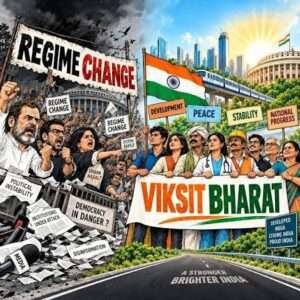
Is democracy under fierce assault from neo-political dynasties championing “regime change by revolution” under the banner of the I.N.D.I.A. Alliance? The question deserves serious consideration, particularly when political parties that claim to be fighting to save democracy are themselves frequently dominated by entrenched families.
It is time to coin a new term for this phenomenon: Dynastocracy.
For a civilisation with a 5,000-year history, shedding the legacy of dynastic monarchy has never been easy. Today’s neo-Maharajahs and political dynasts appear determined to perpetuate their dominance, raising concerns that democracy could degenerate into kleptocracy—a system serving the interests of a privileged few rather than the people. Democracy, ideally conceived as government “of the people, by the people and for the people”, risks being transformed into government “of the few, by the few and for the few”.
Since 2014, “We the People of India” have increasingly challenged established political dynasties through the electoral process. Yet many dynastic leaders have rallied under the I.N.D.I.A. Alliance banner, invoking the slogan “Save Democracy”. The irony is difficult to ignore when the same political establishment is accused of resisting internal democracy and concentrating power within families.
Electoral change alone, however, may not be enough. India needs a genuine second democratic revolution—one that dismantles hereditary entitlement in politics and restores accountability to citizens. Otherwise, entrenched dynastic rivalries and attempts to regain power could deepen political instability and social divisions.
How long can political dynasties survive in a country where an increasingly educated middle class is questioning hereditary leadership?
Inherited Historic Lineage
Dynastocracy has deep historical roots in India. The Nehru-Gandhi family remains its most prominent example.
Motilal Nehru, father of Jawaharlal Nehru, served as president of the Indian National Congress in 1919–20 and again in 1928–29. His son subsequently occupied the party’s top post in 1929–30, 1936–37, 1946 and 1951–54, besides serving as India’s first Prime Minister from 1947 to 1964. By 1978, the family’s political dominance had become firmly established. Sonia Gandhi led the Congress from 1998, except during 2017–19, when Rahul Gandhi was president. Mallikarjun Kharge now heads the party.
The phenomenon extends far beyond one family. India has witnessed the rise of the Abdullahs in Jammu and Kashmir; Scindias; Mulayam Singh Yadav’s family in Uttar Pradesh; the Badals in Punjab; the Patnaiks in Odisha; the Karunanidhis in Tamil Nadu; the Chautalas in Haryana; the Lalu Prasad Yadav family in Bihar; KCR’s family in Telangana; the Naidus and Reddys in Andhra Pradesh; the Thackerays, Chavans, Pawars and Naiks in Maharashtra; the Gogoi family in Assam; and the Gowdas and Kharges in Karnataka.
Unlike in many other democracies, women also play prominent roles in India’s political dynasties. Priyanka Gandhi, Supriya Sule, Kanimozhi and Kavitha are among the examples.
Why has dynastic politics flourished? One institutional safeguard that could have been considered was limiting Prime Ministers and Chief Ministers to two terms. Such restrictions might have helped prevent the concentration of political power, although term limits alone could not have eliminated dynastic succession. The framers of the Constitution and subsequent political leaders did not establish such a restriction.
Montesquieu’s The Spirit of the Laws (1748) offered a perspective on how different forms of government might suit different societies and their circumstances. The larger lesson is that political institutions must be designed to suit a society’s needs rather than serve the ambitions of those who control them.
The darker side of dynastic politics often outweighs its potential advantages. High-command, inner-circle and coterie cultures leave little room for internal debate or dissent. Decisions are frequently concentrated among loyalists, sycophants and “yes-men”, who function as rubber stamps while their leaders acquire a quasi-demigod status.
Equally disturbing is the alleged reliance of some political leaders and spokespersons on persistent misinformation and inflammatory propaganda. The principle commonly associated with Goebbels—that repetition can make a lie appear true—captures the danger. The contemporary expression “gaslighting” describes a related form of manipulation in which people are induced to doubt what they know or perceive.
Political opportunism compounds the problem. Leaders who treat politics primarily as a route to power, wealth, status, perks and privileges can switch loyalties when more attractive prospects emerge. Meanwhile, scenes of legislators rushing into the well of Parliament, tearing papers and breaking microphones make a mockery of the very institution entrusted with safeguarding democracy.
Democracy on the Defensive
Indian democracy is under strain, distorted by political practices that undermine its founding principles. The problems differ across states and constituencies, but the underlying tendency is familiar: entrenched leaders seek to preserve the status quo and promote their progeny, often irrespective of merit.
Political families have become adept at exploiting systemic weaknesses to remain influential across generations. When one dynasty loses power, another may rise to occupy its place. The result is not necessarily a broader distribution of political opportunity but the substitution of one entrenched family for another.
As democracy is hijacked, distorted and weakened, public disillusionment grows. A political system cannot indefinitely survive the gap between its lofty promises and its everyday functioning. Constitutional safeguards, however well designed, cannot remain effective if those entrusted with their operation repeatedly undermine them.
India’s parliamentary democracy, socialism and secularism have all developed distortions. The rhetoric of socialism sits uneasily alongside crony capitalism. Social integration remains an unfinished objective, while pseudo-secularism and communalism fuel mutual suspicion. Caste-based and communal vote-bank politics, often pursued to capture power, threaten to deepen divisions within society.
The political order must therefore evolve from the aspirations and changing social realities of the people, rather than be imposed from above by entrenched elites. The country’s social composition and evolving public expectations must inform the institutions through which its potential is realised.
Democracy’s Riddles
The challenges of democracy are neither new nor simple. More than 2,300 years ago, Plato, in The Republic (Book VIII), warned that democracy could undermine itself through excesses, with demagoguery and disorder potentially paving the way for tyranny or autocracy. The warning remains relevant wherever political competition degenerates into relentless negative campaigning and the mobilisation of public anger.
American jurist Joseph Story, writing about the republic in the nineteenth century, similarly cautioned that a democracy might be secure against external enemies yet perish through the folly, corruption or negligence of its own citizens. Republics, he argued, depend on civic virtue, public spirit and intelligence; they decline when honest and wise people are marginalised while those who flatter the public to deceive it are rewarded.
Will Durant, in The Pleasures of Philosophy (1929), warned that democracy without education could degenerate into hypocrisy, reduce statesmanship to mere politics and sustain a parasitic political class that deceives the governed.
Jean-Jacques Rousseau’s famous observation that “Man is born free; and everywhere he is in chains” offers another perspective on the tension between liberty and authority. Freedom without responsibility can encourage disorder, while excessive control can produce tyranny. The challenge is to preserve freedom while maintaining order and accountability. Democracy’s vulnerability to mediocrity and populism is part of this larger dilemma.
The People’s Responsibility
Ultimately, “We the People” bear considerable responsibility for the growth of dynastic politics. Family-based political succession extends beyond the immediate household to relatives and wider kinship networks. Biradari-based politics will be difficult to dismantle so long as social loyalties continue to determine political choices.
The author cites figures suggesting that only 3% of India’s current MPs represent political dynasties rooted in pre-democratic aristocratic monarchies before 1947. Reservations, meanwhile, have broadened representation in Indian democracy. Yet the electoral process has also enabled newer political families to acquire office and facilitate the entry of their relatives, making the trend increasingly difficult to reverse.
According to the figures cited, 29% of current parliamentarians have family members—parents, siblings, spouses, grandparents, uncles, aunts, cousins or in-laws—who entered politics before them. Another 5% have relatives who entered politics simultaneously or subsequently. Thus, approximately 34% of parliamentarians have family connections in politics, a substantial proportion for any democracy.
Dynastic connections cut across regions, religions and social categories. The figures cited indicate that 66% of Muslim parliamentarians, 25% of parliamentarians elected from Scheduled Caste seats, 28% from Scheduled Tribe seats and 34% of other parliamentarians have family ties in politics.
Many regional parties are built around the personality and ideology of their founders. In such organisations, kinship frequently influences succession and the composition of the ruling class. For the children of established politicians, entering public life can become an easier route to power and prosperity than it is for ordinary citizens without political connections.
Dynasts and the Taxpayer
The lavish lifestyles of political dynasties, in Delhi and the states, deserve scrutiny. The author questions the enormous expenditure borne by taxpayers over the decades on the Nehru-Gandhi family, referring to what he describes as two palaces and an additional property. He also raises concerns about the privileges enjoyed by political leaders, including fortress-like residences, security personnel, escort vehicles and other publicly funded services.
Such arrangements must be examined through the principles of transparency, necessity and accountability. Public office is a responsibility, not a hereditary entitlement to privileges. Taxpayers have every right to question expenditure that appears excessive or unjustified.
Wake Up, We the People
India’s history offers a sobering lesson: internal treachery and fragmentation weakened successive kingdoms and created openings for external aggressors. If citizens fail to correct the distortions afflicting democracy, the country risks allowing internal divisions to undermine its collective strength.
Democracy is not a self-sustaining machine. It requires informed citizens, responsible leadership and institutions that command public confidence. Caste, racial and communal divisions, injustice and economic inequality must not be exploited through rhetoric that spreads hatred and fear. National unity cannot be strengthened by deepening social fault lines.
Elections provide citizens with an opportunity to choose stability, decisive leadership and credible policies across political, social, economic, technological, diplomatic and national-security domains. Voters must assess not merely the promises made by political parties but also their record, integrity, competence and commitment to public service.
The ultimate responsibility rests with citizens to reward morally upright leadership and reject the idea that political office belongs to particular families. No party should be exempt from scrutiny merely because it invokes democracy while practising hereditary succession within its own ranks.
The warnings offered by political thinkers remain relevant. A parliamentary democracy operating under a first-past-the-post electoral system can be weakened when self-centred dynastic leaders place “I, me and myself” above the public interest.
If democracy is to consolidate and advance the principles of liberty, equality and fraternity, “We the People”—the real majority—must challenge the neo-Maharajahs who present themselves as indispensable leaders while treating political power as a family inheritance.
Saving democracy requires more than changing governments. It requires changing the political culture that allows dynastic entitlement to flourish.

