A response to Orangenews9′s debate: Indian cricket is winning and investing as never before. The trouble lies in some state associations — and the cure is to keep the game in front.

Ramakrishna Udupa
Orangenews9 has done the cricket fraternity a service by opening a debate few are willing to start: who has damaged Indian cricket more — greedy former cricketers and self-serving administrators, flawed Lodha recommendations, or excessive judicial intervention? It is a fair question. But before we name a culprit, we should check whether the patient is actually ailing. The evidence says it is not.
The scoreboard says otherwise
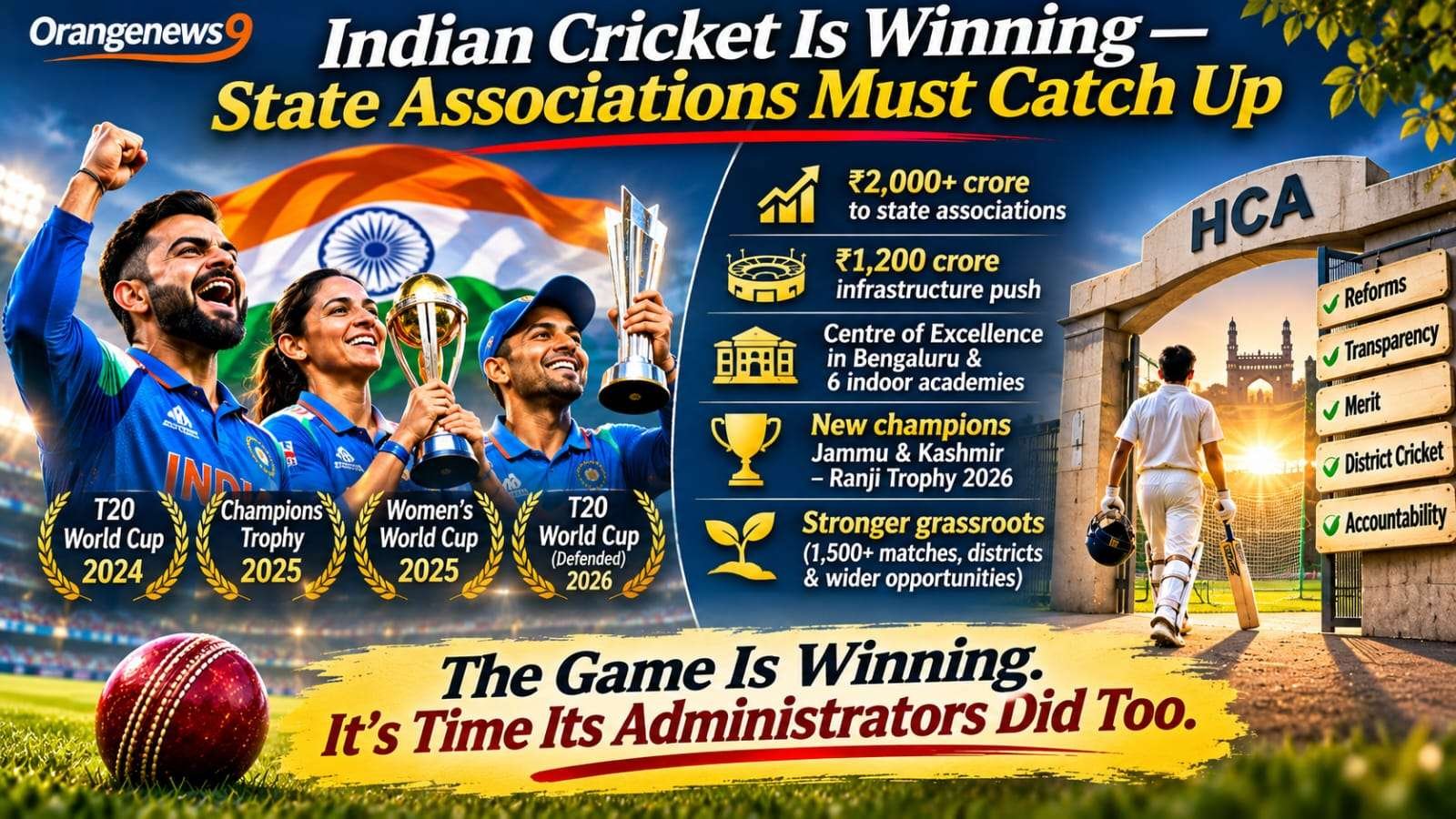
In the last two and a half years, India has won almost everything there is to win. The men’s team won the T20 World Cup in 2024 and the Champions Trophy in Dubai in March 2025. In November 2025, Harmanpreet Kaur’s side beat South Africa by 52 runs in Navi Mumbai to give Indian women their first-ever World Cup. And in March 2026, Suryakumar Yadav’s team beat New Zealand by 96 runs in Ahmedabad, becoming the first side to defend the T20 World Cup and the first to win it at home.
The strength runs deeper than the national team. Jammu and Kashmir — an association that has itself lived through turbulent administration — won its maiden Ranji Trophy in February 2026, getting the better of eight-time champions Karnataka in Hubballi. A sport in ruin does not produce new champions from unexpected corners.
The money is going into the ground
The BCCI disbursed about ₹1,990 crore to state associations in 2023-24, with more than ₹2,000 crore projected for the following year, and allocated ₹1,200 crore towards infrastructure development in 2023-24 alone. Its new Centre of Excellence in Bengaluru, opened in September 2024 on a 40-acre campus, has three grounds, 86 pitches and a dedicated sports science and medicine facility. In April 2026, six BCCI indoor cricket academies were inaugurated across the North-East, and infrastructure subsidies continue to reach the states for stadium and facility upgrades. A game that is being ruined does not build like this.
Why Lodha was needed — and who moved on
Let us also be honest about how we got here. The Lodha Committee was not imposed on a healthy BCCI out of judicial whim. It came out of the 2013 IPL spot-fixing and betting scandal. The Supreme Court first set up the Justice Mukul Mudgal Committee to investigate, and after that committee reported in November 2014, it appointed a three-member panel headed by former Chief Justice of India R.M. Lodha in January 2015 to decide punishments and recommend reforms. The panel reported in January 2016, and the Supreme Court approved the new BCCI constitution in August 2018.
Lodha may not have done a perfect job, and its recommendations deserve the fresh, objective examination the editor calls for. The BCCI fought many of them. But having fought, it adapted, settled its constitution and moved on — and it has been more successful since, not less. Several state associations did the same. Others, HCA among them, are still caught in a cycle of disputes, committees and court cases years later. The rules were the same for everyone. The difference lay in what each association chose to do with them.
Cricketers, judges or the system?
The editor is right that some former international cricketers who entered administration have disappointed the game that made them. But many others have served it honestly as coaches, selectors, mentors and administrators, and Indian cricket’s best years have come with former players closely involved in running it. The failure is not of a profession. It is of systems that allow anyone — cricketer or not — to treat an association as personal territory.
Nor is the judiciary the villain. As Orangenews9 rightly points out, courts step in only when someone approaches them, and someone approaches them only when an association can no longer settle its own differences.
When passion met money
For decades, Hyderabad cricket ran on passion. Club secretaries found grounds, organised matches and paid from their own pockets when there was no money in the game at all. It was pure service. That spirit built Hyderabad cricket, and it remains its greatest asset.
Then the game changed. As BCCI revenues grew and crores began flowing to every state unit, the stakes rose. Control of an association came to mean control of budgets, grounds, selections and votes, and the contest for that control began to crowd out the cricket. That, more than any single person or committee, explains how capable associations slipped into trouble.
The money is not the problem; it is the opportunity. The BCCI and the better-run states have had their own share of litigation and politics, but their cricket never stopped. Tournaments were held on time, selections went on, grounds were built and players kept coming through. The noise stayed in the background; the game stayed in front. That is the discipline every state association must now show — in its finances, its membership rules, its selections and, above all, in actually playing cricket.
HCA: finding its way back
Hyderabad is the example everyone cites for what went wrong. Yet HCA’s story was never all black. It has produced fine cricketers and has had capable, committed administrators who served the game well; somewhere along the way, it slipped into this mess. What matters now is that it is finding its way back, and the credit belongs to many hands: the court-appointed Supervisory Committee (SMC) headed by Justice (Retd.) P. Naveen Rao, the clubs and office-bearers who kept turning up season after season, and the coaches, umpires and players who never stopped believing in Hyderabad cricket.
The signs are encouraging. The Telangana High Court’s judgment of 24 April 2026 recorded that over 1,500 matches were played in a single year. Hyderabad’s Under-19 team won the Vinoo Mankad Trophy in November 2025, the association’s first-ever title in that competition, and several other State sides put in creditable performances. Selections have been opened up, every TG20 team now carries district players, and district sides feature in the leagues and the schools tournament.
The critics are right that a tournament or an announcement does not, by itself, revive district cricket. The real test is whether a talented youngster from Adilabad or Nagarkurnool earns a place in the State team on merit. That will take a few seasons to answer, and everyone who runs HCA should be measured against it. But the direction is right.
The real answer
So who ruined Indian cricket? On the evidence, nobody has. On the field and in its finances, Indian cricket is in the best shape of its history. What has suffered, in places, is the credibility of some state associations. The cure is not to blame judges or cricketers, nor to romanticise the old order, but for every state unit to govern cleanly, account openly and put cricket first.
HCA has a rare chance to show it can be done. Its members, who served the game when it paid nothing, are the ones who will carry it forward. If the present reforms take root and are handed to an accountable, elected administration drawn from those members, the reasons for disputes will fall away, and much of the litigation with them. Hyderabad can then move from being the cautionary tale of Indian cricket to its case study in recovery.
The game is winning. It is time its administrators did too.