



Venkatapathy Raju
I have generally chosen to keep myself away from controversies. However, when Orangenews9 approached me to share my views on the recurring judicial interventions in cricket associations, I felt it was time to speak my mind. The question is particularly relevant to Hyderabad Cricket Association (HCA), an institution with which I share a long association, first as an aspiring cricketer, later as an international player and, for some time, as an office-bearer.
I have no intention of pointing fingers at individuals or settling scores. In fact, I believe I must also hold myself accountable, having been a product of the same system and having served the association. It is therefore painful to witness the decline of an institution that has given so much to generations of cricketers. The real question is not who should be blamed, but why those entrusted with its responsibility have failed to arrest this decline.
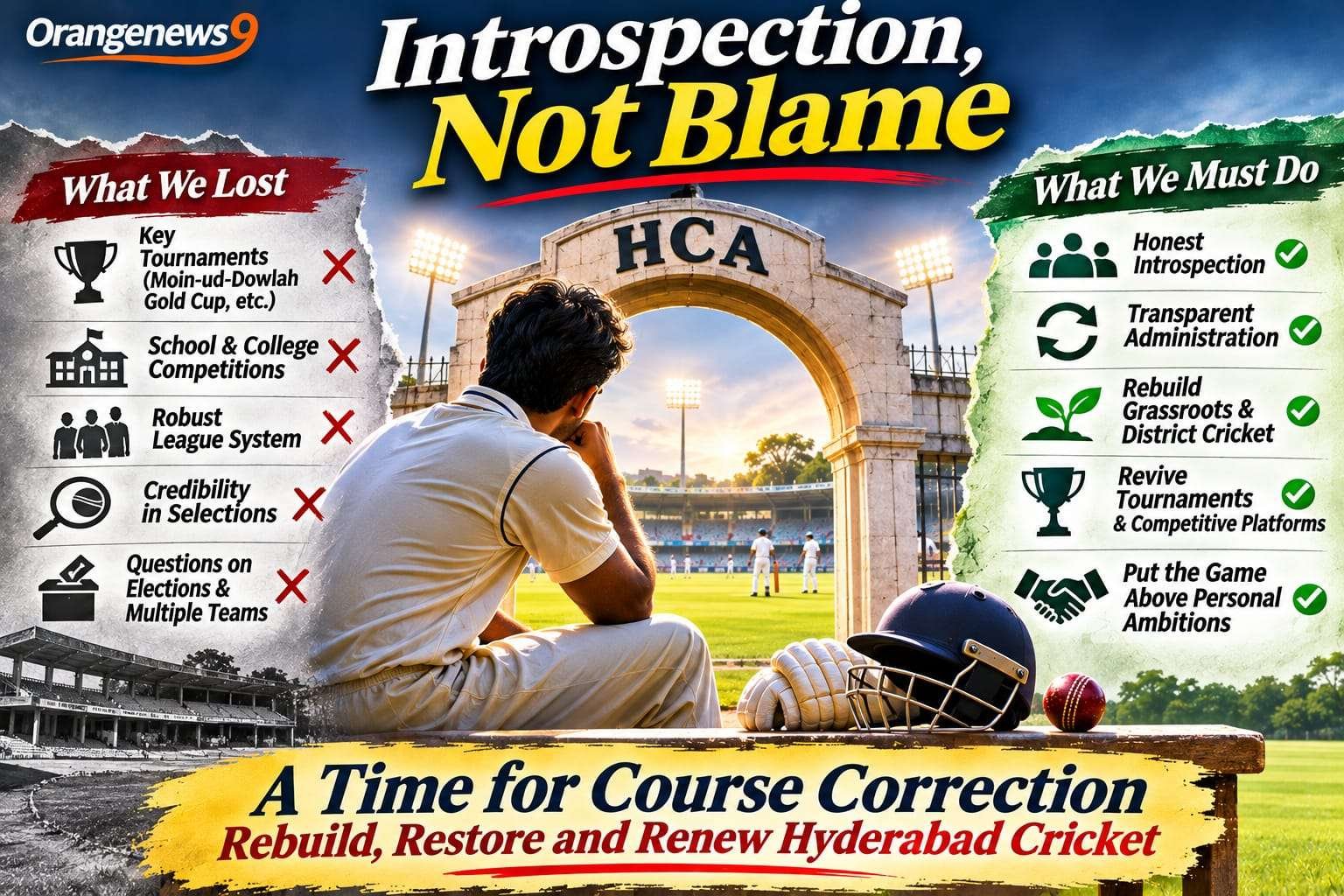
Having witnessed both the best and the worst phases of Hyderabad cricket, I strongly believe that the time has come for every individual who has occupied a position of responsibility to undertake honest introspection. Blaming one another through public statements and counter-allegations will serve no purpose.
Look at what has happened to the cricketing structure itself. The earlier league system and several important domestic tournaments have either disappeared or lost their significance. The school and college tournaments, zonal competitions and other platforms that once provided aspiring cricketers with opportunities to prove themselves have suffered. Even the prestigious Moin-ud-Dowlah Gold Cup, which once attracted quality teams and offered a valuable competitive platform, has disappeared from the cricket canvas of scheme things.
These were not merely tournaments. They were the foundation on which generations of cricketers built their careers, gradually progressing towards state and national representation. When such a well-established cricketing ecosystem is weakened, the damage goes far beyond administration. It directly affects talent identification, competitive standards and the future of the game.
Also read: https://orangenews9.com/beyond-groupism-and-greed/
The deterioration is not confined to tournaments. Questions have also been raised about selections, administration, elections and the multiplication of teams, allegedly driven more by voting considerations than by genuine cricketing requirements. The list of concerns is long. Surely, those who witnessed these developments, and particularly those who were part of the system when they occurred, cannot escape their share of responsibility.
Equally, it is unfair to blame the judiciary for repeatedly intervening in cricket administration. Courts do not ordinarily seek to run sporting institutions. They are approached by individuals and groups who believe that their grievances have not been addressed within the existing system. When elected bodies and affiliated clubs fail to resolve their differences amicably, judicial intervention becomes almost inevitable.
It is therefore incumbent upon those who approach the courts, as well as those against whom complaints are made, to examine whether they have exhausted the possibilities of resolving disputes within the association. Cricket administration cannot become a battleground where every disagreement ends up in litigation.
There is also a need for greater transparency and accountability among affiliated clubs. Those claiming voting rights must establish that they genuinely satisfy the constitutional requirements. If multiple-club ownership or other conflicts of interest exist, they must be addressed without fear or favour. Nobody should be allowed to use institutional positions or affiliated clubs as pressure groups to influence the functioning of an elected body.
Similarly, those who repeatedly invoke the HCA Constitution and its rule book must also ask themselves whether they followed the very provisions they now demand others to respect when they were in positions of authority. Rules cannot be convenient instruments to be invoked selectively.
I personally believe that individuals facing serious allegations of wrongdoing should consider stepping aside, without prejudicing the outcome of any inquiry, to allow the present judicially appointed administration to undertake the necessary corrective measures. Such a gesture would help restore confidence and enable the institution to move forward without unnecessary distractions.
The BCCI, through its pension scheme, has recognised and supported the contributions of former state and international cricketers. Every player who has worn the Indian jersey or represented the state should take pride in that honour. Our collective responsibility should be to protect the game and rebuild the institution that gave us our identity.
Hyderabad cricket needs fresh thinking, fresh blood, a transparent administration and, above all, a commitment to the interests of the game rather than individual ambitions. Those who genuinely love cricket must come together and ensure that the present judicial intervention becomes the last of its kind.
I have always believed that cricket is bigger than any individual or position. Despite having been drawn into legal battles myself, my affection for the game remains unchanged. It is time to stop the blame game, acknowledge our mistakes and allow meaningful course correction.
Introspection is not a sign of weakness. It is the first step towards rebuilding Hyderabad cricket. (The author is a former Indian Test cricketer, administrator, coach, and commentator.)


