Lakshmanrao Upadhyayula
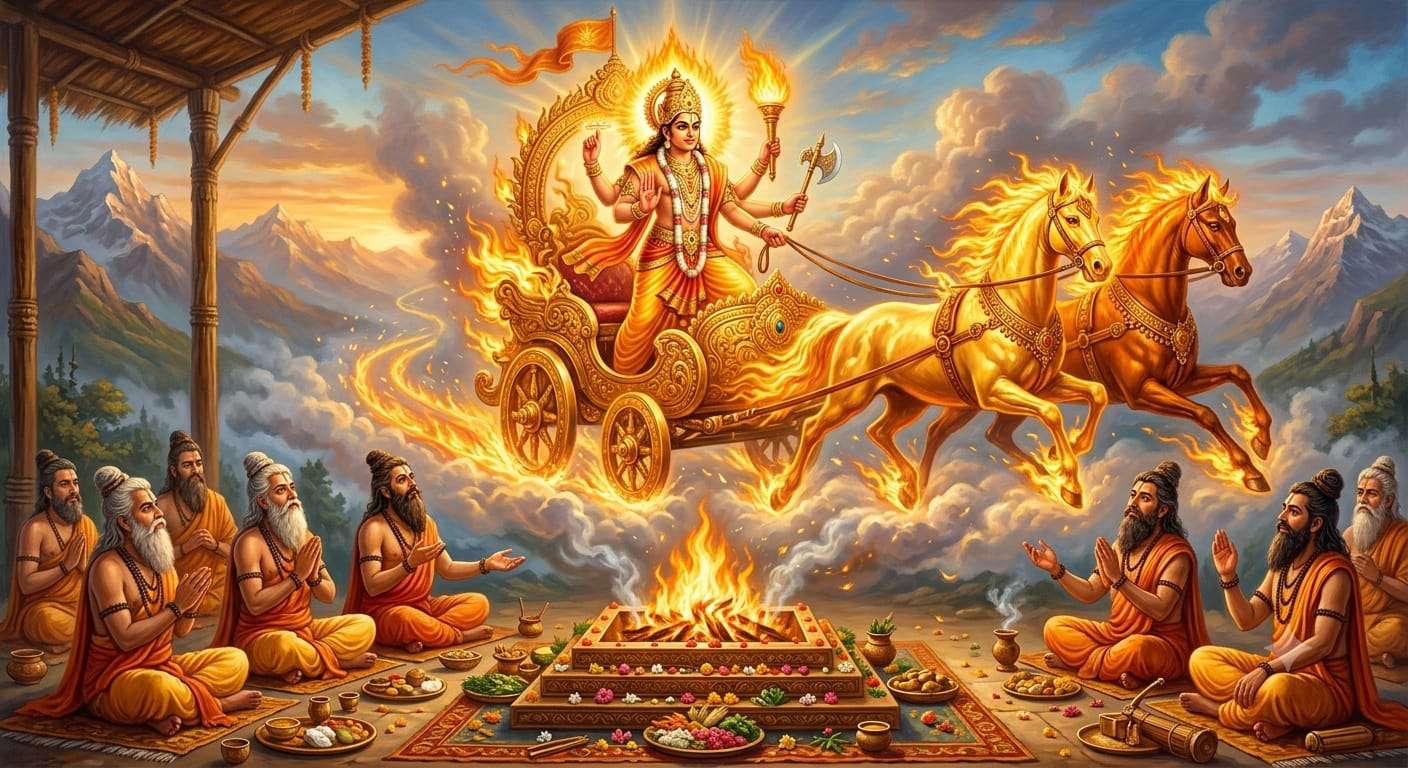
Sage Vāmadeva, one of the most revered seers of the Ṛgveda, offers this profound prayer to Agni in the majestic Triṣṭubh chandas, revealing the sacred relationship between humanity, nature, and the Divine. Agni is not merely the physical fire visible to human eyes but the eternal cosmic principle that transforms, purifies, and elevates all existence. He is the creator of yajña, the divine bridge through which earthly offerings become celestial blessings. Every sacred ritual begins with Agni because he alone carries the aspirations, gratitude, and devotion of human beings to the assembly of the gods. As the divine messenger, he invites every deity to the sacrificial altar, making the yajña a meeting place where heaven and earth unite in harmonious communion.
Agni is celebrated as the sustainer of heaven and earth, preserving the cosmic order through his unfailing presence. His brilliance shines like purified gold, symbolizing incorruptible purity, spiritual wealth, and inexhaustible energy. He destroys hostile forces, both external enemies and the inner enemies of ignorance, selfishness, pride, and falsehood. The Vedic seers recognize him as the radiant soul of Rudra, embodying both compassionate protection and irresistible power. Therefore, before the arrival of inevitable mortality, likened to the hardness of a diamond that none can escape, the wise are instructed to worship Agni with reverence, recognizing that spiritual wisdom alone transcends death.
The sacred altar is prepared for Agni with the same affection and dignity that a noble bride receives upon entering her husband’s home. Just as a virtuous woman, adorned with modesty, grace, and traditional attire, is welcomed into her rightful place after her victorious marriage, Agni is invited to occupy the northern altar prepared exclusively for him. This imagery reflects the Vedic understanding that every sacred act must be performed with purity, respect, and loving devotion. Manifesting in brilliant flames, Agni is lovingly requested to grow in splendour and approach the worshippers, illuminating their lives with divine presence. Every hymn chanted by the priests is dedicated solely to him, acknowledging him as the first recipient of all Vedic praise.
Agni delights in the recitation of sacred hymns because sound itself is regarded as a creative force in Vedic wisdom. Ever alert, ever watchful, and fully aware of the thoughts and actions of humanity, he blesses those who approach him with sincerity. Though immortal, he willingly accepts the offerings of mortal beings and transforms them into divine grace. Through the disciplined chanting of mantras and the precise observance of the threefold Vedic rituals, the priests satisfy Agni, whose presence sanctifies every sacrifice. Purity of pronunciation, clarity of intention, and truthfulness of heart together become the true fuel that sustains the sacred fire.
The seers proclaim Agni as the very embodiment of truth and righteousness. He guides human beings toward noble actions and understands the deepest intentions hidden within every prayer. Their mantras, charged with unwavering devotion and spiritual intensity, are offered continually so that Agni may remain a benevolent and protective presence within their homes and communities. The sacred household fire thus becomes a symbol of moral discipline, hospitality, prosperity, and enduring spiritual companionship.
With remarkable humility, Sage Vāmadeva questions Agni regarding the mystery of divine justice. If accusations of sin arise before Varuṇa, guardian of cosmic law, why should Agni bear such reports? Why should he recount human faults before Sūrya, the all-seeing witness, or before Mitra, the upholder of harmony and friendship, or even before the nurturing Mother Earth who silently sustains every living being? These questions are not expressions of doubt but profound prayers for mercy, forgiveness, and compassionate understanding. The sage acknowledges that every action is visible before the Divine and therefore seeks purification rather than concealment.
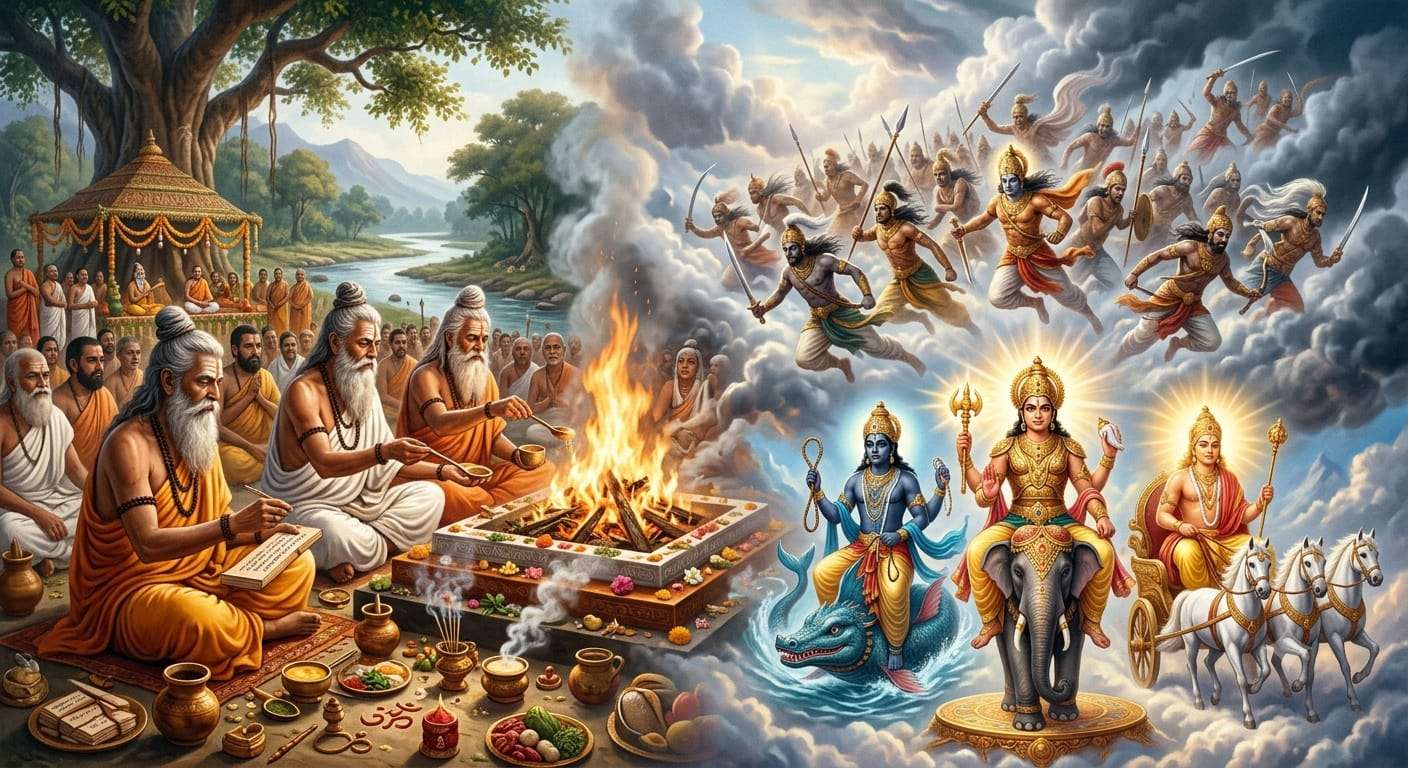
The inquiry extends further into the vast assembly of Vedic deities. Agni is asked how he would recount the deeds of humanity before Vāyu, the omnipresent life-breath, before Rudra, the mighty guardian of sacrifice and the purifier of sinners, before Pūṣan, the giver of strength and protector of travellers, before Viṣṇu, whose three cosmic strides encompass the universe, and before Nirṛti, who governs the mysterious realm where disorder and dissolution reside. Even the truthful Marut hosts, embodiments of irresistible natural energy, become witnesses to human conduct. These questions beautifully express the Vedic conviction that the entire universe participates in the moral order established by Ṛta, the eternal law governing both nature and human life.
Agni himself is portrayed as ever new, eternally reborn through every sacred fire kindled by humanity. Though appearing in countless forms, his essence remains changeless. He organizes the celestial order while simultaneously dwelling within every home and every heart. Human beings, in turn, conduct truth-centred yajñas, recognizing that sincerity alone makes sacrifice meaningful. The daily offering of milk reminds the worshipper of nature’s silent generosity. Though the cow may appear dark in colour and outwardly ordinary, she produces pure, nourishing, life-sustaining milk filled with strength and vitality. The Vedic sages perceive this as a lesson that true worth arises from inner essence rather than external appearance.
Milk becomes one of the most sacred offerings to Agni because it symbolizes nourishment, compassion, and the sustaining abundance of creation. As clarified butter intensifies the sacrificial fire, milk signifies the gentle energy that preserves life. Agni, strengthened by these pure offerings, radiates his brilliance in every direction while remaining firmly established at the altar. The Vedic vision recognizes that one centre of divine energy can illuminate the entire universe without diminishing itself.
The hymns also reveal a profound scientific temperament interwoven with spiritual symbolism. Sūrya draws moisture from the earth and the oceans, causing clouds to gather before releasing life-giving rain. This observation beautifully reflects the hydrological cycle understood through poetic language. Fire, water, sunlight, wind, and earth function together as interconnected forces sustaining all existence. The Vedic seers perceived natural phenomena not as isolated events but as harmonious expressions of universal intelligence operating according to immutable laws.
The ancient sages Medhātithi and the descendants of Aṅgiras are remembered for overcoming the mountain that concealed the symbolic cow, representing the release of hidden light, knowledge, and abundance through the power of yajña. By following the sacred path of disciplined ritual and divine insight, they discovered Uṣā, the radiant dawn of awakening. When Agni was born through the friction of the sacrificial sticks, Sūrya rose to illuminate the world, signifying that spiritual illumination precedes intellectual enlightenment. Inspired by yajña, the sweet rivers flow continuously like swift horses, nourishing civilization with purity and abundance.
The worshippers then express an intensely personal prayer. They implore Agni never to abandon them for the sacrifices of those who practice cruelty, deceit, or injustice. They ask him not to favour wicked neighbours or even misguided relatives who perform rituals without righteousness. Nor should he delight in offerings presented by priests whose hearts are crooked despite their outward learning. The devotees themselves pledge never to covet the wealth of either friend or enemy, accepting only that prosperity which arrives through divine blessing, honest labour, and righteous conduct. Such declarations reveal that ethical integrity stands above material success in Vedic philosophy.
Finally, Agni is praised as the supreme protector, the noble warrior, the perfect conductor of yajña, and the faithful messenger carrying offerings to the divine realms. He is lovingly requested to receive every hymn and every oblation with favour. The sages, mature in wisdom and rich in poetic insight, compose majestic, orderly, and spiritually charged hymns directed solely toward him. Through disciplined chanting and unwavering devotion, they seek not merely ritual completion but the awakening of divine consciousness. In the Vedic vision, Agni remains the eternal flame of truth, the purifier of thought, the guardian of righteousness, the transformer of matter into spirit, and the luminous presence through whom humanity ascends from earthly existence toward immortal wisdom.