


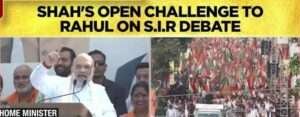
Union Home Minister Amit Shah has thrown down an open challenge to Congress leader Rahul Gandhi: if he has the courage of his convictions, let him come forward for a public debate on the Special Intensive Revision (SIR) of electoral rolls. Shah has made it clear that the BJP is prepared to discuss the issue anywhere Rahul chooses – whether at a street-corner meeting in Haryana, closer to Delhi, or on the floor of Parliament through a special session. The choice is entirely his. The question now is simple: will Rahul accept the challenge, or will he continue hiding behind allegations and political theatrics?
Shah’s challenge was loaded with political sarcasm, and understandably so. He even suggested that the BJP’s Haryana Yuva Morcha president could take on Rahul in a street-corner debate. The larger message was unmistakable: the Prime Minister of the world’s largest democracy cannot be expected to descend to the level of street confrontations merely to satisfy the political theatrics of an opposition leader. Nevertheless, Shah made it equally clear that the BJP leadership is not shying away from a substantive debate on SIR, regardless of the platform Rahul or his allies choose.
More importantly, Shah questioned Rahul’s accountability as Leader of the Opposition. He asked him to disclose details of his foreign visits, including his recent trip to Vietnam. Holding a constitutional position of considerable public responsibility is not merely about enjoying its privileges or making sweeping accusations against the government. It also demands transparency and accountability. If the Prime Minister and the government are answerable to Parliament and the people, why should the Leader of the Opposition consider himself exempt from similar scrutiny?
The BJP-led NDA has never treated Parliament as an obstacle to be paralysed whenever an inconvenient issue arises. It has faced debates, defended its policies and accepted parliamentary outcomes, including defeats such as that of the Delimitation Bill. Parliament is not the private property of any political party. Elected representatives have a responsibility to participate in discussions, question the government and uphold the dignity of the institution. Repeatedly disrupting proceedings, shouting down debates and preventing legislative business is an abdication of that responsibility.
Congress and its INDIA bloc allies may counter that the BJP, too, disrupted Parliament when it was in Opposition. But there is an important distinction between raising substantive issues and making disruption a political strategy. During the UPA-I and UPA-II years (2004–2014), the Congress-led government repeatedly faced demands from the BJP for discussions on contentious issues. Senior leaders such as L.K. Advani in the Lok Sabha and the late Arun Jaitley in the Rajya Sabha sought accountability through parliamentary debate. The opposition’s protests were rooted in issues that demanded answers. Today, however, the Congress and its allies appear increasingly comfortable reducing Parliament to a battleground of slogans, adjournments and manufactured outrage.
Coming specifically to SIR, the Congress and its allies have already approached the Supreme Court, which is seized of the matter. The apex court has sought responses from the Election Commission of India and the government on the Opposition’s allegations, including concerns relating to amendments to Form 6. The Election Commission has responded to the queries raised in the proceedings. The constitutional process must be allowed to take its course. If the Opposition has credible evidence of wrongdoing, it should place it before the court rather than attempt to pronounce its own verdict through political campaigns.
Equally questionable is the attempt to sensationalise reports suggesting differences of opinion among Election Commissioners. Discussion, disagreement and deliberation are integral to the functioning of any independent institution. What ultimately matters is the institutional decision arrived at through due process, not whether every Commissioner held an identical view at every stage. Differences in deliberations cannot automatically be portrayed as evidence of institutional collapse.
Unfortunately, the Congress seems to measure every institution by its own organisational culture, where the Gandhi family’s word has historically carried overriding authority, often at the expense of seniority and merit. The same dynastic dominance is evident in several of its INDIA bloc partners, including the Samajwadi Party and other regional outfits. The BJP, by contrast, believes that major policy decisions must emerge from discussion, consultation and consensus rather than the whims of an individual or family.
Congress leaders would do well to recall their own history before preaching institutional propriety. The Emergency imposed in 1975 and the subsequent reversal of the Supreme Court’s Shah Bano verdict through legislation remain glaring examples of executive and political interference in matters of constitutional importance. The BJP-led NDA, despite enjoying a commanding parliamentary majority in 2014 and 2019, has not sought to casually overturn constitutional processes simply because it possessed the numbers to do so.
As Telangana BJP’s Chief Spokesperson and Media In-charge, I endorse Amit Shah’s invitation and challenge Rahul Gandhi to accept a constructive, evidence-based debate on SIR. Let the discussion be based on facts, constitutional provisions, electoral safeguards and judicial observations, not manufactured suspicion or political convenience. The objective must be to strengthen free and fair elections, not undermine public confidence in a constitutional institution.
Rahul Gandhi has repeatedly questioned the credibility of India’s electoral system. Now that the Home Minister has offered him an open platform to substantiate his allegations, there should be no room for excuses. Will he debate, or will he once again choose the politics of allegations over the responsibility of accountability?