


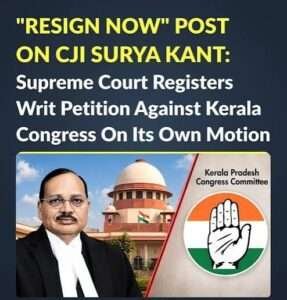
The Supreme Court’s decision to issue contempt notices to the office-bearers of the Kerala Pradesh Congress Committee (KPCC) over an objectionable social media post targeting the Chief Justice of India, Justice Surya Kant, is a timely reminder that constitutional institutions cannot be taken for granted or treated with contempt by political parties. The message is loud and clear: the Constitution is supreme, and no individual or political organisation is above it. For a party that never tires of carrying a pocket-sized copy of the Constitution while accusing the Modi government of putting democracy in danger, this should be a particularly embarrassing moment. What is becoming increasingly difficult to digest is the Congress’s growing propensity to undermine virtually every constitutional institution whenever its decisions or functioning do not suit its political convenience. Parliament is repeatedly reduced to a theatre of disruption, judicial pronouncements are questioned with political overtones, and the Election Commission of India (ECI), particularly Chief Election Commissioner Gyanesh Kumar, is subjected to an unprecedented campaign of vilification. Now, the audacity of the Kerala Congress unit in addressing the CJI as though he were answerable to a political party and demanding his resignation, even offering to find his replacement, has crossed every conceivable Lakshman Rekha. The Supreme Court has rightly distinguished legitimate criticism and intimidation. A political party has every right to disagree with a judicial verdict, question an electoral decision or demand accountability from the government. But that freedom cannot become a licence to ridicule constitutional authorities, threaten their independence or question their right to occupy constitutional offices. The KPCC’s subsequent apology and explanation that the offending post was uploaded without the leadership’s authorisation do not automatically erase the seriousness of the episode. The apex court must examine the matter on its merits. Its observation that judicial independence cannot be a matter of political convenience deserves to be remembered by every political organisation. Equally disturbing is the Congress’s sustained campaign against the Election Commission over the Special Intensive Revision (SIR) of electoral rolls. Instead of placing verifiable evidence before the appropriate authorities and pursuing remedies through established legal channels, the party appears more interested in creating a political spectacle, throwing allegations of electoral manipulation and questioning the credibility of the constitutional authority entrusted with conducting elections. If the Congress genuinely believes that SIR has been manipulated, why should it hesitate to substantiate its allegations with documentary evidence?
In fact, the Election Commission should consider issuing a formal notice to the Congress leadership, asking it to place its specific allegations, supporting evidence and verifiable instances of wrongdoing on record. If the allegations are substantiated, the Commission must act against those responsible. If they are deliberately fabricated or found to constitute violations of applicable election laws, appropriate proceedings should follow. Any action concerning the party’s registration or recognition must, of course, remain strictly within the Commission’s statutory powers and established legal procedures. Nobody should be above accountability, least of all a national political party. The larger question is whether constitutional institutions should continue to remain silent spectators while their authority is repeatedly challenged through political theatrics. Parliament has its rules, the judiciary has its contempt jurisdiction, and the Election Commission has its statutory and constitutional responsibilities. Each institution must discharge its mandate fearlessly, without political intimidation or selective application of the law. The Congress must understand that losing elections is not a constitutional crisis. Losing political relevance cannot justify undermining institutions. Nor does carrying a miniature Constitution in one hand confer the exclusive right to interpret it, much less the authority to intimidate those entrusted with protecting it. A strong message from every constitutional institution is the need of the hour. The law must take its course, irrespective of political stature. Democracy survives not because political parties enjoy unlimited freedom to attack institutions, but because institutions remain strong enough to defend the Constitution. The Congress should be reminded that the Constitution is not a political prop to be displayed during protests and discarded when its provisions become inconvenient. Respect the Constitution, respect its institutions, or be prepared to face the consequences under the law.