



Sanjaya, the seer blessed with divine vision, continued his solemn narration to the grief-stricken Dhritarashtra, unfolding not merely the events of a battlefield but the irresistible march of destiny. Every word carried the weight of fate, every moment revealed the unseen justice governing human deeds. The final encounter between Arjuna and Karna was no ordinary duel; it was the culmination of years of pride, virtue, injustice, and divine purpose, where the destiny of kingdoms and the moral order of the universe converged upon a single decisive moment.
As the fierce battle reached its climax, Karna’s chariot wheel suddenly sank deep into the earth, fulfilling the curse pronounced long before. Struggling to free it, Karna turned toward Arjuna with tears in his eyes and spoke with the dignity of a warrior who knew the sacred laws of battle. He pleaded, “O Arjuna, my chariot wheel is trapped in the earth. Until I lift it, do not release your arrows. I stand upon the ground while you remain upon your chariot. It is not righteous for a warrior to strike another placed in such unequal circumstances. The ancient code of warfare forbids attacking one who has laid down his weapons, whose hair is loosened, or who stands defenseless. You are not only the foremost of warriors but also born in an illustrious lineage. You know well the sacred principles of righteous combat. Fight according to that noble code. I do not speak these words out of fear of you or Krishna, but only to remind you of the eternal path of virtue.”
Before Arjuna could respond, Krishna, the Supreme Guide and Knower of Time, addressed Karna with words that pierced deeper than any weapon. “Where was this wisdom when your heart rejoiced in unrighteousness? Why does the language of virtue arise in you only at the hour of danger? Where was this righteousness when arrogance and envy ruled your mind? Have you forgotten the countless wrongs committed against the sons of Pandu? Those who steadfastly walk the path of righteousness are ultimately blessed with divine grace, while those who uphold injustice must inevitably reap its bitter fruit.”
Krishna’s voice grew more powerful as He recounted the painful history of the Pandavas. “Where was your sense of justice when the house of lac was deceitfully prepared to burn Kunti and her sons while they slept? Where was your virtue during the fraudulent game of dice, when Yudhishthira was robbed of his kingdom, wealth, and honour? Did righteousness speak through you when Draupadi, the queen of unparalleled dignity, was dragged into the royal assembly and humiliated before the gathered kings? Where was your conscience when the Pandavas were repeatedly insulted and attacked under false pretences, and when Abhimanyu, a youthful hero, was mercilessly surrounded and slain against every principle of honourable warfare? Reflect deeply, Karna. In many of these grievous acts, you stood not merely as a witness but as one of their chief supporters. Can you now invoke the laws of righteousness after having abandoned them throughout your life?”
Krishna’s words stirred a storm of emotion within Karna. The sharp remembrance of his own actions ignited a fierce conflict between wounded pride and suppressed conscience. Human nature often resists criticism by clinging more firmly to its own convictions, and Karna was no exception. His warrior spirit, his lifelong loyalty to Duryodhana, and the painful burden of his choices surged through every fibre of his being. As Arjuna paused in thoughtful silence, Karna seized the chance and unleashed a relentless shower of arrows. Arjuna answered with equal mastery, every missile meeting its counterpart in the sky until the heavens themselves seemed woven with blazing shafts of steel and fire.
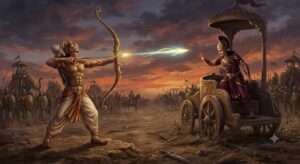
The battle intensified with astonishing fury. Arjuna shattered Karna’s supporting forces, scattered his protectors, and struck down his magnificent banner that had long proclaimed his invincible reputation. Witnessing the collapse of their greatest champion, the Kaurava warriors cried out in helpless despair. Hope slowly deserted their hearts as they realized that the hour long foretold by destiny had finally arrived.
Then Arjuna prepared the supreme weapon that would bring the conflict to its ordained conclusion. Sanctifying the celestial arrow with sacred mantras, he invoked the blessings of truth and righteousness, declaring, “If I have faithfully performed austerities, if I have honoured my teachers, if charity and righteous deeds have adorned my life, then may this divine missile accomplish its purpose and sever the head of Karna.” Released from the Gandiva, the blazing astra sped forth with irresistible force. It struck with a power greater than Indra’s thunderbolt, with a swiftness surpassing the Sudarshana Chakra, and with a terrifying majesty comparable to the Trident of Lord Shiva. It was the very embodiment of divine justice.
The heavens blazed with unbearable brilliance. Warriors on both sides stood stunned, many losing consciousness before its dazzling radiance. Thunderous vibrations echoed across the sky. The earth trembled beneath its impact, while the five great elements themselves seemed to shudder in silent witness to the fulfilment of destiny. In a single irresistible stroke, the celestial weapon severed Karna’s head. It fell into the stream of his own blood, while his mighty body, broad-chested, powerful-armed, and heroic in stature, collapsed like a towering mountain shattered by the thunderbolt of Indra. His radiant head descended as though the setting sun itself had fallen from the western mountain.
As every eye remained fixed upon the fallen hero, a wondrous sight unfolded. A brilliant stream of celestial light emerged from Karna’s body and ascended into the heavens, merging with Surya, the Sun-god, his divine father. Those who witnessed the spectacle stood speechless with awe, realizing that although the warrior had fallen, his immortal essence had returned to its eternal source.
Sanjaya continued, “O King, with Karna’s death the curse pronounced by the Brahmin reached its completion. The earth released the imprisoned wheel of his chariot, which stood level once more. The blazing radiance that had scorched countless enemies departed with Karna. Time itself had decreed that he could not survive beyond this destined hour, for none could cross the path ordained by Providence.”
The Panchalas raised triumphant cries of victory. Conches resounded, war drums thundered, and countless musical instruments echoed across Kurukshetra. The Pandavas and their allies rejoiced, for the greatest obstacle to their victory had finally fallen. Yet amidst the celebration, Karna’s majestic body lay upon the battlefield in lonely silence. His mighty arms that had drawn the celestial bow, his broad chest that had faced innumerable battles, and his powerful thighs that had never trembled before any enemy now rested motionless upon the dust. There remained none to admire the splendour of the warrior who had once commanded the admiration of kings.
As the evening descended, the Sun slowly approached the western horizon. The golden rays touched the lifeless body of Karna, stained with the dust and blood of battle. Ancient poets beautifully imagined that Surya, having embraced his fallen son with his final rays, descended into the western ocean as though to cleanse himself in its sacred waters after witnessing the sorrowful end of his beloved child.
Sanjaya’s moving narration pierced the heart of the aged Dhritarashtra. The blind monarch trembled with overwhelming grief as the weight of every past decision returned to haunt him. The fall of Karna was not merely the death of a mighty warrior; it was the solemn proclamation that destiny may be delayed, but it can never be denied. Pride may flourish for a season, injustice may appear victorious for a time, but the eternal law of dharma ultimately prevails, revealing that every action bears its appointed fruit under the unfailing justice of the Divine.

