



Vaishampayana said to Janamejaya, “O King, when Sanjaya narrated the fall of Duryodhana after the destruction of his brothers and allies, Dhritarashtra was overwhelmed by a grief too deep for words. Suppressing his pride, he asked in anguish, ‘Holding only his mace, where has my son gone on foot? Has any emperor, who once commanded the earth, ever been reduced to such a fate? Tell me, Sanjaya, what transpired after the death of Susharma.'”
Sanjaya replied, “O King, the sovereign who had once led the mighty host of eleven Akshauhinis departed the battlefield alone, abandoned by fortune. With weary steps he reached a cool lake known as Dwaipayana, situated to the north-east of the battlefield. Entering its tranquil waters through the power of his mystical knowledge, he concealed himself beneath the surface. There, surrounded by silence, he remembered Vidura’s wise counsel. Regret consumed his heart as he lamented, ‘I failed to honour the words of the one who wished only my welfare.’ Bereft of kingdom, brothers, sons, friends and glory, he surrendered himself to sorrow, leaving the decree of destiny to unfold.”
Meanwhile, the shattered remnants of the Kaurava army made one final desperate assault upon the Pandavas. Guided by Krishna, whose divine presence illuminated the radiant chariot bearing the banner of Hanuman, Arjuna advanced like the fire of dissolution. His celestial arrows swept away the remaining warriors until none could withstand him. Friends and kinsmen hailed his unmatched valour, while the Kaurava host resembled a mighty tree bent and broken by a devastating storm. Of that once-invincible army, only Kripacharya, Ashwatthama and Kritavarma remained alive.
During the confusion of the battlefield, Dhrishtadyumna saw Satyaki holding me captive. Smiling, he said, “Why do you restrain Sanjaya? What danger can he possibly cause now? Let him go.” But Satyaki, still burning with memories of past enmities, declared, “He is a traitor. I shall sever his head.” As he raised his sword, the venerable sage Vyasa suddenly appeared. In his calm and commanding voice he said, “It is not righteous to slay Sanjaya. Spare his life.” Reverently obeying the sage’s command, both warriors released me. Vyasa then looked upon me with compassion and said, “You have been granted life. Depart in peace.” I bowed before him in gratitude, and as mysteriously as he had appeared, the great sage vanished from my sight.
Thereafter I walked towards Lake Dwaipayana and found Duryodhana hidden within its waters. Tears filled his eyes as he looked around the lonely shore. His sorrow was so profound that words failed us both for some time. At length I narrated how Sage Vyasa had preserved my life. After a while of silence, he asked softly, “Has anyone survived on our side?” I replied, “Kripacharya, Ashwatthama and Kritavarma alone remain alive. None else has escaped.”
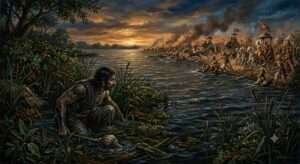
Hearing this, Duryodhana placed his hand upon my shoulder with affection and said, “Go to my father and tell him that all our warriors have fallen, while the Pandavas and their followers survive. Though wounded, I have escaped with life, and that itself is enough. What value has a kingdom gained through charity after stripping me of my rightful inheritance? How can I endure the triumphant celebrations of the Pandavas after the slaughter of my brothers, sons and loyal servants? Tell my father that I shall remain concealed within this lake until the proper moment arrives. My vengeance is not yet extinguished.” Having spoken thus, he descended deeper into the waters through the mastery of his mystical powers, sustaining himself beneath the surface by controlling his breath.
Not long afterwards, Kripacharya, Ashwatthama and Kritavarma, riding exhausted horses wearied by battle, searched anxiously for their king. On seeing me alive they exclaimed with relief, “Sanjaya, you have survived! Is the Kuru king also alive?” I revealed Duryodhana’s hiding place and recounted everything that had occurred. Deeply grieved, they said, “The king believes that none of us survived. Deprived of hope, he has hidden himself in the lake. Alas! The sovereign of the earth has fallen into such a pitiable condition. Had he known that we still lived, he would surely have stood beside us, and together we might yet have challenged the enemy.”
Even as they spoke, the victorious Pandavas, their confidence strengthened by success, approached that very region with their forces. Judging it unwise to remain, Kripacharya placed me upon his chariot and carried me safely away to our deserted camp.
Within the Kaurava encampment another spectacle of grief unfolded. Royal women, overwhelmed by unbearable sorrow, ran in confusion with loosened hair falling upon their shoulders. Veiling their faces with trembling garments, they struggled to suppress their sobs, though tears streamed ceaselessly down their cheeks. Their hands, reddened by striking their faces in anguish, rose repeatedly as they cried aloud the names of their husbands, sons and fathers. Noble ladies, once accustomed to splendour, were carried in palanquins and chariots by faithful attendants, while others wandered helplessly across the ground, lamenting the destruction of their families. Fear seized the entire camp, and people fled in every direction.
At that moment Yuyutsu, whose heart burned with grief, declared, “Bhishma, Drona, Karna, Shalya, Shakuni and the great Kaurava heroes have all perished. The king alone has departed elsewhere after escaping the Pandavas. By divine grace I alone have survived. It is now my sacred duty to escort these royal women safely to Hastinapura.” Descending from his chariot, he sought the approval of Krishna and Yudhishthira. Dharmaraja embraced him warmly and said, “Your decision is righteous. Go without fear and fulfil this noble responsibility.”
Yuyutsu departed with the royal ladies and soon met the aged guardians of the palace, who were escorting the bereaved women. He comforted them throughout the journey. Before they entered Hastinapura, Vidura came forth to receive them. On learning from Yuyutsu about the deaths of Shalya, Shakuni and the entire Kaurava army, and of Duryodhana’s lonely departure from the battlefield, Vidura was deeply shaken by sorrow. Yet he praised Yuyutsu’s wisdom and said, “Sanjaya will soon arrive and recount every event in detail before the king. Until then, let no rumour spread throughout the city. Escort the royal ladies quietly to their respective residences and instruct everyone to remain composed and silent.” Vidura then arranged strict security for the inner chambers of the palace, ensuring the protection and dignity of the bereaved queens.
Thus the once-glorious Kaurava camp, where the trumpeting of elephants, the neighing of horses, the roaring of mighty warriors and the ceaseless sounds of military life had once echoed without interruption, sank into a silence more dreadful than death itself. Every banner drooped, every pathway lay deserted, and grief reigned where pride had once flourished.
Unable to bear the uncertainty any longer, Dhritarashtra asked, “Sanjaya, when our vast army had been destroyed by the enemy, what did you and my son do thereafter?” Desiring to calm the anxious heart of the blind monarch, Sanjaya prepared to narrate the final and most poignant chapter of the Kurukshetra war.

