



Drishtadyumna, fearless and proud of his prowess, rose without hesitation even after receiving the fierce kick of Ashwatthama. In a flash, the son of Drona cast aside his bow, seized Drishtadyumna by the neck, and twisted it with relentless force. Dragging him violently to the ground, he pinned his chest beneath his knees and rained merciless blows upon his ribs with clenched fists, blazing with unrestrained fury. Before the bewildered commander could gather his senses, Ashwatthama struck him into unconsciousness. Seeing his helpless foe lying powerless, he removed the string from his bow, fashioned it into a deadly noose, and tightened it around Drishtadyumna’s neck, intent on slaughtering him like a sacrificial beast.
With his feet crushing the warrior’s chest and throat, Ashwatthama pressed harder, while Drishtadyumna, struggling for breath, clawed desperately at the earth. In a faint and broken voice he pleaded, “O Brahmin warrior, slay me with a weapon. Why prolong this agony? Even an enemy deserves a swift and honourable death.” Ashwatthama gazed sternly upon his fallen adversary and replied, “You, who treacherously slew your preceptor, deserve neither honour nor salvation. The vile manner in which you killed my father shall be repaid in equal measure. I shall end your life in the most ignoble fashion.” With those dreadful words, he tortured Drishtadyumna beyond endurance until every sign of life departed from him.
The uproar awakened the sleeping inhabitants of the camp. Startled by the terrifying commotion, men and women fled in panic as though a wrathful demon had descended upon them. Like a lion tearing apart a rogue elephant, Ashwatthama continued his assault, trampling, striking, and crushing the helpless Drishtadyumna until the Panchala commander breathed his last. The memory of his father’s humiliation burned fiercely within him, and vengeance alone guided his merciless hands.
Having accomplished his dreadful purpose, Ashwatthama calmly restrung his bow and emerged from the chamber with grim satisfaction. Mounting his chariot with a chilling smile, he resolved to cleanse the entire camp in blood. The thunder of his chariot wheels echoed through the darkness, as though delighting unseen spirits and dreadful beings who rejoiced in the harvest of death. Meanwhile, the guards discovered the lifeless body of Drishtadyumna. The women of the camp broke into heartrending cries, and sorrow descended upon the sleeping encampment like an impenetrable cloud. Kings from the neighbouring tents rushed to the scene, while the lamentations grew ever louder.
The terrified guards cried out, “We know not whether he is man or demon. A single warrior has slaughtered Drishtadyumna and now departs upon his chariot. Pursue the destroyer!” The assembled kings shouted in one voice, “Do not let him escape! Capture him alive!”
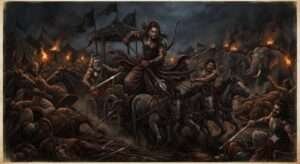
Hearing their challenge, the son of Drona unleashed a storm of razor-edged arrows. His unmatched mastery of archery transformed the battlefield into a whirlwind of death. Soldiers and princes fell in rapid succession beneath his relentless shafts, while the dreadful spectacle seemed to earn the approval of the unseen hosts of spirits that haunted the night.
Ashwatthama then rushed toward the quarters of Uttamaujas with sword in hand. Bursting into the warrior’s private chamber, he seized him by the hair before he could fully awaken, hurled him violently to the ground, and struck him repeatedly with crushing kicks until life deserted his body. Yudhamanyu, believing that a supernatural being had invaded the camp, charged fearlessly with his mace. Yet Ashwatthama ignored the blow, overpowered him with ruthless ferocity, and slew him in a manner as pitiless as the fate that had overtaken Drishtadyumna.
Even these killings failed to satisfy the blazing vengeance within his heart. After slaying the sons of Drupada, Ashwatthama strode through the camp like the very Lord of Death, sword flashing in his hand. Around him, the dreadful hosts of demons were imagined to revel in the carnage, feasting upon flesh and drinking blood while blessing the son of Drona for the terrible fulfilment of his vengeance.
None escaped his wrath. Those asleep, those awakened by the tumult, those who resisted, and those who sought to flee were all cut down without distinction. Alone, he annihilated the mighty Panchala host. Elephants were hewn apart, their trunks severed and massive heads shattered. Mountains of flesh and broken bodies covered the earth, while streams of blood flowed like crimson rivers across the battlefield.
Turning next toward the horse lines, Ashwatthama inflicted equal devastation. Horses were maimed, their legs severed, their backs cleft, and their bodies hacked into fragments with merciless precision. Everywhere lay heaps of corpses, pools of blood, and mire formed from torn flesh. Leaving behind only silence and ruin, he advanced toward the remaining quarters of the Pandava camp, destroying every living being that crossed his path. Thus, O King Dhritarashtra, the son of Drona moved like an irresistible force of destruction, reducing the once-glorious camp of the Pandavas to a realm of terror, mourning, and death.

