



Mylai Singaravelar Temple is an ancient shrine dedicated to Lord Murugan, situated within the famous Kapaleeswarar Temple complex at Mylapore, Chennai. The shrine is distinguished by its rare iconography, remarkable architecture, and rich Tamil devotional literary heritage.
The shrine has a documented history dating back to the 15th century, when Saint Arunagirinathar composed ten Thiruppugazh hymns in praise of Mylai Singaravelar. However, the exact period of its original construction is not known.
Lord Murugan is worshipped here as Singaravelar, with six faces, accompanied by his consorts Valli and Deivayanai. While Lord Murugan is depicted with his peacock mount, both Valli and Deivayanai are depicted seated on elephants, a rare iconographical feature.
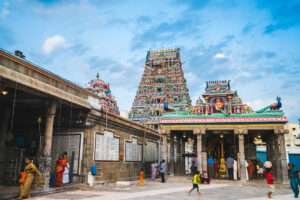
The east-facing shrine has its own flagstaff, sixteen-pillared mandapam, Maha Mandapam, Ardha Mandapam and an imposing Vimana. Interestingly, the Vimana of Singaravelar is taller than that of the Kapaleeswarar shrine. A separate four-pillared mandapam is used for the Oonjal Utsavam (swing festival). A shrine dedicated to Saint Arunagirinathar is situated opposite the Singaravelar shrine.
Mylapore has been an important centre of religious worship and Tamil literary activity for centuries. The compositions of Saint Arunagirinathar establish the prominence of Murugan worship at Mylapore during the 15th century.
The present Kapaleeswarar Temple complex is generally believed to have developed following the destruction of the earlier temple near the seashore during the Portuguese period in the 16th century.
The independent flagstaff, spacious mandapams, separate festival arrangements and imposing Vimana of Singaravelar have led some researchers to suggest that it may originally have been an independent Murugan temple, subsequently incorporated into the Kapaleeswarar Temple complex. However, this remains a historical hypothesis.
According to the Sthalapurana, before proceeding to defeat the demon Surapadman, Lord Murugan visited Mylapore and worshipped Lord Kapaleeswarar, seeking his divine blessings. Pleased with his worship, Lord Shiva blessed him with the sacred Vel. According to a local tradition, Murugan received the Sakthi Vel at Sikkal and subsequently received the beautiful Singara Vel at Mylapore, thereby acquiring the name Singaravelar.
Lord Shiva then instructed Murugan to worship his elder brother, Lord Vinayaka. Pleased with Murugan’s worship, Vinayaka performed a joyous divine dance. This tradition is associated with the Koothadum Vinayaka shrine at Mylapore.
The tradition of Murugan receiving the sacred Vel at Mylapore finds literary mention in verse 376 of Thirumayilai Kovai, composed by Ambalavana Kavirayar, which describes Singaravelar receiving the divine Vel after worshipping Lord Shiva.
Apart from the ten Thiruppugazh hymns composed by Saint Arunagirinathar, several Tamil devotional literary works are dedicated to Mylai Singaravelar.
Thirumayilai Pillai Tamil, composed by Tandavarayar and traditionally dated to 1756 CE, consists of 101 verses celebrating the divine childhood of Lord Murugan.
Thirumayilai Kovai, composed by Ambalavana Kavirayar, consists of 416 verses glorifying Singaravelar and the sacredness of Mylapore. Singaravelar Venba is another devotional composition dedicated to the Lord.
These literary works reflect the rich devotional heritage and centuries-old tradition of Murugan worship at Mylapore.
Thaipusam, Kanda Sashti, Vaikasi Visakam and Krithigai are important occasions of worship. The annual float festival and Oonjal Utsavam are special features associated with Singaravelar.


