



The Sacred Shakti Peetha Associated with Narakasura, the Legendary King of Pragjyotishpura
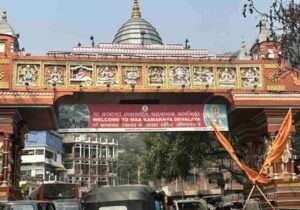
Sri Kamakhya Devi Temple, situated atop Nilachal Hill in Guwahati, Assam, is one of India’s most sacred Shakti Peethas and an important centre of Shakti worship. The temple has a special connection with Narakasura, the legendary king of ancient Pragjyotishpura, who is associated with the origins of the Kamarupa kingdom. According to tradition, Narakasura was the father of Bhagadatta, who later ruled Pragjyotishpura.
The temple has ancient origins, although its exact age is uncertain. The present structure was largely reconstructed in 1565 CE by the Koch rulers, under King Nara Narayan and Chilarai. Later Ahom rulers contributed to its expansion. Narakasura’s association with the temple belongs to its ancient mythological traditions.
The presiding deity is Goddess Kamakhya, a powerful manifestation of Adi Shakti, representing fertility and creation. Instead of a conventional idol, the goddess is worshipped through a naturally occurring yoni-shaped rock formation, continuously moistened by an underground spring. According to Shakti Peetha tradition, this is where Goddess Sati’s yoni fell.
The temple follows the distinctive Nilachal architectural style, featuring a beehive-shaped dome, sculptured walls and a subterranean sanctum. The complex contains several smaller shrines dedicated to different manifestations of the goddess.
According to local legend, Narakasura was born to Bhudevi (Mother Earth) and Lord Vishnu in his Varaha incarnation. He became the powerful ruler of Pragjyotishpura, the ancient kingdom associated with present-day Assam. Initially regarded as a capable ruler, Narakasura gradually became arrogant because of his growing strength and authority.
Narakasura heard about the extraordinary beauty and divine power of Goddess Kamakhya, who resided on Nilachal Hill. Captivated by her, he approached the goddess and expressed his desire to marry her.
Goddess Kamakhya, knowing his intentions, placed an extraordinary condition before him. She declared that he must construct a staircase from the foot of Nilachal Hill to her abode before the first light of dawn. Only if he completed this seemingly impossible task would she agree to marry him.
Confident of his supernatural powers, Narakasura immediately began the construction. Throughout the night, he worked with tremendous speed, carrying massive stones and building the pathway up the sacred hill.
As the night progressed, the staircase was almost complete. Realising that Narakasura might succeed, Goddess Kamakhya devised a plan to prevent the marriage. Through her divine powers, she caused a rooster to crow before the actual break of dawn.
Believing that morning had arrived and that he had failed the challenge, Narakasura abandoned his work in anger. When he discovered that the rooster had crowed prematurely, he killed it in frustration. Local tradition associates the place with Kukurakata, meaning the place where the rooster was killed.
The unfinished stone pathway, traditionally known as Mekhelauja Path, is associated with this legend and is believed by devotees to preserve the memory of Narakasura’s attempt.
Another local tradition recounts that Narakasura later prevented Sage Vashistha from worshipping Goddess Kamakhya. Angered by this disrespect, the sage cursed him, contributing to his eventual downfall.
As Narakasura’s arrogance increased, he conquered several kingdoms and attacked the heavenly realms. He seized the precious earrings of Aditi, the mother of the Devas, and imprisoned thousands of women, traditionally numbered as 16,000 or 16,100 in different accounts.
Unable to tolerate his tyranny, the Devas sought the protection of Lord Krishna.
Lord Krishna, accompanied by Satyabhama, proceeded to Pragjyotishpura and fought Narakasura’s formidable forces. After defeating the powerful guardian Mura and overcoming the kingdom’s defences, Krishna confronted Narakasura in battle.
According to the widely known Bhagavata Purana account, Lord Krishna killed Narakasura with his Sudarshana Chakra. Other popular traditions give Satyabhama, identified with Bhudevi, a decisive role in his defeat.
Following Narakasura’s death, the imprisoned women were liberated, and Aditi’s earrings were recovered. Bhudevi approached Krishna, seeking protection for her son Bhagadatta.
Popular Deepavali traditions further narrate that Narakasura wished his death to be remembered as a day of happiness rather than sorrow. This belief is associated with Naraka Chaturdashi, symbolising the victory of righteousness over arrogance, oppression and evil.
Thus, the legends of Goddess Kamakhya and Lord Krishna together preserve the extraordinary story of Narakasura, connecting the sacred hill of Assam with the celebrations of Deepavali.
The most important festival is Ambubachi Mela, celebrated annually in June, honouring the goddess’s symbolic menstrual cycle and the creative power of Mother Earth. The temple remains closed for three days before reopening for worship. Other important festivals include Pohan Biya, Durga Puja and Kali Puja.

