



The son of Drona turned the once peaceful and slumbering encampment of the Panchalas into a dreadful landscape of corpses, streams of blood, and mire mingled with flesh. Men, horses, and elephants lay so hopelessly entangled that no distinction could be made between human and beast. Having surrendered himself to a terrible and condemnable frenzy, Ashwatthama moved from one encampment to another, driven by an insatiable thirst for vengeance. The warriors, suddenly awakened from sleep, rose in confusion to confront him, only to be overwhelmed within moments by the fury of his attack.
Ashwatthama appeared like Yama himself at the end of time, striking down every living creature that crossed his path. The camp became a ghastly spectacle of severed tusks and trunks, shattered limbs, horse-heads and elephant-heads, while human bodies were crushed into shapeless masses beneath the feet of the advancing warrior. His terrible sword flashed ceaselessly through the darkness, and the carnage seemed to furnish a feast for ghosts and malignant spirits. Those who fled were pursued; those who surrendered were not spared. The unarmed, the wounded, the exhausted, the aged and the young alike fell beneath his sword. In that hour, the weapon in Ashwatthama’s hand seemed to transform him into the very embodiment of destruction.
He swept through the Chedi encampments with the force of a rogue elephant breaking through a flowering garden, a wild gaur raging through a tranquil lake, or a forest fire consuming dry timber. Wherever he passed, resistance collapsed. His body was smeared with blood and flesh, and his terrible appearance made the terrified survivors believe that some demon had descended upon their sleeping army. He now advanced towards the royal encampments, while the dreadful sound of his roar travelled through the night.
Sikhandi, the Upapandavas and other surviving warriors, hearing of Ashwatthama’s slaughter, gathered their courage and prepared to confront him. The Prabhadrakas and the warriors of Matsya joined them, their hearts burning with anger. Ashwatthama looked upon Sikhandi and the assembled warriors with a terrifying, almost spectral gaze and sprang upon them like a lion descending upon a herd of deer. His divine sword moved with astonishing speed, severing heads and limbs and cutting warriors into pieces before they could recover from their shock.
Prativindhya, the son of Yudhishthira, became one of the first to encounter the full fury of Ashwatthama’s sword. The terrible weapon swept across the ranks, and Prativindhya was struck down. Then Shrutasoma, the son of Bhima, rushed forward to confront the son of Drona. Armed with his weapon and sword, he resisted fiercely, but Ashwatthama, consumed by wrath, cut down his horse and severed his limbs and head in an instant.
Satanika, the son of Nakula, attacked Ashwatthama with a discus and pierced his chest. Enraged beyond measure, Ashwatthama struck him down, crushed him beneath his feet and severed his head from his body. Srutasena, the son of Sahadeva, advanced against the enemy with a mace and struck him with great force. Yet Ashwatthama remained unmoved. With demonic ferocity, he severed Srutasena’s head and crushed his body beneath the relentless violence of his attack.
Srutakirti, the son of Arjuna, then resisted the advancing warrior with his bow. But Ashwatthama sprang upon him like a lion upon its prey, slashed his neck and cast him lifeless upon the ground. Thus, in a single night of unparalleled brutality, the sons of Draupadi were slain in the ruthless surge of Drona’s son.
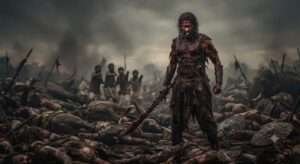
The Prabhadrakas and Sikhandi now surrounded Ashwatthama. They assailed him with showers of arrows, pestles, spears and maces, determined to restrain the terrible warrior. But the more fiercely they attacked, the more dreadful became his fury. Ashwatthama moved among them like an elemental force, cutting through their ranks and reducing warriors to shapeless heaps of flesh. Sikhandi himself discharged a volley of arrows in an attempt to halt his advance. Ashwatthama, blazing with renewed anger, answered with a devastating stroke that severed heads, arms and trunks, leaving the battlefield strewn with mangled remains.
Even after their commanders had fallen, the Panchalas and Prabhadrakas continued the struggle with desperate courage. Yet Ashwatthama was now beyond restraint. He leapt upon them like a wild lion among frightened deer, crushing their ranks in moments and roaring restlessly through the darkness. But amid his fury, one thought tormented him: Krishna and Arjuna were nowhere to be seen. Their absence frustrated his desire for complete vengeance, and he searched the battlefield for them with growing impatience.
Until then, the terrified survivors had imagined that some supernatural demon was ravaging the camp. Now the dreadful truth stood before them in human form: it was Ashwatthama, the son of Drona, who had become the instrument of this night of destruction.
Some of the elders recalled strange and ominous dreams they had witnessed during the long course of the war. Each night, they had seen in their dreams a gigantic woman of terrible appearance, with blood-red eyes, crimson garments and red garlands, her loose hair flying wildly around her. Her body was smeared with blood, and she seemed to gather warriors, elephants and horses, bind them and lay them before Ashwatthama, who cut them down without mercy. Now, hearing the same dreadful roars and witnessing the same terrible spectacle in waking life, they understood the meaning of those visions. The figure they had seen in their dreams seemed to have foreshadowed this very night, and Ashwatthama appeared to be fulfilling the terrible destiny revealed to them.
Sanjaya, describing these horrors to King Dhritarashtra, declared that those who attempted to flee were pursued by Ashwatthama from his chariot. He struck them with sharp arrows and slew them as they ran. Fear seized every heart, for none who came face to face with the son of Drona could remain confident of survival.
Ashwatthama’s night of vengeance therefore stands as one of the darkest episodes of the Mahabharata. In him, demonic fury and the sanction of destiny seem strangely intertwined. His actions reveal the terrifying depths to which vengeance can descend when grief, anger and wounded pride overpower reason and restraint. Through a single warrior, the epic exposes the many shades of Dharma and its opposite—the boundary between justice and revenge, courage and cruelty, divine sanction and human madness. The night does not merely portray a massacre; it becomes a profound meditation on how vengeance, once released from the discipline of Dharma, can transform a warrior into an instrument of destruction.

