



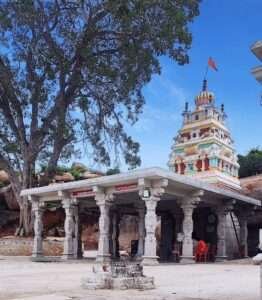
Malemalleshwara Temple is an ancient and lesser-known Shiva temple situated at the foothills of Malemalleshwara Hill, to the west of Koppal city in Karnataka. The temple has great historical and religious significance and is associated with Arjuna’s penance to obtain the divine Pashupatastra from Lord Shiva.
The temple is believed to be nearly 1,000 years old. The surrounding hill has archaeological remains dating back around 3,000 years, indicating the antiquity of this region.
Lord Shiva is worshipped here as Malemalleshwara in the form of an Udbhava Linga (self-manifested Shiva Linga). The word ‘Male’ in Kannada means hill, and Malemalleshwara signifies the Lord Malleshwara of the hill.
The ancient temple, situated amidst rocky hills, has undergone extensive renovation. The surrounding hill has natural caves, ancient rock carvings and a beautiful natural water body known as Kamala Sarovara, where lotus flowers bloom.
Malemalleshwara Hill is historically significant for its prehistoric remains, ancient burial sites and rock carvings. An Ashokan inscription dating back to the 3rd century BCE, written in Prakrit using the Brahmi script, is found on a rock known as Palki Gundu.
Several Jain inscriptions are also found on the hill, including one associated with Jain Acharya Simhanandi, who is believed to have observed Sallekhana in 1008 CE.
The hill is also associated with Sri Gavisiddeshwara, the 11th pontiff of Koppal Gavimath, who is believed to have performed penance here during his childhood.
According to the local Sthalapurana, Malemalleshwara Hill is identified with the sacred Indrakila Parvata mentioned in the Mahabharata.
During the period of the Pandavas’ exile, Arjuna undertook severe penance seeking the blessings of Lord Shiva and the powerful Pashupatastra.
According to the Mahabharata tradition, Lord Shiva appeared in the guise of a hunter, and a wild boar became the cause of a dispute between them. A fierce encounter followed, during which Arjuna demonstrated extraordinary courage, determination and devotion. Pleased with Arjuna’s perseverance, Lord Shiva revealed his divine form and blessed him with the sacred Pashupatastra.
The local tradition identifies Malemalleshwara Hill as the sacred place where Arjuna performed this penance and received the divine weapon.
Another interesting legend associated with this hill concerns Bhimasena, who is believed to have killed a tiger inside a natural cave. The cave is consequently known as Bheema Gavi.
The most remarkable feature of this temple is the perennial natural spring emerging from the rocky formation inside the sanctum. Water continuously flows over the self-manifested Shiva Linga throughout the year, performing a natural Abhishekam.
According to local accounts, the flow of water continues even during severe summers and droughts. Devotees regard this uninterrupted natural Abhishekam as a manifestation of Lord Malleshwara’s divine grace.
The annual Jatra Mahotsava and Rathotsava are celebrated with great devotion, attracting devotees from Koppal and surrounding villages. Special pujas and religious ceremonies mark these celebrations.


