Upadhyayula Lakshman Rao
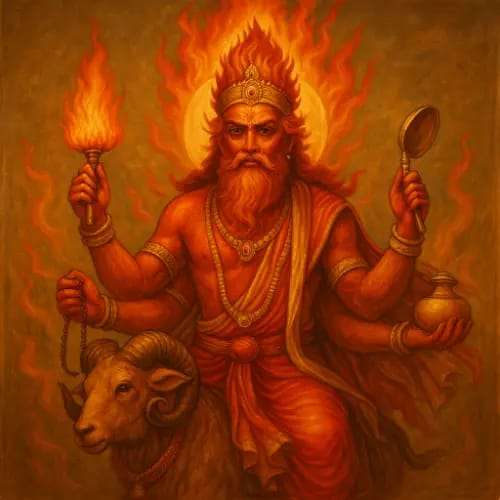
In the sacred vision of the seer Deerghatama, the divine fire is invoked with reverence through the measured cadence of Anustup, wherein sound itself becomes a bridge between the mortal and the eternal. Agni is hailed as the radiant principle, the visible light of consciousness, who shines forth as both the material flame and the subtle intelligence pervading the cosmos. The wise, endowed with discernment, raise their voices in hymns not merely as ritual utterances but as structured vibrations aligned with cosmic order, seeking to harmonize human intent with universal law.
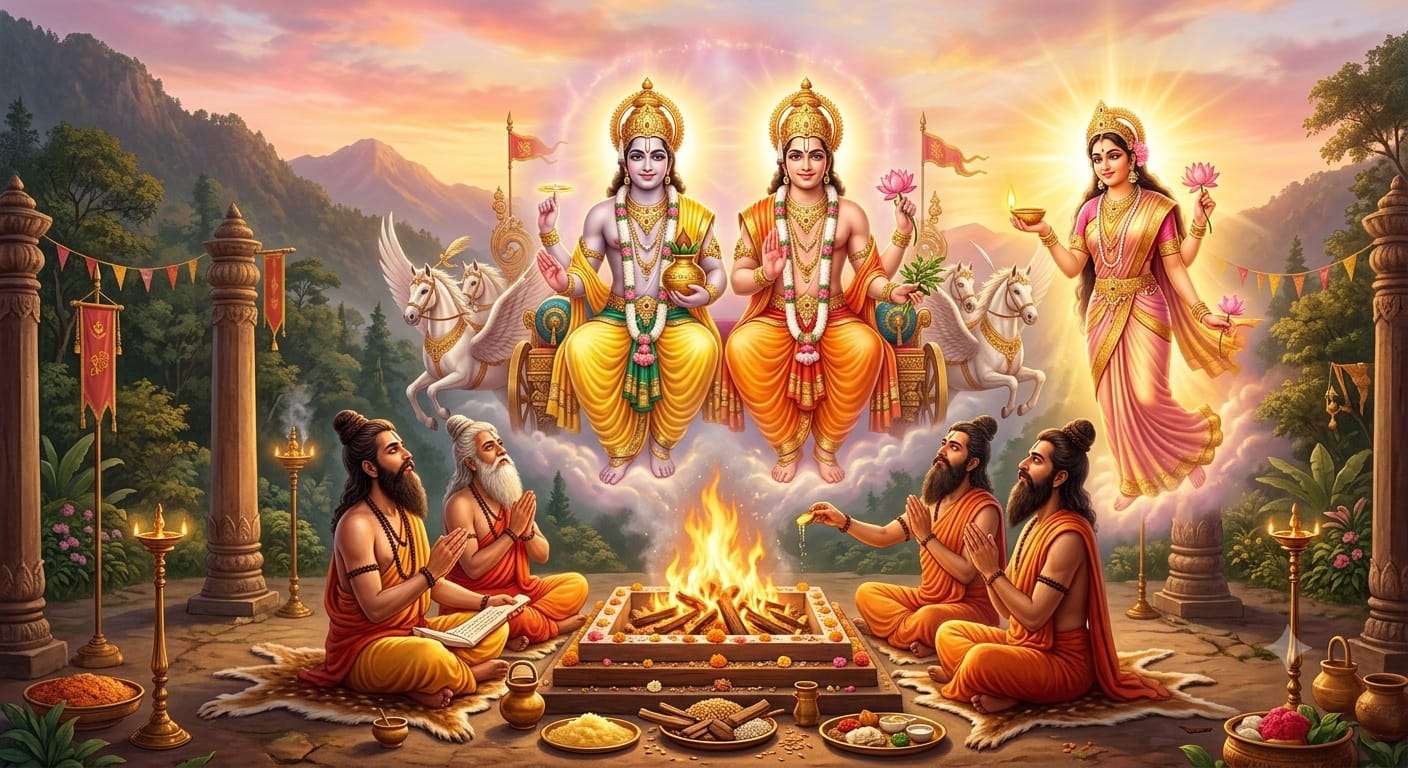
Agni is entreated to summon the celestial recipients of the oblations, for he alone is the carrier, the messenger who traverses realms unseen. The flowing streams of clarified butter and the sacred soma represent not only offerings but also transformations of matter into energy, symbolizing the cyclic interchange between the physical and the divine. The sanctified enclosure of the yajna becomes a microcosm of the universe itself, where every act is governed by precision, purity, and intentionality. The presence of Agni is invoked to remain steadfast throughout the ritual, sustaining continuity and ensuring that every offering reaches its rightful destination.
In this dual role, Agni is both the consuming fire and the protector against chaos, embodying the paradox of creation and dissolution. The merits accrued from the yajna are believed to extend beyond the immediate participants, permeating the celestial hosts and reinforcing the interconnected web of existence. His nature is described as pure, resplendent, and ever-awakening, reflecting both the physical properties of fire and its metaphysical symbolism as the principle of transformation. Thus, Agni becomes worthy of praise not only by priests but by all seekers of truth.
From the celestial heights, Agni is invited to descend and invigorate the sacrifice, to nourish it with the distilled essence of soma, and to purify it thrice—signifying refinement across body, mind, and spirit. The hymns composed are deliberate and articulate, shaped by disciplined speech, for the sacred tongue is itself an instrument of manifestation. Agni is further requested to invite Indra, the dynamic force of expansion and strength, whose presence ensures the fruition of the ritual’s intent.
The ritual space is meticulously prepared by the priests, who spread the sacred grass as a seat of purity and alignment. This act, though simple in form, reflects a deep understanding of order and preparation, akin to establishing stable conditions for any transformative process. The precincts of the yajna are vast and symbolically infinite, suggesting that the ritual extends beyond physical boundaries into the expanse of consciousness. The gates of this sacred domain are envisioned as ever-open, welcoming divine forces and sustaining the continuity of cosmic interaction.
The twin manifestations of fire, the terrestrial and the electrical, reveal an intuitive grasp of natural phenomena, recognizing fire not merely as a visible flame but also as latent energy within matter and the atmosphere. These forms of Agni, radiant and potent, are invoked to bless both the composers of hymns and the officiating priests, ensuring that knowledge and action remain unified. Through them, the assembly of divine intelligences is invited, affirming the yajna as a collaborative convergence of forces.
The presence of the three divine feminine principles—Bharati, Ila, and Saraswati—elevates the ritual into a harmonious synthesis of expression, perception, and knowledge. Bharati resonates as the celestial voice, Ila as the grounded articulation upon earth, and Saraswati as the flowing current of wisdom that traverses all realms. Their placement upon the sacred grass signifies the sanctification of speech, thought, and understanding, ensuring that the yajna is not merely an external act but an inner awakening.
The invocation of waters introduces another dimension of scientific awareness, acknowledging their dynamic movement and life-sustaining properties. The release of rain through the agency of subtle fire within the atmosphere reflects an early perception of natural cycles, where energy transformations govern climatic phenomena. Agni, present even within herbs and organic life, is called upon to hasten the priests and energize the proceedings, illustrating an understanding of vitality as a unifying force within all living systems.
As the ritual culminates, Agni in his role as the luminous conveyor, carries the offerings to the gods, guided by the sacred utterance of swaha, which signifies surrender and transformation. Indra, along with Pusha, the Maruts, and other divine forces, is invited to partake, symbolizing the integration of strength, nourishment, and dynamic motion within the cosmic order. The priests, through disciplined recitation and precise action, create a field of resonance where intention becomes reality.
Thus, the yajna emerges not merely as a ritualistic act but as a profound synthesis of spirituality and proto-scientific insight. It reflects an understanding of energy, transformation, ecology, and consciousness, woven together through symbolism and practice. In this sacred convergence, Agni stands as the eternal mediator, the flame that unites heaven and earth, matter and spirit, action and realization.