



The recent struggles of the Indian cricket team have inevitably revived an old but important question: what exactly is the role of a coach in a senior international cricket team, and how much influence should he actually have over a group of experienced players?
This is not about questioning the credentials of Gautam Gambhir or blaming him for every defeat. Nor is it about absolving players, selectors or the captain of responsibility. It is about examining whether the traditional concept of a “coach” remains relevant in precisely the same form when dealing with a mature international side.
When John Wright took charge of the Indian team as coach, he inherited a formidable group of experienced players—Sourav Ganguly, Sachin Tendulkar, Rahul Dravid, VVS Laxman and Virender Sehwag, among others. The bowling department too had considerable experience and depth. The coach’s role was largely to bring discipline, planning and cohesion to a group that already possessed enormous cricketing knowledge.
Today, the circumstances are different. Some of India’s greatest recent stars, including Rohit Sharma and Virat Kohli, are moving towards the end of their international careers, while several others are still trying to establish themselves consistently. Shubman Gill has emerged as an important figure, while players such as Ravindra Jadeja and Washington Sundar have often provided crucial contributions.
The question, therefore, is not whether a coach has any role. Clearly, he does. The question is where that role should begin and where it should end.
Take the often-repeated principle that a batsman should be capable of batting at any position. In theory, adaptability is a virtue. In practice, however, constant experimentation with batting positions can create uncertainty rather than flexibility. If a tactical decision proves unsuccessful, responsibility cannot simply be placed at the coach’s door. The captain and the players who execute the plan on the field are equally accountable.
After all, who actually plays the game—the team or the coach?
Cricket is different from football, hockey or basketball, where coaches can continuously influence proceedings from the sidelines and make immediate tactical interventions. In cricket, particularly Test cricket and ODIs, the situation is fundamentally different. Once the players walk onto the field, the captain and the players are the principal decision-makers. A coach cannot call a batsman back after a poor shot or alter a bowler’s delivery while the ball is being released.
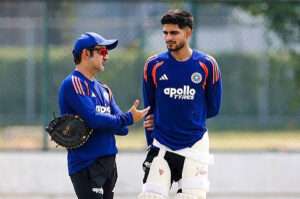
This does not make the coach irrelevant. A good coach can analyse opposition strengths and weaknesses, prepare game plans, identify technical deficiencies, help players manage pressure and create an environment conducive to performance. But much of that work happens before the match, not during every critical moment of play.
A senior Indian team is not an under-16 or under-19 side requiring constant instruction. These are professionals who have spent years playing competitive cricket. They have access to specialist batting, bowling, fielding, fitness, physiotherapy, medical and analytical support. They do not need to be reminded repeatedly that they must perform.
This places enormous responsibility on the captain.
The captain must command the respect of the dressing room, understand the strengths and weaknesses of individual players and possess the authority to counsel a struggling teammate. A coach can advise, but ultimately it is the captain who must translate strategy into action on the field.
The selectors too have a major responsibility. Once they choose experienced players for the senior side, they must also trust the captain and the support system rather than creating confusion through frequent experimentation.
Perhaps, therefore, Indian cricket needs to reconsider the nomenclature and expectations attached to the word “coach.” For a senior international team, the position could perhaps be more appropriately viewed as that of a team manager, strategist and mentor, working in partnership with the captain rather than operating above him.
There is also a legitimate question about the acceptability of the coach within the dressing room. Players naturally tend to respond differently to someone whose cricketing achievements and experience command their respect. That does not necessarily mean only former superstars such as Sachin Tendulkar, Rahul Dravid or M.S. Dhoni could qualify. Coaching ability, tactical intelligence, communication skills and man-management matter enormously. But credibility and mutual respect are equally important.
The time has perhaps come for an honest and dispassionate debate within the BCCI and Indian cricket. Is the present coaching structure producing the best results, or has the role acquired expectations that are disproportionate to what a coach can actually influence?
The answer need not be either “coach” or “no coach.” The real issue is finding the right balance between the coach, captain, selectors and players.
Indian cricket does not need another power centre in the dressing room. It needs a coherent leadership structure in which everyone knows his responsibility—and, equally importantly, where that responsibility ends.



It’s a good view point. Coach should be like the hub of the wheel ton which different spokes stick.