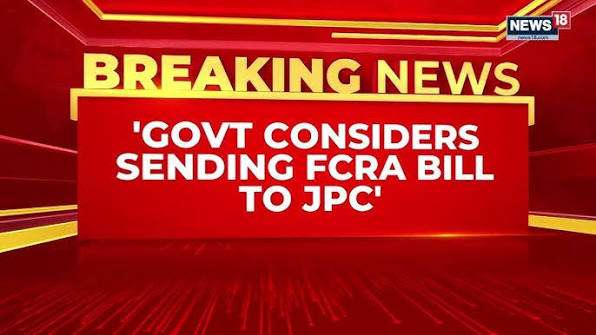
New Delhi: The government is considering sending ‘The Foreign Contribution (Regulation) Amendment Bill, 2026’ to a joint committee of both houses of Parliament, even as the Congress and some opposition parties have demanded that it be withdrawn, sources said on Tuesday.
The Congress and TMC were among the parties that raised the issue during the meeting of the Business Advisory Committee of the Rajya Sabha, though it was not part of the agenda, asking when the FCRA Bill will be taken up in the House, to which the government said a decision will be taken on it in due course of time.
The two parties demanded that the bill be withdrawn, but others like BJD feel the bill could be sent to a joint committee of Parliament for further scrutiny.
The DMK also wants the Bill to be withdrawn, the sources said.
The Bill was introduced in the Lok Sabha on March 25 this year and proposes tighter government oversight on non-governmental organisations (NGOs) and foreign funding in the country.
Government sources said it is considering sending the Bill to a joint committee of both Houses of Parliament and a motion may be brought in the Lok Sabha in this regard on Wednesday.
The Bill seeks to create a designated authority to manage and dispose of assets if an organisation loses its FCRA licence.
The opposition parties, which have raised strong objections to the FCRA Bill, allege that it targets minorities as certain provisions will choke legitimate funding for Christian NGOs and minority-run social welfare and educational institutions.
But the government has made it clear that the proposed legislation is not religion-specific and is aimed at regulating foreign contributions.
The Business Advisory Committee of the Rajya Sabha was chaired by Chairman C P Radhakrishnan and attended by Parliamentary Affairs Minister Kiren Rijiju and leader of the house J P Nadda and opposition leaders Jairam Ramesh (Cong), Tiruchi Siva (DMK) and Sasmit Patra (BJD).
During the meeting, the BAC allotted two hours for ‘The Mines and Minerals (Development and Regulation) Amendment Bill, 2026’; two hours for ‘The Tribunals Reforms Bill, 2026’; three hours for ‘The National Co-operative Development Corporation (Amendment) Bill, 2026’; and 1.5 hours for ‘The Kerala (Alteration of Name) Bill, 2026 ‘.
Later, Deputy Chairman Harivansh announced the decisions of the business advisory committee in the House.
Meanwhile, thousands of people belonging to various Christian denominations staged a rally in Mizoram’s capital Aizawl on Tuesday to protest the proposed Foreign Contribution (Regulation) Act (FCRA) Amendment Bill.
The event was organised by the newly formed Council of Churches in Mizoram (CCM), a conglomerate of nine major churches, including the Presbyterian Church of India and Baptist Church of Mizoram (BCM).
The protest march was held in two directions – one from Zarkawt and another from Sikulpuikawn and participants converged outside Vanapa Hall for a public programme.
During the rally, protesters chanted slogans such as “We oppose the passage of the FCRA amendment bill in its present form,” “We object to the forceful seizure of our assets”.
They also held mass prayers seeking divine intervention in the matter.
Addressing the crowd, CCM president Rev Dr R Lalbiakliana claimed that the proposed FCRA Bill will adversely affect religious minorities, churches and NGOs and could undermine constitutional safeguards.
He urged the Centre and the concerned authorities to reconsider the Bill and refrain from passing it in its present form.
Lalbiakliana alleged that the Bill contains provisions that could empower authorities to seize and sell the assets and properties of churches and NGOs whose FCRA registrations are cancelled or not renewed.
He particularly objected to provisions under Chapter 3A of the proposed Bill relating to a designated authority, claiming that it could exercise sweeping powers over land, buildings, funds and other assets of organisations without prior court permission or judicial oversight.
The church leader said that the proposed law was also objectionable because of its alleged retrospective effect, arguing that assets acquired and activities undertaken several years ago could potentially come under its purview..
Schools, hospitals, buildings, vehicles and ambulances acquired or constructed using foreign contributions or local funds could be vulnerable to confiscation, he claimed.