Lakshmanrao Upadhyayula
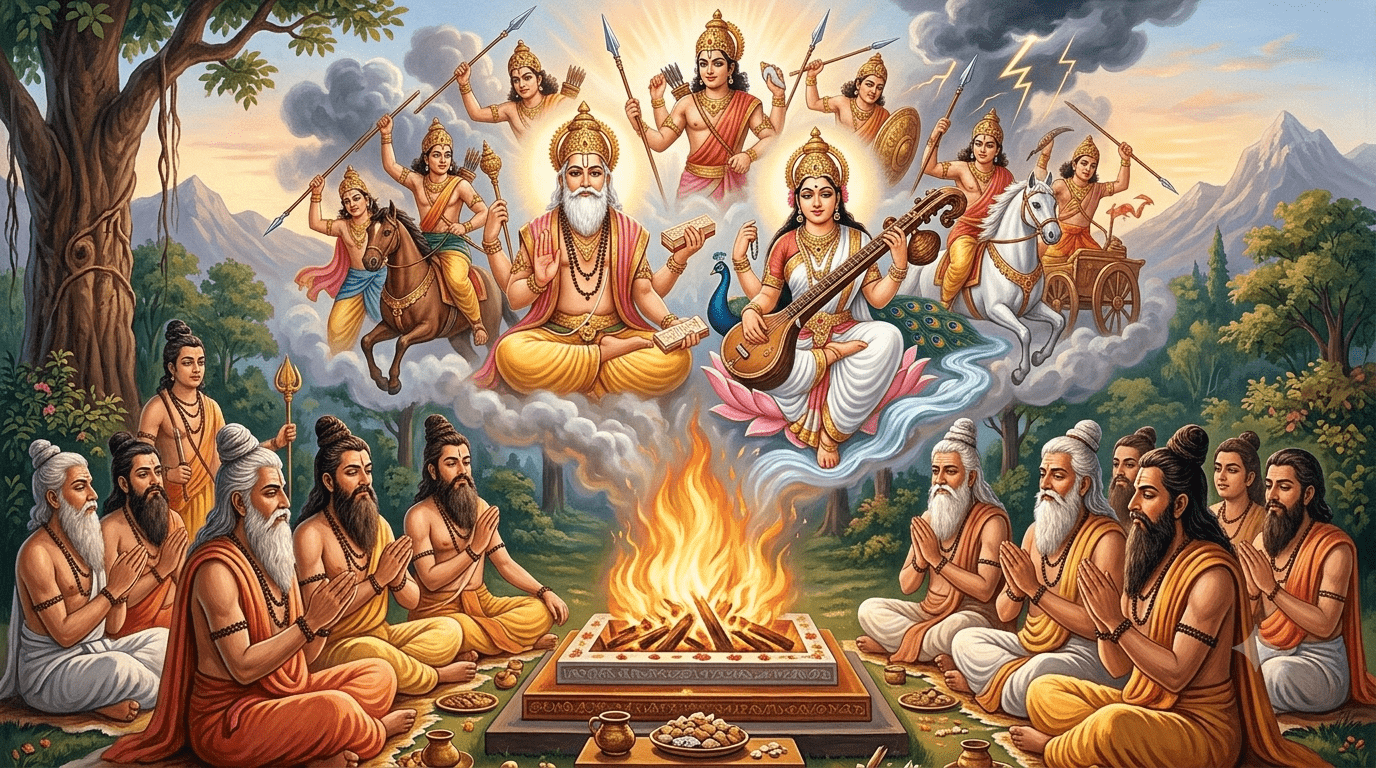
The venerable sage Śaunaka Gṛtsamada, inspired by the luminous vision of the Vedic seers, offers this exalted prayer in the majestic metres of Triṣṭubh and Jagatī, as preserved in the sacred hymns of the Rigveda. These metres, solemn and expansive, are fitting vehicles for truths that embrace both the cosmic order and the inward spiritual journey of humanity. In this hymn, the sage invokes Indra, Bṛhaspati, Sarasvatī, and the Maruts, seeking not only material abundance and protection but also the removal of all obstacles that hinder the free flow of divine energy within creation and within the human heart.
Indra, the radiant lord of thunder and rain, is praised as the source of vitality, brilliance, and invigorating power. He is the mighty slayer of Vṛtra, the great cosmic adversary who withheld the life-giving waters. In Vedic symbolism, these waters represent rain, rivers, inspiration, and the currents of consciousness. Their release signifies the restoration of movement where stagnation once prevailed. Scientifically, this image mirrors the hydrological cycle upon which all terrestrial life depends; spiritually, it reflects the liberation of inner energies when ignorance and fear are overcome.
The hymn declares that Indra existed before the manifested universe, indicating the primacy of divine intelligence over material formation. Aditi, the boundless mother of the gods, reveals to Indra the source that nourished Vṛtra, symbolizing the profound insight through which the roots of bondage are discovered. Only by understanding the origin of an obstacle can it be effectively removed. This principle resonates with both scientific inquiry and spiritual discipline: diagnosis precedes transformation.
The rivers, once released by Indra, flow unceasingly toward the ocean according to his divine intention. This portrays the universal law by which all energies move toward their destined fulfillment. Just as rivers descend by the force of gravity to merge with the sea, so every individual soul is drawn toward the infinite consciousness from which it arose. The Vedic seers perceived in nature not chaos, but purposeful order governed by ṛta, the eternal cosmic harmony.
Vṛtra had spread himself through the heavens and enveloped the material world, obstructing the circulation of life. Armed with the adamantine vajra, Indra shattered this constriction. The vajra, forged from concentrated power, symbolizes both the thunderbolt and the irresistible force of awakened knowledge. When Vṛtra rushed against Indra with gathered strength, he was struck down by divine precision. The lesson is enduring: no matter how formidable darkness appears, truth armed with discernment ultimately prevails.
Bṛhaspati, lord of sacred speech and spiritual wisdom, is then invoked. His weapon is likened to the vajra, for wisdom cuts through confusion as sharply as lightning cleaves the sky. He is asked to destroy the descendants of Vṛkadhara, representing those tendencies that prey upon righteousness and truth. The Vedic understanding is clear: eloquence rooted in truth possesses the power to dismantle falsehood and restore order.
The sage recalls Indra’s ancient victories and prays that the same strength be directed against present adversaries. Here, enemies are both external and internal. They include hostile forces in the world, but also pride, lethargy, fear, and doubt. Indra is invoked from the highest realms, where he hears the chants of the priests and hurls his stone-like thunderbolt into the lower regions to subdue destructive powers. This imagery reflects the descent of higher consciousness into the depths of human experience to transform what is hidden and unresolved.
The prayer seeks abundant descendants, thriving cattle, and lasting prosperity. In Vedic society, children ensured continuity, cattle represented wealth and nourishment, and a flourishing household reflected divine favor. On a deeper level, children symbolize noble actions, cattle symbolize rays of knowledge, and prosperity signifies fullness of life sustained by dharma.
Indra and Soma are implored to remove those who injure and divide the righteous. Soma, the sacred elixir, represents ecstasy, inspiration, and the bliss of communion with the divine. The place of fear is transformed into a fearless dwelling when courage and spiritual insight unite. This profound psychological insight remains universally relevant: where awareness and inner strength prevail, fear loses its dominion.
The sage prays that Indra not impose hardship or allow him to fall into idleness. Effort, discipline, and sacred work are indispensable to spiritual growth. The worshipper affirms unwavering devotion to the purification of Soma, trusting that Indra fulfills sincere aspirations, grants worthy gifts, and accepts the sacrificial offering. The imagery of cows gathering at the sacred enclosure evokes the convergence of life’s energies toward a center of purification and illumination.
Sarasvatī, goddess of wisdom, speech, and inspired understanding, is invoked for protection and victory. She empowers thought, language, and insight. Together with the Maruts and Indra, she overcomes forces of malice and confusion. The hymn recalls Indra’s destruction of the hostile Sundamarka, illustrating the triumph of heroic virtue over treachery and corruption.
Bṛhaspati is asked to search out hidden enemies and destroy them in every direction. These concealed adversaries may be subtle doubts, secret betrayals, or unnoticed weaknesses of character. The prayer reveals a remarkable psychological sophistication: true protection requires not only visible defense but also the exposure of hidden threats within and without.
Indra, the heroic protector, is requested to stand with the warriors and to transfer the wealth of the arrogant to the humble and deserving. Those blinded by pride are rendered powerless, for arrogance obscures judgment and invites downfall. Wealth, in this spiritual context, includes material resources, moral strength, and the fruits of wisdom.
Finally, the Maruts, youthful and dynamic powers of the atmosphere, are saluted with reverence. They represent energy, movement, and collective strength. Their manifested power is admired, and the sage prays for comfort, worthy offspring, and splendid riches that may be enjoyed with gratitude and responsibility. Their example teaches that vigor disciplined by harmony becomes a source of blessing for all.
This hymn stands as a magnificent synthesis of Vedic theology, spiritual psychology, and scientific observation. Rainfall, rivers, thunder, speech, and fertility are all perceived as expressions of a unified cosmic intelligence. The slaying of Vṛtra symbolizes the perennial victory of truth over obstruction, movement over stagnation, and illumination over darkness. Through devotion, wisdom, and disciplined effort, the seeker participates in this eternal triumph and becomes a conscious collaborator in the divine order that sustains the universe.