
M Radha Madhavi
India’s banking sector today tells a striking before-and-after story. A decade ago, banks—particularly public sector banks—were weighed down by a mountain of stressed and hidden loans. Today, their balance sheets are considerably healthier, capital positions stronger and the level of bad loans has fallen to a historic low.
The transformation did not happen by accident. It was the outcome of a painful clean-up that forced banks to recognise losses that had accumulated during the preceding boom years, strengthened the legal framework for dealing with defaulters and provided banks with the capital needed to absorb the shock.
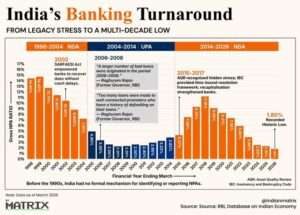
As former Reserve Bank of India Governor Raghuram Rajan noted, a larger number of bad loans were originated during 2006–2008, when India was experiencing a powerful investment and credit boom. In that period, banks extended large loans to infrastructure, steel, power and other capital-intensive projects. Some lending decisions were influenced by promoters with strong connections and, in certain cases, histories of default. When projects subsequently ran into trouble, banks often resorted to evergreening—rolling over or restructuring loans rather than recognising that they had effectively become non-performing.
The result was a problem that remained partly hidden on bank balance sheets.
The turning point came with the 2015 Asset Quality Review (AQR) undertaken by the RBI. Banks were compelled to identify stressed assets honestly instead of postponing recognition. This initially made the banking sector look worse, not better. Gross NPAs surged as previously concealed stress came into the open. But that painful disclosure was necessary. A problem cannot be solved when it is being disguised.
The next major pillar was the Insolvency and Bankruptcy Code (IBC), 2016. It fundamentally changed the approach towards corporate defaults by establishing a time-bound insolvency resolution mechanism. Most importantly, it altered the incentives of promoters. Default was no longer simply a matter of negotiating repeated extensions with lenders. Under insolvency proceedings, promoters could risk losing control of their companies, while creditors received a more structured mechanism to pursue recovery.
The clean-up was also supported by substantial government recapitalisation of public sector banks. Capital infusion gave lenders the capacity to recognise losses, write down bad assets and continue lending without being paralysed by weak capital positions. Consolidation of several public sector banks, improved governance, tighter supervision, better risk management and greater use of technology added further strength to the system.
Recoveries through insolvency proceedings, asset reconstruction mechanisms and other channels complemented these measures. Not every case resulted in full recovery, and the IBC itself has faced delays and operational challenges. Yet its importance lies not merely in the money recovered but in the credibility of the message it sent: persistent default would no longer be treated as an endless banking accommodation.
The numbers demonstrate the scale of the turnaround. Gross non-performing assets of scheduled commercial banks, which had climbed to a peak of 11.18 per cent, fell to just 1.80 per cent in March 2026, according to the latest banking-sector data. That is not a cosmetic improvement. It represents a fundamental repair of bank balance sheets.
The significance goes beyond the NPA ratio. Healthy banks are essential for economic growth because they can lend more confidently to businesses, infrastructure projects, entrepreneurs and households. When banks are trapped in bad loans, fresh credit suffers, investment slows and taxpayers are ultimately exposed to the consequences of repeated recapitalisation.
India’s banking clean-up therefore offers an important policy lesson. Recognition of bad loans may initially produce uncomfortable headlines and political criticism, but postponing recognition only makes the eventual correction more expensive.
The post-2015 clean-up was undoubtedly disruptive and painful. But it brought transparency to the banking system, strengthened creditor discipline and restored confidence in the ability of banks to lend.
The real achievement is not merely that NPAs have fallen from 11.18 per cent to 1.80 per cent. It is that India moved from concealing banking stress to confronting it.
The job, however, is not finished. Banks must guard against a return to politically influenced lending, weak due diligence and evergreening. Low NPAs should never become an excuse for complacency. The next challenge is to ensure that the lessons of the bad-loan crisis are institutionalised permanently.
India’s banking story has changed dramatically. The crisis exposed the cost of indiscriminate lending and delayed recognition. The clean-up demonstrated what transparency, accountability, capital support and credible insolvency mechanisms can achieve.
The message is simple: clean balance sheets are not just a banking achievement—they are the foundation for sustainable economic growth.