



Among the towering personalities who have walked the path of history, the world shall scarcely behold another like Bhishma. From every perspective, he appears a man of unblemished righteousness and immeasurable merit. Bound by an unwavering oath to the throne of Hastinapura, he stood in battle against those whom he loved most deeply on earth—the Pandavas, his own cherished kin. Though affection flowed in his heart for them as naturally as breath itself, his vow of loyalty to the royal seat compelled him to fight with relentless Vigor. Yet even while waging war, the grandsire, mindful of the welfare of society and the triumph of righteousness, had revealed the secret of his own destruction to those very enemies whom he opposed. Such a paradox of duty and compassion stirred profound questions of dharma within the hearts of the Pandava warriors.
Arjuna, in particular, found his spirit shaken by this grave dilemma. The thought that he must become the instrument through which the venerable Bhishma would meet his end weighed heavily upon his conscience. In quiet anguish he confessed his turmoil to his charioteer and eternal companion, Krishna. “When our father departed from this world,” Arjuna said with sorrow, “we were but helpless children. It was our grandsire who, through tireless effort and unyielding discipline, raised us and shaped us into warrior princes worthy of our lineage. The very person who has been more sacred to me than a deity now stands destined to fall beneath the arrows I release. What greater torment can there be for one bound by royal duty and righteous conduct?”
Arjuna continued with deep emotion, declaring that even if Bhishma, with the power of his sinews and the fury of his arrows, were to consume the Pandava armies like a raging fire, he would rather stand silent and endure the loss than betray the path of righteousness. “We are the brothers of Dharmaraja Yudhishthira,” he said, “the embodiment of virtue and merit. It is not in our nature to attain victory through cruelty or the violation of dharma.”
Krishna listened patiently and then replied with firm clarity. “In the harsh arena of war,” he said, “the duty of a warrior and a king is to confront the enemy without hesitation and remove every obstacle that threatens the stability of the realm. By such action alone can peace, prosperity, and order flourish among the people. The ancient law of kingship declares that rulers may rightfully collect a portion of the people’s wealth as tax, yet in return they must safeguard the welfare and growth of the kingdom. This code of royal conduct was proclaimed by Brihaspati himself to Indra. Therefore, O Arjuna, remember that you have openly vowed before the world that you would defeat Bhishma. If you now withdraw from that resolve, your words will appear hollow, and the people will mock your weakness. Whether directly or indirectly, Bhishma must fall, for the destiny of kingship demands it. Such an act, performed for the protection of the realm, cannot be called cruelty. Fate itself has ordained that you shall be the instrument through which Bhishma meets his end.”
Hearing this, Arjuna reflected for a moment and replied thoughtfully, “Sikhandi was born for the very purpose of ending Bhishma’s life. Bhishma has vowed never to fight one who was once a woman. If Sikhandi stands before him, the grandsire will refuse to shoot his arrows. I shall therefore strike down the other warriors while appearing to aim at Bhishma, and Sikhandi shall accomplish the destined task.” Krishna, however, laughed softly at Arjuna’s reasoning. “Bhishma’s prowess flows through his veins like blazing fire,” he said. “None but you possesses the skill to defeat him. Your wish to spare him will never be fulfilled. Fate cannot be evaded by clever thought. You yourself shall witness how destiny unfolds.”
Arjuna finally surrendered to the inevitable design of destiny. “So be it,” he said. “What is written by fate cannot be halted nor reversed.” With this acceptance, confidence returned to the hearts of Krishna and the Pandavas. They retired to their respective camps that night, and the decision of Arjuna to confront Bhishma brought relief to the entire army, allowing them to rest with renewed determination.
Sanjaya then narrated these events to the anxious king Dhritarashtra. Yet the king’s worry only deepened. He questioned Sanjaya with great urgency: “Tell me, how did the Pandavas arrange Sikhandi at the forefront of battle? How did they restrain the terrible advance of Bhishma upon the battlefield?”
Sanjaya began his report. At the break of dawn, the Pandava forces assembled in disciplined formation, ready to resume the terrible war. Strategically, they placed Sikhandi at the front of their ranks so that he would stand prominently before Bhishma. On either side of him stood the mighty Bhima and the peerless Arjuna, guarding him like vigilant sentinels. Behind them stood the valiant Abhimanyu along with the sons of Draupadi. On the flanks, the warriors Chekitana and Satyaki remained alert with weapons drawn. Dharmaraja Yudhishthira positioned himself slightly behind this vanguard, protected by Dhrishtadyumna, the sons of the Panchala king, and the twin warriors Nakula and Sahadeva. Further around them, King Virata, King Drupada, the five Kekaya princes, and Dhrishtaketu arranged their armies in a protective circle, forming a formidable shield against any external assault. Thus, the Pandavas established a magnificent and carefully crafted military formation.
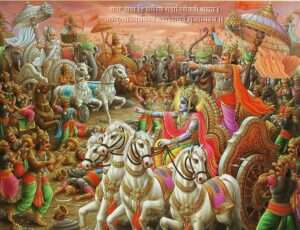
The Kaurava forces too, arranged themselves for battle with equal determination. At their head stood the venerable Bhishma, shining like a blazing star amid the ranks. Around him gathered the sons of Dhritarashtra, eager to guard their supreme commander. On the right flank stood Drona and his son Ashwatthama with a powerful contingent. At the front were Duryodhana, Kripacharya, and Kritavarma, while Duryodhana himself maintained a central position as part of the strategic design. The kings of Kamboja and Bruhadbala surrounded him, and behind them the king of Trigarta stood with his formidable forces.
Soon the two vast armies faced each other across the battlefield like opposing oceans ready to collide. The thunder of conches, kettledrums, and trumpets filled the air, mingling with the roaring cries of warriors eager for combat. Sanjaya described the spectacle to Dhritarashtra with grave intensity: “O King, the battle between the Kauravas and the Pandavas resembles the ancient wars between gods and demons. The gates of death in Yama’s kingdom stand wide open, receiving an endless stream of fallen heroes.”
Amid the raging conflict the twin warriors Nakula and Sahadeva fought with remarkable skill, breaking through the enemy lines and cornering the Kaurava forces. Bhima and Arjuna roared like lions and leapt simultaneously into the midst of the opposing army. The Pandava forces surged forward with unstoppable enthusiasm, their movement resembling the mighty currents of the ocean overwhelming the shore. Everywhere, the clash of weapons echoed—bowstrings twanged like thunder, arrows whistled through the sky, and spears and maces tore through the air with terrifying force. The battlefield trembled with the cries of elephants, the galloping of horses, and the shattering collision of chariots.
At that moment, Bhishma, surveying the field, began to unleash torrents of arrows that flashed like tongues of fire. Moving across the battlefield with the dreadful majesty of Rudra himself, he sent waves of destruction through the enemy ranks. Soldiers, elephants, horses, and chariots collided with unimaginable fury as the sound of combat reverberated across the plain.
Then Sikhandi sighted Bhishma and shot three arrows toward him. The grandsire looked upon him calmly and, with a gentle smile, spoke without anger. “Sikhandi, you were born as the daughter of King Drupada and later transformed into a man by divine will. Against one whose nature was once feminine, I shall not raise my weapons. Even if you attack me in pride and anger, I shall not strike back.”
These words ignited Sikhandi’s fury. “O Bhishma,” he replied sharply, “you have conquered countless kings and once stood as the equal of the great warrior Parashurama. Your fame and pride in your strength have spread throughout the world. Yet before me, you refuse to demonstrate your skill. If you possess even a fragment of that legendary prowess, then face me with your arrows. Otherwise, cast aside your bow and depart from this battlefield. Whether you respond or not, I shall strike you down today. What matters if I was born male or female? Before this day ends, I shall chase you until your proud reputation as the swiftest of archers fades into dust.”
With these fiery words, Sikhandi released five more arrows toward Bhishma. Observing this unusual boldness, Arjuna reflected that the final days of the grandsire must indeed be approaching. Encouraging Sikhandi with a touch of sarcasm, he said, “If you speak so boldly yet refrain from fighting, our declarations will appear empty before the world. While I stand beside you, who can possibly defeat you? Advance and confront Bhishma without fear.”
Meanwhile, Bhishma turned away from Sikhandi and charged toward the Panchala forces like a ravenous lion attacking its prey. The Pandava warriors, led by Arjuna, struck fiercely against the Kaurava army, causing many among them to retreat step by step in fear. Seeing this, Duryodhana rushed toward Bhishma and cried out in alarm, “Grandfather, before your very eyes our armies are falling into weakness and disorder.”
Bhishma answered with solemn composure. “Duryodhana, my vow to slay ten thousand warriors each day has been fulfilled. Through long years, you have enjoyed my protection and service. Now the debt I owed to the throne is nearly repaid. Listen carefully, O King. My strength is fading. Today, either I shall destroy the Pandavas, or I shall fall by their hands. They are protected by divine grace and cannot easily be slain by mortal power.”
With these words, Bhishma made it clear that victory ultimately belonged to the Pandavas. His loyalty had always been to the throne of Hastinapura rather than to the personal ambitions of Duryodhana. Thus, in the midst of the thunderous battlefield, the grandsire revealed the final truth of his destiny, while Sanjaya continued his solemn narration to the troubled king Dhritarashtra.

