



The mighty Bhūriśravā and the valiant Sātyaki confronted one another in a dreadful and furious encounter upon the field of Kurukṣetra, each accusing the other with harsh and piercing words born of ancient hostility and wounded pride. Then, like enraged elephants maddened in the wilderness, they rushed against each other, discharging ceaseless torrents of arrows that struck, tore, and drenched their bodies in blood. Their shafts shattered bows, slew steeds, and broke armour, while the clamour of their combat resounded like thunder among the armies. Long they fought with unconquerable spirit until, exhausted by toil and wounded in every limb, both warriors paused briefly to drink water and recover their strength. Thereafter they again advanced against each other with swords and shields, displaying marvellous dexterity in attack and defence. Their swiftly whirling blades clashed violently, scattering showers of fiery sparks, and the spectacle appeared like two blazing meteors colliding in the heavens.
Gradually Bhūriśravā gained the upper hand, and the discerning Sri Krishna, perceiving the peril of Sātyaki, addressed Arjuna with grave concern. “O foremost of the Pāṇḍavas,” said he, “Sātyaki has already exhausted himself by fighting through vast hosts of warriors, and now the son of Somadatta seeks to overpower him in single combat. The jewel of the Śini race came here solely for your sake, yet he has become trapped like a noble elephant surrounded by lions. It is your duty to protect him.” Even while Krishna spoke, Bhūriśravā hurled Sātyaki violently to the ground and stood over him with terrible courage and martial pride. Again Krishna urged Arjuna, saying, “While I stand beside you, it is not fitting that your beloved disciple should be humiliated and destroyed by the enemy.”
Arjuna, though deeply troubled, replied with the restraint of righteousness. “O Krishna, countless chariots surround us on every side, and Sātyaki and Bhūriśravā are engaged in lawful single combat, observing the ancient code of warriors. In such a situation it is not proper for me to strike him unfairly.” Yet after a moment he spoke again with sorrowful resolve. “Still, I cannot remain a witness to the destruction of my companion. I shall confront these warriors and save Sātyaki from death.”
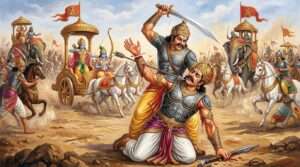
Meanwhile Bhūriśravā seized the exhausted Sātyaki by the neck with one hand and cast him forcefully upon the earth. Pressing his foot against the hero’s chest, he raised his gleaming sword aloft, while the jewelled bracelets upon his wrist flashed brilliantly in the sunlight. The Kaurava army roared in savage delight, crying aloud, “Slay him! Sever his head! Cut him to pieces!” The uplifted arm of Bhūriśravā, bearing the shining sword, appeared like the banner of Indra raised amidst storm clouds. Seeing the imminent danger, Krishna hastened Arjuna once more to act without delay.
Arjuna, though admiring the magnificent courage and chivalric splendour displayed by Bhūriśravā of the Kuru race, at last released a keen and infallible shaft. The arrow flew with lightning swiftness and severed the arm that held the sword. The mighty limb fell writhing upon the earth like a wounded serpent, and a cry of grief arose from the Kaurava hosts at this sudden reversal of fortune. Bhūriśravā, overcome with indignation, turned toward Arjuna and spoke with bitter reproach. “O Arjuna, while I was engaged elsewhere and had not even cast my eyes upon you, you struck me from afar in violation of the honourable conduct of warriors. Who taught you such ignoble craft? Was it your preceptor Droṇa, your father Indra, or Rudra who bestowed upon you the Pāśupata weapon? Surely Damodara himself encouraged you toward this sinful and dishonourable deed.”
Arjuna calmly answered the wounded hero. “When kings engage in battle, it is no unrighteous act for allies and kinsmen to come to one another’s aid. Why do you condemn me while failing to rebuke your own commanders who could not protect you from my arrow? You sought to slay Sātyaki when he was exhausted and weakened from endless combat, and you humiliated him while I yet lived. How could I permit my companion to perish before my eyes? Moreover, you all joined together in the cruel and unrighteous slaughter of Abhimanyu.”
Hearing these words, Bhūriśravā fell silent. Then Arjuna, filled with compassion and wishing to remove the grief lodged within the warrior’s heart, spoke gently once more. “O noble soul, though this act may appear blameworthy, the duty of a Kṣatriya compelled me to act thus. Reflect also upon my solemn vow and upon the evil root from which all these calamities have sprung. Suyodhana alone is the cause of these disasters. He shall surely descend into darkness, while your place among the heavens is assured.”
Thereupon Bhūriśravā released Sātyaki completely and, casting aside all desire for earthly combat, spread arrows upon the ground with his remaining hand and sat in meditation, preparing himself for the final journey. Yet Sātyaki, consumed by wrath and unable to master the fury born of humiliation and the memory of Abhimanyu’s slaughter, suddenly rose with sword in hand and severed the head of Bhūriśravā, despite the loud cries of Krishna, Arjuna, Bhīma, Aśvatthāma, and Karṇa imploring him to desist. Thus the son of Somadatta ascended to the celestial regions amidst the blessings of Siddhas and Cāraṇas. When reproached for his act, Sātyaki reminded all present of the unrighteous destruction of Abhimanyu and declared that no mercy had then been shown to the helpless youth.
Among the Kaurava warriors arose murmurs of sorrow and reflection. Many lamented that such an end should never have befallen Bhūriśravā, yet they acknowledged that wrath drives men toward deeds beyond the bounds of reason and virtue. Those who had once suffered insult and injury at Bhūriśravā’s hands now found themselves unable to restrain vengeance when opportunity appeared before them.
Then, as Sañjaya narrated these events to the blind monarch Dhṛtarāṣṭra, the king expressed astonishment. “Droṇa, Kṛtavarmā, and many other mighty warriors could not conquer Sātyaki. How then was he humiliated by Bhūriśravā of the Kuru line?” In response, Sañjaya explained the ancient cause lying hidden behind the conflict between the houses of Śini and Somadatta.
In the illustrious lunar race there arose the great king Yayāti, from whom descended Devamīḍha of the Yadu clan. From that lineage came the noble prince Śūra, whose son was Vasudeva, father of Krishna. In earlier days King Devaka had proclaimed a svayaṃvara for his daughter Devakī. Then the mighty Śini of the Yādava race defeated all assembled princes and carried away Devakī for Vasudeva. Somadatta, seeking the bride, challenged Śini to combat and fought fiercely against him. Yet Śini overcame him utterly, seized him by the hair, cast him upon the earth, and humiliated him with kicks before sparing his life. Burning with shame, Somadatta retired to the forests and performed severe austerities to Lord Shiva. Pleased with his penance, the great god appeared before him and granted a boon. By that time Śini himself had passed away, and therefore Somadatta prayed for a son who would one day humble the grandson of Śini. Shiva granted the boon, and through that divine favour Bhūriśravā gained the power to humiliate Sātyaki upon the battlefield.
Thereafter Sañjaya resumed his narration of the war. Following the death of Bhūriśravā, Arjuna once more directed his chariot toward Saindhava, while Aśvatthāma and other mighty warriors moved to obstruct his advance. Karṇa then fiercely confronted Sātyaki, and a terrible duel commenced between them. Sañjaya further related the hidden events preceding that day’s battle. The omniscient Sri Krishna, foreseeing the danger awaiting Sātyaki at the hands of Bhūriśravā, had secretly instructed his charioteer Dāruka on the previous night. “Tomorrow,” said Krishna, “Partha must fulfil his terrible vow. Therefore keep my celestial chariot prepared for battle, and when you hear the sound of the Pāñcajanya, bring it without delay.”
At the appointed hour Krishna blew the sacred conch, and immediately Dāruka arrived with the divine chariot yoked to the celestial steeds Śaibya, Sugrīva, Meghapuṣpa, and Balāhaka, while the mighty banner of Garuḍa shone brilliantly above it. Krishna entrusted that glorious chariot to Sātyaki himself. Karṇa stood astonished at the sight, while Krishna instructed Sātyaki in the strategy of battle and sent him forth in support of Arjuna. When Sātyaki advanced, Karṇa confronted him with great pomp and challenge. Seeing this, Arjuna smiled and said to Krishna, “Karṇa, unable to endure the death of Bhūriśravā, has now turned against Sātyaki. Yet our purpose is the destruction of Saindhava, and we must not delay ourselves by becoming entangled in Karṇa’s wrath.” Krishna replied confidently, “Sātyaki is equal to Karṇa in valour, skill, and strength. Moreover, his protectors and wheel-guards remain ever vigilant around him. Therefore cast away all anxiety concerning him.”
Then Krishna drove the chariot swiftly toward Saindhava, while the terrible duel between Karṇa and Sātyaki captivated the gaze of all warriors upon the field. Even the celestial hosts gazed down in wonder and spoke among themselves, saying, “Never among gods or demons has such a battle been witnessed. Rare indeed is such splendour of courage, skill, and unconquerable heroism as displayed by these two mighty warriors.”

