



Sanjaya said, “O King Dhritarashtra, countless warriors assembled in carefully devised battle formations and engaged one another with relentless fury. The charging elephants, galloping horses, and rushing chariots raised such immense clouds of dust that the sun itself seemed hidden beneath a gloomy veil. Soon, however, torrents of blood flowing from elephants, horses, and fallen warriors drenched the battlefield, weighing down the dust and revealing the dreadful spectacle once again. The swift precision and irresistible courage of the Pandava warriors steadily shattered the confidence of the Kaurava ranks. Though Duryodhana moved tirelessly among his soldiers, urging them to stand firm, fear had already begun to spread through their hearts.”
Amid the raging conflict, Dharmaraja struck Kripacharya with three sharp arrows and, with unfailing aim, slew the horses of Kritavarma’s chariot. Ashwatthama quickly rescued Kritavarma, placing him upon his own chariot and carrying him safely away. Witnessing Dharmaraja smash Kritavarma’s chariot, Duryodhana’s anger swelled beyond measure. Burning with wrath, he dispatched seven hundred mighty chariots to encircle Dharmaraja and overwhelm him from every direction.
Shikhandi, beholding the foremost warriors before him, advanced with astonishing zeal. Like a tempest sweeping through a fragile grove, he crashed into the Kaurava chariot divisions, breaking both their formations and their spirit. His fearless assault filled the Pandava army with renewed confidence while casting fresh despair upon the enemy.
Sanjaya continued, “O King, dreadful meteors streaked across the heavens and countless inauspicious omens appeared before our warriors. Yet Shakuni dismissed every warning. Inflamed by arrogance, he rallied the troops, declaring, ‘I shall strike the Pandavas from behind and slay Dharmaraja. Whoever dares to oppose me shall perish at my hands.’”
While King Shalya struggled desperately on the front lines and gradually yielded before the relentless Pandava advance, Shakuni marched with ten thousand cavalry to attack the rear of the Pandava army. Raising his voice above the clamour of battle, he cried, “Why should you fear while I stand among you?” His bold words revived the shaken Kaurava soldiers and momentarily disturbed the Pandava ranks.
Perceiving Shakuni’s movement, Dharmaraja calmly turned to Sahadeva and commanded, “Take five thousand horsemen, together with the sons of Draupadi, and confront Shakuni without delay.” Without the slightest hesitation, Sahadeva accepted the command and executed the plan with flawless discipline. A terrible battle followed. Warriors hurled maces, spears, and javelins with tremendous force. Some grappled like seasoned wrestlers, throwing one another to the ground; others clashed with flashing swords, while many leapt upon their foes and crushed them beneath irresistible blows. The field echoed with countless forms of combat, each fiercer than the last.
Sahadeva’s rising courage shook the confidence of his adversaries. Though Shakuni commanded six thousand horsemen, Sahadeva, leading merely two thousand cavalry, matched that superior force through extraordinary skill, unwavering resolve, and unmatched martial spirit. Shakuni then turned his attack upon Dhrishtadyumna, who answered every assault with fearless courage and noble valour.
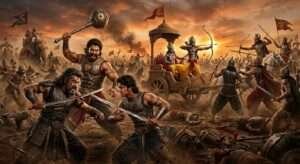
Before long, over five thousand three hundred horses lay lifeless upon the field. Broken weapons, shattered chariots, severed limbs, and crushed bodies covered the earth. Flesh, bones, and blood mingled into a dreadful mire, making it impossible to distinguish man from beast. Such was the terrifying condition of the battlefield that even the bravest warriors trembled at the sight. Hope faded from many hearts as heaps of mangled bodies lay scattered across the plain. “O King,” said Sanjaya, “only seven hundred horses remained from our side, while Shakuni escaped under the protection of the few surviving warriors.”
Seeking Duryodhana, Shakuni asked the fleeing soldiers where their king could be found. They pointed towards the royal umbrella, radiant like the full moon above the crowded lines of chariots. “Behold,” they said, “there stands your king, shining amidst the foremost warriors, delighting in the sport of battle.” Reaching him, Shakuni proudly declared, “I have leapt upon enemy chariots and destroyed their horses. I shall now strike with even greater speed against the sons of Pandu. No man who clings to life can conquer them. First destroy their elephants and chariots; then their infantry will crumble with ease.”
Inspired by these words, the Kaurava army regained a measure of confidence. Duryodhana himself surged forward with renewed vigour, driving fiercely against the Pandava divisions, while triumphant cries once again arose from his soldiers.
At that moment Arjuna addressed Krishna, saying, “Behold, Duryodhana advances with determined purpose. Guide my chariot directly towards his army. Today I shall consume his forces beneath a relentless shower of arrows.” Krishna, ever serene amidst the storm of war, drove the celestial chariot without pause as the terrible conflict continued into its eighteenth day.
Arjuna reflected deeply, saying, “This ocean-like Kaurava army has now dwindled to the measure of a cow’s hoof through the power of my bow. The sons of the blind king, intoxicated by wealth and pride, invited this calamity upon themselves. Had they listened to the noble Bhishma after his fall, peace might have prevailed. That great soul offered them wise counsel, yet wicked Duryodhana rejected every word. Even after Bhishma’s fall, Krishna advised that further war against us was neither righteous nor beneficial. Only then did I fully realise that Duryodhana and his companions were blind to wisdom.”
He continued, “The deaths of Bhagadatta, Jayadratha, and the mighty kings who sought to protect him, the fall of Drona, the destruction of Dushasana and his brothers, and even Karna’s death alongside his kinsmen failed to awaken understanding in Duryodhana’s heart. Even after witnessing the fall of Shalya, he refuses to acknowledge the strength and righteousness of Dharmaraja. Such is the unbending nature of his misguided mind. Why should we grieve? So long as Duryodhana lives, he will never surrender even a portion of the kingdom to Dharmaraja, whose destiny is to protect the people. Therefore, the final act of this great struggle must now be completed.”
Krishna replied, “When I came seeking peace, Vidura asked why I had undertaken such a mission, for he knew Duryodhana’s nature well. That arrogant prince possesses neither the wisdom to discern right from wrong nor the humility to abandon his wicked pride. War alone remained the path before us, for he would never yield even the smallest measure of land while breath remained within him. Vidura revealed these truths long ago. Moreover, at Duryodhana’s birth, the sages foretold that he would become the cause of the destruction of countless kings.”
Arjuna answered solemnly, “Everything has unfolded exactly as those enlightened seers predicted. Only when Duryodhana witnesses the ruin of all who stood beside him, and finally falls himself, shall Dharmaraja rightfully regain the kingdom. That alone is truth. Let him first behold his own helplessness and the collapse of his pride. Drive swiftly, Krishna, for I shall shatter what remains of his army.”
Then Arjuna blazed across the battlefield like a consuming forest fire. Mighty elephants stood like ancient trees, splendid chariots resembled a dense woodland, swift horses spread like thick undergrowth, and countless warriors appeared as intertwined creepers. Krishna became the irresistible wind that fanned the flames, while Arjuna’s celestial arrows devoured the vast forest of the Kaurava host. The heavens watched in silent wonder as the blazing tempest scattered the opposing army in every direction.
Thus, with unwavering clarity and solemn precision, Sanjaya narrated every movement of that dreadful day to the grief-stricken King Dhritarashtra, revealing both the terrible grandeur of war and the inexorable march of destiny.

