
Seshadri Venkateshwaran
Orangenews9 has consistently highlighted the mismanagement in the Hyderabad Cricket Association (HCA), bringing public attention to the recurring judicial interventions in its affairs. However, this is not an isolated HCA phenomenon. Similar situations have surfaced in several cricket associations and sports federations across the country, raising a fundamental question: who should ultimately be held responsible for the deteriorating standards of sports administration?
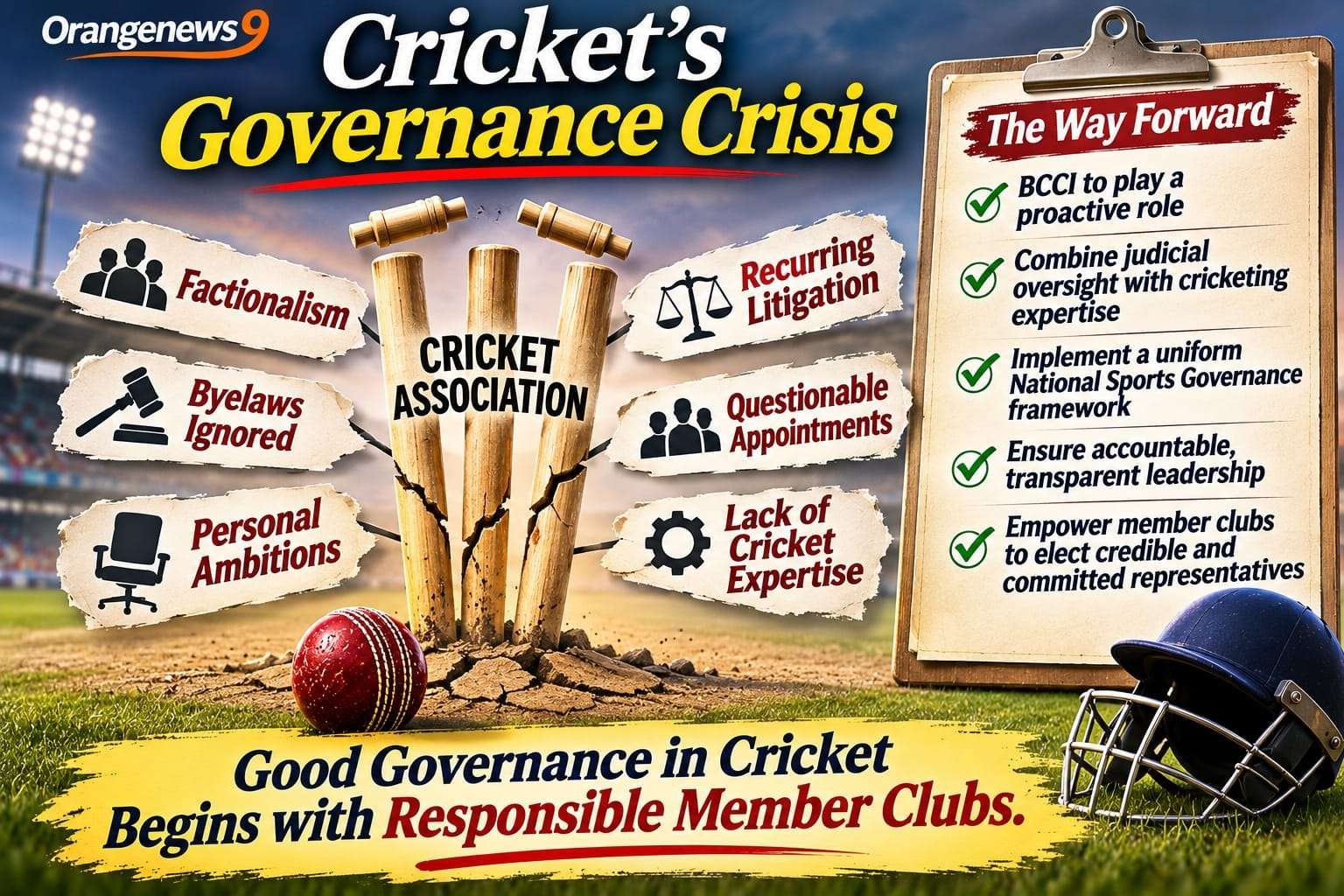
In my considered opinion, the primary cause is the factionalism that has become deeply entrenched in several associations. Individuals and groups, often driven by personal ambitions and vested interests rather than the development of the game, tend to turn cricket administration into a battleground for power and control. While every association has individuals with varying intentions, the problem becomes particularly acute when office-bearers disregard the very bye-laws and regulations that govern their institutions.
An association’s constitution and bye-laws are not ornamental documents to be invoked selectively to suit individual convenience. They are the foundation on which its administration, elections, decision-making and accountability must rest. When established procedures are bypassed, constitutional provisions are selectively interpreted and decisions are taken without transparency, disputes become inevitable. Eventually, disgruntled groups approach the courts, turning internal administrative differences into prolonged legal battles.
However, I would not place the entire responsibility on elected office-bearers. Even court-appointed committees are not necessarily immune to administrative shortcomings. A retired judge heading such a committee may bring considerable judicial experience, integrity and credibility to the assignment. But judicial eminence alone cannot substitute for practical knowledge of cricket administration. The functioning of a cricket association involves complex sporting, financial, organisational and institutional responsibilities that require specialised understanding.
Also read: https://orangenews9.com/my-response-to-who-ruined-indian-cricket/
There is also the larger question of those who surround and advise such committees. If individuals with questionable credentials, or those facing allegations of impropriety, are entrusted with important administrative responsibilities, the very purpose of judicial intervention could be undermined. Allegations must, of course, be independently examined and should not be treated as established facts. Nevertheless, the selection of people assisting court-appointed administrators must be guided by transparency, proven competence and credibility. Otherwise, changing the person at the top may not necessarily change the system at the grassroots level. This, unfortunately, appears to be one of the concerns confronting the HCA today.
In my view, the Board of Control for Cricket in India (BCCI), as the parent body of affiliated state associations, must accept a more proactive role in addressing such recurring crises. Rather than remaining a distant observer while disputes escalate into litigation, it should facilitate institutional solutions. Courts could also consider taking the assistance of experienced cricket administrators, wherever appropriate, to ensure that sporting expertise complements judicial oversight. The objective should not be to undermine judicial authority but to create an administration that understands both the law and the game.
Also read: https://orangenews9.com/my-conter-who-really-changed-indian-cricket/
The proposed National Sports Governance framework also offers an opportunity to bring greater transparency, accountability and uniformity to sports administration. However, legislation or regulations alone cannot transform institutions. Their provisions must be implemented sincerely and consistently, without selective application or exceptions for influential individuals and organisations.
Ultimately, however, I believe the greatest responsibility rests with the member clubs. They are the foundation and voting constituents of an association. They cannot remain passive spectators, complain about mismanagement and then repeatedly elect individuals whose credentials, intentions or administrative capabilities are questionable. Their voting rights carry a corresponding responsibility. They must choose representatives based on integrity, commitment, experience and a genuine interest in developing cricket.
Judicial intervention may become necessary when institutions fail to put their houses in order. But courts cannot be expected to administer cricket associations indefinitely. Nor can the BCCI alone guarantee good governance if the clubs themselves fail to discharge their responsibilities.
The real solution lies in restoring institutional discipline, respecting bye-laws, ensuring accountable leadership and placing the interests of cricket above personal ambitions. Unless member clubs recognise this responsibility, the cycle of factionalism, mismanagement and litigation will continue, irrespective of who occupies the administrator’s chair. (The author was former Secretary of HCA)