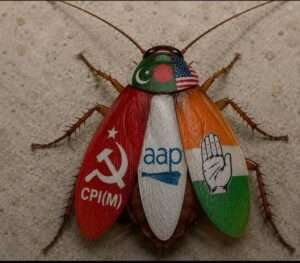

The biggest casualty of selective activism is credibility. The Cockroach Janta Party (CJP), which rode to national prominence by championing the cause of students during the NEET-UG paper leak controversy, now finds itself trapped by an uncomfortable question of its own making: Does its outrage stop where Congress governments begin? For months, CJP projected itself as the uncompromising voice of Bharat’s youth. Its leaders occupied television studios, organised protests at Jantar Mantar, mobilised students from across the country and relentlessly attacked the Narendra Modi government over examination failures. The campaign was so aggressive that it eventually culminated in the resignation of Union Education Minister Dharmendra Pradhan. The slogan was simple—students deserve justice. Apparently, that slogan comes with terms and conditions. Today, students raising concerns over examination controversies in Opposition-ruled (AAP) Punjab and the ongoing Congress-ruled Jharkhand Public Service Commission (JPSC) irregularities are discovering what selective politics looks like. The decibel levels have dropped. Television cameras have vanished. Protest marches are nowhere to be seen. The moral indignation that once dominated prime-time debates has evaporated almost overnight. Why? What changed? Did examination integrity suddenly cease to matter? Or is accountability demanded only when the government under attack happens to be led by the BJP? These questions are becoming impossible to ignore. A movement that claims to represent students cannot conveniently distinguish between students based on the political colour of the government they happen to be protesting against. Justice cannot wear party colours. Fairness cannot have electoral preferences. If a paper leak or recruitment irregularity is unacceptable in one state, it is unacceptable in every state. If students deserve solidarity in Delhi, they deserve the same solidarity in Ranchi and Punjab. Anything less is hypocrisy dressed up as activism.
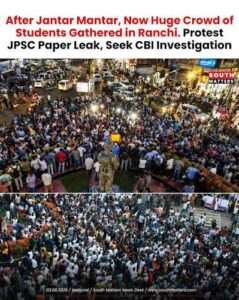
Equally disturbing is the studied silence of the Congress and its allies. They enthusiastically weaponised the NEET controversy to corner the Union government. They stalled Parliament for the entire week. Every alleged lapse became proof of administrative collapse. Every student protest became a political opportunity. But where is that passion now? Where are the press conferences? Where are the protest marches? Where are the social media campaigns proclaiming that the future of Bharat’s youth is at stake? Silence, it appears, has become the preferred political strategy. This selective morality exposes the uncomfortable truth behind much of today’s political activism. Principles are loudly advertised when they damage political opponents and quietly abandoned when they threaten political friends. That is not public service. That is political opportunism. The timing only deepens the suspicion. Punjab heads towards Assembly elections early next year. Understandably, embarrassing a Aam Admi Party government, which is an ally of Congress, may not fit the Opposition’s electoral script. But if electoral arithmetic dictates moral outrage, then the movement ceases to be about students and becomes merely another instrument of partisan politics. Bharat’s students deserve far better than that. They are not disposable props to be summoned for one protest and forgotten in the next. Their future cannot become collateral damage in the cynical calculations of political parties searching for convenient narratives. Every deserving candidate denied a fair opportunity suffers the same injustice, whether the examination is conducted in Bihar, Jharkhand, Punjab or anywhere else in the country. The pain of an aspirant does not change with the party in power. Nor should the demand for accountability. The CJP must now answer the question it once posed to everyone else. Will it stand with every aggrieved student, irrespective of which party governs the state? Or will it continue to measure injustice with two different yardsticks—one for political adversaries and another for political allies? Because if outrage depends on the party in power, then it is not outrage at all. It is political choreography. And Bharat’s students deserve better than actors performing selective indignation on a political stage.