



The conflict between Saudi Arabia and Houthi rebels is one of West Asia’s most serious security challenges. The conflict is a result of Yemen’s long-running civil war, political instability, regional power struggles, and international strategic interests. The conflict escalated after Houthi rebels seized the Yemeni capital, Sana’a, in 2014. The intervention of a Saudi-led military coalition in March 2015 transformed the conflict from a domestic political crisis to a regional security challenge. Although diplomatic efforts have attempted to de-escalate tensions, the conflict remains a serious threat to humanitarian security, maritime trade, and regional stability.
The primary cause of this conflict is Yemen’s political instability and weak governance. Widespread protests during the 2011 Arab Spring forced President Ali Abdullah Saleh to step down. His successor, Abdrabbuh Mansur Hadi, failed to establish an effective and inclusive regime. Corruption, unemployment, economic inequality, and weak government institutions weakened the political system. As a result, competition increased among various armed groups and political forces, creating favorable conditions for the expansion of the Houthi movement.
The second major reason is the Houthi movement’s political and social grievances. The Houthi movement, also known as Ansar Allah, emerged from the Zaidi Shia community in northern Yemen. Its supporters protested political neglect, economic underdevelopment, and religious-cultural marginalization. Over time, the movement evolved into a powerful armed organization. Although its roots lie in Yemen’s domestic environment, its military expansion and conflict with rival political groups further exacerbated the country’s instability.
The Houthis’ capture of the capital, Sana’a, in 2014 marked a turning point in the conflict. They subsequently expanded their influence in several other areas of the country, weakening the internationally recognized Yemeni government and disrupting the political transition process. Saudi Arabia viewed this development as a serious security challenge near its southern border. Sharing a long border with Yemen, Saudi Arabia feared that the Houthi expansion could impact its regional security and strategic interests.
Saudi Arabia’s security concerns are another significant factor in the conflict. The Houthis’ missile and drone attacks on Saudi territory, targeting military installations and critical infrastructure, have escalated tensions between the two sides. In March 2015, Saudi Arabia intervened militarily to curb the Houthis’ growing power and support the recognized Yemeni government. While the stated objective of this intervention was to restore the Yemeni government, the prolonged military campaign further complicated the resolution of the conflict.
A broader geopolitical factor in this conflict is regional competition between Iran and Saudi Arabia. Iran has provided various levels of political, technical, and military support to the Houthi movement. Saudi Arabia views this as a threat to growing Iranian influence near its southern border. Although the Houthi movement has its own domestic roots and independent political priorities, the Iran-Saudi rivalry has given the conflict a broader regional dimension. Thus, Yemen has become a major center of internal political conflict as well as power competition in West Asia.
The conflict has had serious consequences for regional peace and security. Its most visible impact is the humanitarian crisis. The prolonged war has displaced large numbers of people and exacerbated problems such as food insecurity, malnutrition, and lack of health services. Hospitals, schools, water supply systems, and other public facilities have been damaged. Weak governance and economic crisis have made life more difficult for ordinary citizens. Such circumstances can also create opportunities for the expansion of militant organizations and illicit activities.
Another major impact has been on maritime security. Yemen’s geographical location is highly strategic, being near the Bab-el-Mandeb Strait. This strait connects the Red Sea to the Gulf of Aden and provides a vital route for trade between Asia and Europe via the Suez Canal. The Houthis’ targeting of commercial vessels and maritime traffic has impacted the security of international shipping. Increasing attacks in the Red Sea, particularly since late 2023, have prompted many shipping companies to seek alternative routes. Travel time, fuel costs, and transportation costs have increased as ships circumvent the southern tip of Africa.
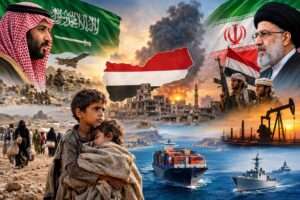
The third impact has been on energy security. West Asia is a major hub for global oil supplies, and security incidents there can impact international energy markets. The attacks on Saudi Arabia’s Abqaiq and Khurais oil installations in 2019 exposed the vulnerabilities of critical energy infrastructure. It would be unfair to attribute these attacks solely to the Saudi-Houthi conflict, but they did highlight the broader risks associated with regional instability. The threat of attacks on energy installations increases oil price uncertainty, increases insurance costs, and increases the risk of disruptions to global supply.
Fourth, the impact has been on the regional balance of power and international relations. The conflict has deepened distrust between Iran and Saudi Arabia and increased the role of outside powers in West Asia. The increased use of missiles, drones, and other advanced weapons has intensified military competition. This has forced regional countries to devote greater resources to their defense systems, intelligence capabilities, and maritime security. Furthermore, the conflict’s expansion could lead to broader regional tensions, impacting counterterrorism cooperation and other diplomatic efforts.
Its impact on global trade is also significant. The Red Sea and Suez Canal routes are vital to international supply chains. Insecurity in the region could increase the cost of transporting goods, delay supplies, and put additional pressure on import-dependent economies. Rising transportation costs for food, fuel, and industrial goods could exacerbate economic challenges, particularly for developing countries.
A lasting solution to this conflict lies in an inclusive political process and regional diplomacy, rather than military action. It is essential to advance meaningful dialogue between the Houthi movement, the recognized Yemeni government, and other relevant parties, under UN mediation. Issues related to political representation, power-sharing, security arrangements, and the equitable distribution of national resources must be resolved. Furthermore, dialogue and confidence-building measures between Saudi Arabia and Iran must be strengthened. Progress toward improving relations between the two countries can be leveraged to establish peace in Yemen by 2023.
Additionally, it is essential to ensure an effective ceasefire, the uninterrupted supply of humanitarian aid, and the protection of civilians. The international community must cooperate, in accordance with international law, to maintain the security of sea lanes and freedom of navigation. Creating employment opportunities, rebuilding the economy, and strengthening accountable governance institutions are equally important for long-term peace in Yemen.
In conclusion, the Saudi-Houthi conflict demonstrates how domestic political instability, regional rivalries, and external interference can transform a local crisis into a broader international security challenge. Its consequences extend beyond Yemen’s borders, affecting humanitarian well-being, maritime trade, energy security, and the stability of West Asia. Lasting peace requires an inclusive political solution, Saudi-Iranian dialogue, respect for international law, and continued cooperation for Yemen’s reconstruction. A peaceful, stable, and sovereign Yemen is not only in the interest of its citizens, but also essential for the security of the entire region and the world.


