



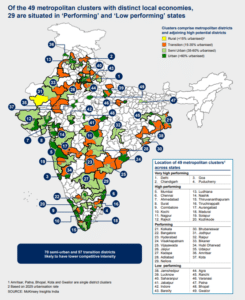
Bharat’s ambition to become a developed nation by 2047 demands a fundamental rethink of how its cities are planned, governed and prepared for the future. Economic growth cannot be sustained by infrastructure spending alone. It requires enduring institutions capable of converting scientific evidence into sound policy, investment into public value, and urbanisation into an opportunity rather than an environmental and administrative crisis. When the Indian Institute of Science was established in 1909, its founders understood that scientific excellence required a locally rooted institution with a long-term vision. The Tata Institute of Fundamental Research followed the same tradition. Both became world-class institutions because they were built to outlast individuals and governments. Bharat now needs comparable institutional ambition in metropolitan planning. The stakes could hardly be higher. Projections indicate that 70 per cent of Bharat’s economic growth will emerge from just 49 metropolitan regions or clusters. The National Capital Region spans three states and ten cities, while the Mumbai Metropolitan Region covers over 6,328 square kilometres and includes nine municipalities. These sprawling economic ecosystems cannot be planned effectively through fragmented municipal decisions or the changing priorities of successive administrations. The employment challenge makes this imperative even more urgent. Bharat’s working-age population is expected to increase by at least 12 million annually until 2039. As globalisation gives way to strategic realignment and manufacturing supply chains are reconsidered, Bharat must capture opportunities in manufacturing while strengthening its position in finance, technology and artificial intelligence. Cities must generate productive employment, attract investment and develop skills. Without coordinated metropolitan planning, this demographic advantage could become a missed opportunity. NITI Aayog’s Growth Hub (G-Hub) initiative, piloting dynamic economic masterplans for Surat, the Mumbai Metropolitan Region and Visakhapatnam, offers a promising direction. Collaboration among academia, governments and industry associations can help translate development plans into implementable projects, supported by reliable data and institutional continuity. Such initiatives must become the foundation of a wider transformation, not remain isolated experiments. Over the next decade, Bharat’s cities will require more than $840 billion in capital infrastructure investment. The question is not merely how much money will be spent, but whether it will create lasting economic and social value. Poorly conceived projects can damage biodiversity, worsen air and water quality, and lock cities into expensive, unsustainable development patterns. The consequences of planning failures may persist long after the officials responsible have moved on.
Mumbai’s air pollution illustrates the complexity. Pollution levels are shaped by meteorology, transport emissions, construction dust, waste burning and chemical reactions involving locally emitted pollutants. Tackling the problem requires trained specialists, properly maintained monitoring systems, consistent data archives and scientific modelling. Similar institutional capacity is essential for water management, land ownership, town planning and urban mobility. Without it, governments will continue reacting to symptoms instead of addressing causes. The administrative structure compounds the problem. Municipal commissioners and district collectors typically serve three to five years, while complex urban transformation requires decades. Municipal bodies must simultaneously manage roads, healthcare, education, water, sanitation and waste management. Under such pressure, immediate service delivery inevitably competes with long-term planning. When officials leave, institutional memory often leaves with them, forcing successors to reinvent the wheel. Metropolitan development authorities, meanwhile, concentrate heavily on major infrastructure such as metros, expressways and airports. Regional economic coordination, research, skill development and environmental monitoring need equally serious attention, but often lack dedicated institutional leadership. Bharat can learn from international examples. New York’s Regional Plan Association has worked for nine decades on metropolitan prosperity and sustainability. San Francisco’s SPUR brings diverse stakeholders together to advance civic solutions and better planning. Brazil’s ARIES has developed a long-term strategic vision for Recife, while Mexico’s CAMe coordinates air-quality and environmental management across metropolitan jurisdictions. These examples demonstrate that independent, locally anchored institutions can complement governments without replacing them. Seeded by philanthropy, supported by private enterprise and research partners, and embedded in local governance, they can preserve data, attract expertise, assess outcomes and convert evidence into investment-ready proposals. The time for institutional improvisation is over. Philanthropic capital must help establish and endow these institutions. Industry must recognise that productive cities are essential to talent, competitiveness and growth. Governments must provide access, accountability and sustained cooperation. Viksit Bharat 2047 cannot be built on five-year administrative horizons when its challenges demand generations of thinking. Strong metropolitan institutions will help Bharat anticipate disasters, confront climate risks, manage public-health emergencies and create cities worthy of their citizens. The choice is clear: build institutions that outlast governments, or continue paying for the failures of short-term thinking.

