



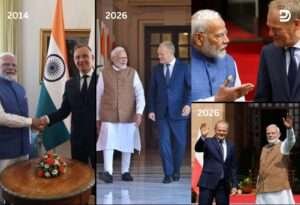
The defining feature of Narendra Modi’s foreign policy is not the number of countries he visits, the agreements he signs or the grand receptions he receives. It is the increasingly visible effort to make Bharat a friend, partner and indispensable stakeholder across geographical and ideological divides. In a world increasingly fractured by wars, rivalries, protectionism and competing power blocs, Modi’s New Bharat is pursuing a foreign policy that places national interest above ideological compulsions. The message is simple: Bharat would rather build bridges than burn them. The emerging Northern European engagement offers an interesting illustration of this diplomatic strategy. What might appear to be a series of bilateral visits, diplomatic exchanges and commercial agreements is actually part of a larger strategic design. From Sweden and Denmark to Finland, Norway, Estonia, Latvia, Lithuania and Poland, Bharat has steadily expanded its engagement with countries that possess advanced technologies, industrial capabilities, strategic locations and considerable economic potential. These are not merely ceremonial friendships. They are partnerships being built around defence modernisation, cybersecurity, artificial intelligence, semiconductors, quantum computing, space technology, advanced manufacturing, ports and connectivity. The pattern is particularly significant because these countries occupy an increasingly important position in Europe’s security architecture. With NATO strengthening its northern flank and European nations stepping up defence expenditure, Bharat’s growing engagement opens opportunities for defence manufacturing, technology transfers, joint research and co-production. Poland, which has emerged as a major European defence spender, is an especially important partner. Prime Minister Donald Tusk’s October 2026 visit to Bharat, accompanied by around 100 business leaders, demonstrated the growing commercial and strategic appetite on both sides. The proposed defence industry dialogue, startup cooperation and the Pixxel-Scanway partnership in advanced space technology underline the possibilities. But Bharat’s European outreach is not confined to defence. The conclusion of negotiations for the Bharat-European Union Free Trade Agreement on January 27, 2026, represents a potentially transformative milestone. The combined economic weight of the two sides is estimated at $24 trillion, while Bharat-EU merchandise trade had already reached $136.54 billion in 2024-25. European technology and capital, when combined with Bharat’s manufacturing capacity, skilled workforce and expanding consumer market, could create opportunities that neither side can unlock as effectively on its own.
The May 2026 elevation of Bharat-Sweden relations to a Strategic Partnership and the third India-Nordic Summit’s decision to deepen cooperation in green technology and innovation further reinforce this approach. India’s interest in Arctic research, maritime connectivity and the Northern Sea Route also reflects an understanding that tomorrow’s economic and strategic opportunities will increasingly extend beyond traditional geographical boundaries. What makes this diplomacy particularly interesting, however, is Bharat’s ability to engage countries with competing geopolitical interests without surrendering its own strategic autonomy. Bharat courts NATO members and deepens its European security engagement, yet keeps its longstanding strategic relationship with Russia intact. Cooperation with Moscow in defence, energy, space and Arctic development continues even as New Delhi expands its partnerships with Washington, Brussels and other Western capitals. Critics may call this diplomatic tightrope-walking. In reality, it is a recognition that international relations are not a school debating competition in which countries must choose one side and permanently oppose the other. This is where Modi’s national-interest doctrine assumes significance. Bharat is neither interested in becoming anybody’s junior partner nor in allowing external pressures to dictate its choices. Its position on the Ukraine conflict, its continued purchase of Russian energy and its growing defence cooperation with Western nations demonstrate that strategic autonomy is not merely a slogan. It is being practised, sometimes amid considerable diplomatic discomfort. The economic and defence dimensions reinforce this confidence. Bharat’s defence exports touched a record ₹38,424 crore, approximately $4.6 billion, in FY2025-26. This is a remarkable indication of the country’s transition from being predominantly an arms importer to an emerging defence manufacturing and exporting nation. Of course, signing agreements is easier than translating them into tangible outcomes. Technology transfers, investments, market access and joint manufacturing will ultimately determine whether these diplomatic initiatives deliver. Bharat must also ensure that its growing international partnerships create employment, strengthen domestic capabilities and benefit Indian industry rather than remain impressive entries in diplomatic communiqués. Nevertheless, the larger direction is unmistakable. From Europe to the Gulf, from the United States to Russia, from Africa to the Indo-Pacific, Bharat is widening its diplomatic footprint and diversifying its strategic options. Modi’s New Bharat is signalling that it has neither permanent enemies nor unquestioning allies, only enduring national interests. In an increasingly polarised world, the ability to speak to adversaries, cooperate with competitors and build friendships across continents could prove to be Bharat’s greatest diplomatic asset. The objective is not to join every camp, but to make every camp recognise India’s importance. Bridges, after all, are far more useful than walls.

