



Day and night are verily the Prajapati, of which day is prana and night is matter. Those who unite in love during the day waste their prana. Those who unite in love at night are as good as celibacy.
Spirituality is like science, applicable to all classes of people. If science has invented a medicine, it has to be universally accepted to all. Similarly, spirituality is for entire humanity.
Very few people are designed to be a brahmachari. The majority of humankind is meant to be a householder (grihastha. This mantra gives you the path to live a life of celibacy while being a grihastha. Based on our purva janma past birth’s unintelligent actions, we are born with certain vasanas in this embodiment. Spirituality is to deal with your vasanas with present intelligent actions. There is a cause and effect principle. Past actions create present vasanas; present actions determine your future course of vasanas. So make good use of leading a life befitting your current situation so that you handle the vasanas and evolve.
Shastras have time and again given the solution that vasanas can be exhausted either by pure knowledge or through experience. When you experience it, be very mindful and conscious that you are getting into it out of no choice. If you disregard the vasana, it will frustrate you. When you do not have the wisdom, you will not be able to exhaust the knowledge and the vasana, as ignorance will persist. Where there is light, there will be no darkness. If darkness persists, then there is no light. Where there is wisdom, there is no avidya ignorance) in the form of vasanas. Since vasanas are there, you cannot burn it with knowledge; you have no choice but to enter into experience very cautiously.
Many orthodox people in the spiritual field consider going through an experience itself as vice. It is not vice to go through an experience, but getting to get carried away and lost in the experience is true vice.
The three vices one does while going through an experience are:
Craving – Before the experience, one is constantly craving for the enjoyment. There is an obsession, a thirst as if it is the only purpose of life. The mind is constantly worshipping worldly objects and enjoyment.
Indulging – While experiencing, people are recklessly indulging as if there is no next moment.
Lingering – After the experience, you keep lingering in the joys you have derived from sensual activities.
These three are non-essentials of experience, makes you materialistic and sensuous. When these three vices are taken care, then one can evolve through experiences. So, one has to wisely and intelligently go through the experience. Experience it without craving, indulging, and lingering. This is the path of a householder for practising spirituality.
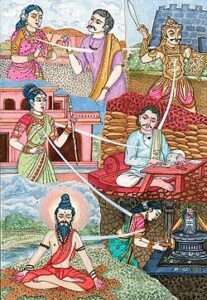
You will then burn of the vasanas and since you are performing intelligent actions, you will also not create fresh vasanas. This is karma yoga. You can use the vasanas as a means to exhaust the vasanas. Using action to get rid of the impediment of action.
However, one should not use experience to justify one’s vasana. The spirit is not to get carried away by vasana, but experiencing it because you have no choice.
Mantra 14
अन्नं वै प्रजापतिस्ततो ह वै तद्रेतस्तस्मादिमाः प्रजाः
प्रजायन्त इति ॥ १.१४॥
annaṃ vai prajāpatistato ha vai tadretastasmādimāḥ prajāḥ
prajāyanta iti .. 1.14..
Food is verily Prajapati; from that indeed arises the human seed; from that all creatures are born.
The Upanishad started with the student Kabandi asking the Guru Pippalada whence these creatures are born? Where has this pluralistic phenomenon come from?
In the beginning, the Guru said Prajapati, who is the creator, expressed out of his own power prana and matter. Then the northern route, southern route, six months of the sun, six months of the moon, the fortnightly, day and night. Further, he brings it down to the level of procreation; he is the food and is responsible for the human seed. From the Spirit, he has come down to matter, food. Everything is nothing but Prajapati. We are eating food; the food produces the human seed, and new creatures are born. This verse is similar to the following verse in the Bhagavad Gita:
ब्रह्मार्पणं ब्रह्महवि र्ब्रह्माग्नौ ब्रह्मणा हुतम् ।
ब्रह्मैव तेन गन्तव्यं ब्रह्मकर्मसमाधिना ॥
Brahmaarpanam brahmahavir brahmaagnau brahmanaahutam
Brahmaiva tena gantavyam brahmakarmasamaadhinaa
The act of offering is Brahman, the oblation is Brahman, offered by Brahman in the fire of Brahman, by seeing Brahman in action, Brahman verily shall be reached by him.
Everything is nothing but Brahman alone. Prajapati says, ‘I created the world, I give the desire to procreate, I have given the seed to procreate, I am responsible for producing creatures.’ Brahman is responsible for everything and yet in the entire experience we are not remembering the Prajapati / Brahman. We are not even aware that Brahman is responsible for everything. We claim that we are the creator. We are unmindful, ungrateful of the role Brahman is playing in our life.
Awareness is tantamount to Bhakti/devotion. Bhakti is an awareness of the role of Providence in our life which nullifies our ego. Understanding this concept is jnanam, and it expresses as awareness, which is bhakti. So knowledge jnanam and bhakti devotion are closely related. Jnanam triggers bhakti, and bhakti supplements or complements jnanam. Jnanam and bhakti are two sides of the same coin. One who has true jnanam will have bhakti, and true bhakti will have jnanam.
Mantra 15
तद्ये ह वै तत् प्रजापतिव्रतं चरन्ति ते मिथुनमुत्पादयन्ते ।
तेषामेवैष ब्रह्मलोको येषां तपो ब्रह्मचर्यं येषु सत्यं
प्रतिष्ठितम् ॥ १.१५॥
tadye ha vai tat prajāpativrataṃ caranti te mithunamutpādayante .
teṣāmevaiṣa brahmaloko yeṣāṃ tapo brahmacaryaṃ yeṣu satyaṃ
pratiṣṭhitam .. 1.15..
Thus, those who observe the vow of Prajapati produce a pair. For them alone is the Brahmaloka in whom penance, celibacy and truth abide.
This Upanishad is a Brahmanopanishad and conveys an explanatory message to a grihastha. The guru gives the path for self-control. This mantra advises having a pair, which is self-control, tapas. These messages were not understood for generations, and that licentious indulgence has created overpopulation of humanity. Vedic master have conceived it long ago. When you have self-control, you will then uphold Prajapati, invoke Brahman, and lead a life of celibacy. One who leads such a life of self-control is practising tapah, brahmachary, and satyam even if he is a householder. Such people attain Brahmaloka, an elevated spiritual state. If you violate this principle, you will go to pitruloka.
Mantra 16
तेषामसौ विरजो ब्रह्मलोको न येषु जिह्ममनृतं न माया चेति ॥ १.१६॥
teṣāmasau virajo brahmaloko na yeṣu jihmamanṛtaṃ na māyā ceti .. 1.16..
Thus, the pure Brahmaloka is to them only in whom there is no deceit, falsehood and hypocrisy.
The 15th & 16th mantras give qualities that should be practised if you want to elevate spiritually. In the 15th mantra, the Guru spoke about tapas penance, brahmacharya celibacy and leading a life of satyam truthfulness. In the 16th mantra, the Guru tells us not to lead a life of deceit, falsehood, and hypocrisy. One should lead a life of truthfulness for themselves and not be concerned about others’ opinions.
Deceit is leading a life by cheating others and being dishonest.
Falsehood is living in a way that distorts reality.
Hypocrisy is leading a life based on others’ opinions and not true to one’s nature. We pretend to be something else whom we are not.
If you avoid these three things deceit, falsehood, and hypocrisy you are on the path of Brahmaloka.
The spiritual bliss of elevation is for those who practise the qualities mentioned in mantra 15 and avoid the qualities indicated in mantra 16. There is no compromise but to lead a life of satyam. The best way to understand satyam is to uphold your conscience. To confront your conscience is to violate satyam, which is to lead a life of deceit, falsehood, and hypocrisy. Your conscience should support what you are doing. When there is discomfort in any action, then you are not on the path of satyam.
This Chapter Prashna 1 ends with this mantra. This chapter established that the entire pluralistic world has risen from Prajapati who is the creator. A sequential explanation of how the various manifestations have all emerged from Prajapati. The prana consumes matter in the outer world. Everything in the outer world is Prajapati and that is prana, energy. This chapter does not explain how the prana is operating within an individual.
इति प्रश्नोपनिषदि प्रथमः प्रश्नः ॥
iti praśnopaniṣadi prathamaḥ praśnaḥ ..
The second chapter explains how Prajapati, Brahman, plays a role within the body of each individual in every experience you go through. The sum total of endless experiences is what we call it as life.
The next question is asked by the sishya Bhargava. The question is what are the factors involved in bringing about an experience. The Guru answers in 13 mantras.
An experience comes about when the subject comes in contact with the object. The subject is the individual and the object is the world. When the individual comes in contact with the world, there is an experience. The previous section analysed the object. Now this section analyses who an individual is. The factors in an individual that are responsible for an experience are organs of perception, organs of action, mind, and intellect. Organs of perception jnana indriyas are eyes, ears, nose, tongue, and skin. Then there are the karma indriyas, instruments of action: hands, feet, speech, organs of elimination, and reproduction.
The instrument of perception has to be backed by the mind, and the instrument of action has to be backed by the intellect. Objects send the stimuli. All these four have to come together to have an experience.
Mind should back the perception of eyes/ears, for an experience to see/hear. While you are engaging the organs of action, say, speaking it is supported by intellect. If you are not conscious of what you are saying, it will not make sense. The conscious ability is the intellect. One is to receive the world, and the other is to process it and respond to the world. That makes an experience complete.
The next question is: what is the presiding deity, who are the devas controlling all these that are happening within me? Above these 4 instruments, the Guru is talking of five elements – space, air, fire, water, earth. These five elements are the five presiding deities of the instrument of knowledge. How they command and control your experiences, and how this body is governed by Prajapati.
Q: How does mind back the sense of perception and intellect back the organs of action?
A: The job of the senses is to receive the stimuli from the world; the mind, which receives the stimuli, is like the clerk in an organisation. The mind should send to the intellect, which is compared to the head of the organisation. The intellect assesses it and responds to the world through the organs of action. This cycle of stimuli coming from the world, received by the mind, processed by the intellect, response through the organs of action makes a complete cycle of experience. Above these are the five elements, Pancha boothas, controlling it. How these Pancha boothas, or the devas, are lording the senses is the second question by sishya Bhargava to the Guru Pippalada.

