



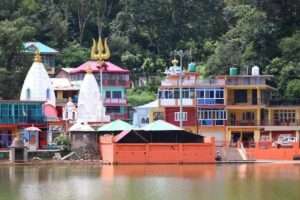
Lomesh Rishi Temple, also known as Lomash Rishi Temple, is situated beside the beautiful Rewalsar Lake in Mandi district of Himachal Pradesh. Rewalsar is one of the rare sacred places in India revered by Hindus, Buddhists and Sikhs. Around the lake are Hindu temples, Buddhist monasteries, and the historic Rewalsar Sahib Gurdwara, making this a remarkable centre of spiritual harmony. The Himachal Pradesh Government identifies the shrine at Rewalsar as the Lomesh Rishi Temple, a Shiva temple associated with the sacred tradition of Sage Lomesh.
The exact age of the present temple structure is not known. However, the sacred tradition of Rewalsar and its association with Lomesh Rishi is ancient, with the site mentioned in the Skanda Purana tradition.
The principal deity of the temple is Maharishi Lomesh, worshipped as the great sage who performed intense penance at Rewalsar. The temple also has a close association with Lord Shiva, because according to the sacred tradition, Shiva and Goddess Parvati appeared before Lomesh Rishi after being pleased with his severe penance.
The main idol of Lomesh Rishi is traditionally represented in a seated meditative posture, reflecting his identity as a great yogi and ascetic. The temple is therefore distinctive among Hindu shrines because the principal object of worship is a revered Rishi rather than a conventional form of a major deity.
The temple is a simple traditional Himalayan shrine located close to Rewalsar Lake. Its architecture is modest compared with the larger stone temples of Mandi, with its importance lying mainly in its sacred association with Lomesh Rishi and the spiritual landscape surrounding the lake.
Rewalsar has been an important sacred centre for centuries. The District Mandi administration specifically records its mention in the Skanda Purana as a sacred pilgrimage place. The place subsequently became important in Buddhist tradition because of its association with Guru Padmasambhava, while Sikh tradition connects Rewalsar with Guru Gobind Singh, who stayed here during his visit to the hill states.
This makes Rewalsar much more than the location of a single temple. It is a sacred landscape in which three religious traditions developed around the same lake. The Lomesh Rishi Temple represents the Hindu layer of this long spiritual history.
According to the sacred tradition associated with the Skanda Purana, the story of Rewalsar begins with Maharishi Lomesh, a great sage who was seeking a peaceful and spiritually powerful place for deep meditation.
During his journey, Lomesh Rishi climbed Drona Mountain. From its heights, he saw a beautiful lake surrounded by forests, flowers and birds. Captivated by the serenity of the place, he descended the mountain and reached its banks. The sacred tradition identifies this place as Hridayeshwar.
Recognising the spiritual power of the surroundings, Lomesh Rishi decided to remain there and began severe tapasya to Lord Shiva. Days turned into years as the sage remained absorbed in meditation, seeking only the grace of Mahadeva.
Pleased with his unwavering devotion, Lord Shiva appeared before Lomesh Rishi along with Goddess Parvati and blessed him. The divine appearance transformed the lake and its surroundings into a sacred pilgrimage place, and the site came to be associated forever with the sage’s penance.
This is why Rewalsar is remembered as the tapasthali of Lomesh Rishi. The lake is not merely a beautiful Himalayan water body in Hindu tradition; it is regarded as a sacred place sanctified by the tapasya of a great Rishi and the blessings of Shiva and Parvati.
Centuries later, Rewalsar acquired an even wider spiritual significance. Buddhists associate the lake with Guru Padmasambhava, while Sikhs associate the place with Guru Gobind Singh. Thus, the same sacred landscape came to be revered by three faiths, making Rewalsar one of the most unique pilgrimage centres of the Himalayas.
The main festival is the annual Baisakhi fair, when Baba Lomesh Rishi and Mata Naina Devi are taken in a traditional procession around Rewalsar Lake. Devotees also take a holy dip in the lake and offer prayers at the temple.


