



As the great war approached its decisive hour, Karna’s chariot rolled toward destiny under the guidance of the Madra king Salya. Though Duryodhana had appointed Salya to strengthen Karna’s spirit, Salya chose instead to speak with uncompromising honesty. Before the assembled warriors, he reminded Karna that the venerable Bhishma, the preceptor Drona, and the mighty sage Parasurama had repeatedly declared the immeasurable prowess of Arjuna and the unfathomable majesty of Sri Krishna. Those great souls had witnessed the irresistible power of the son of Pandu and the divine supremacy of Vasudeva. Salya declared that no warrior, however celebrated, could lightly dismiss such testimony. Even if Lord Shiva Himself were imagined apart from His own divine purpose, none could diminish the invincible union of Krishna and Arjuna, for they stood together as the eternal instruments of righteousness. Therefore, Salya urged Karna to abandon vain confidence, gather the warriors, and fight with sobriety, for his brilliance before Krishna and Arjuna would resemble the faint glow of a firefly before the radiance of the midday sun.
Karna listened without lowering his pride. His voice remained firm as he answered that he was not ignorant of the greatness of Krishna and Arjuna. He knew well their strength, their divine favour, and their unmatched skill in battle. Yet, knowing all this, he would never withdraw from combat. Whatever words others might utter, he had resolved that either he would survive or they would remain alive, but not both. He asked Salya to abandon discouraging speech, for the hour demanded valour rather than fearful counsel.
Then Karna raised his voice so that every king and warrior might hear the burden hidden within his heart. He confessed that the memory which truly distressed him was not the strength of Krishna or Arjuna but the dreadful curses pronounced by Parasurama and by the grieving Brahmin. He declared that truth should now be spoken openly, for those assembled were about to share either his victory or his destruction.
Karna recounted how, desiring to master the highest science of celestial weapons, he journeyed to Mahendragiri and sought instruction from the illustrious sage Parasurama. When the sage inquired about his lineage, Karna, consumed by his longing to obtain the Brahmastra, concealed his true birth and declared himself to be a Brahmin. Pleased by his discipline, devotion, and unwavering dedication, Parasurama accepted him as a disciple. Under that incomparable master, Karna mastered the profound mysteries of archery, received many celestial weapons, the invincible Bhargavastra, and finally the sacred Brahmastra itself, which his guru instructed him to employ only when confronted by overwhelming danger.
One day, as Parasurama rested with his head upon Karna’s lap, a fierce insect pierced deeply into Karna’s thigh. The pain was unbearable, and blood flowed freely, yet Karna did not move lest his revered teacher’s sleep be disturbed. When Parasurama awoke and saw the stream of blood, he questioned his disciple in astonishment. After hearing the account, the sage declared that such endurance could never belong to a Brahmin. Only a Kshatriya possessed such extraordinary fortitude in suffering. Pressed by his master, Karna confessed the truth of his birth. At that moment he also suspected that the strange insect had been no ordinary creature but Indra himself, assuming that form to secure the future victory of Arjuna.
The revelation ignited the wrath of Parasurama. Feeling deceived, the great sage pronounced an irreversible curse. He declared that when Karna faced the gravest peril and most needed the Brahmastra, the sacred knowledge would vanish from his memory. The mighty Bhargavastra likewise would fail him in the decisive moment. Only when death approached would that forgotten knowledge return, too late to alter his destiny.
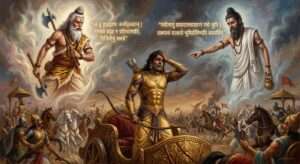
Karna then narrated the second calamity that shadowed his life. During his training in archery, one of his arrows accidentally struck and killed the beloved calf of a Brahmin. Overcome with grief, the owner cursed him in fierce indignation. He proclaimed that just as the innocent calf had fallen helplessly, so too would Karna perish while engaged in battle. At the very moment when victory seemed within reach, the wheel of his chariot would sink into the earth, rendering him vulnerable before the very warrior whom he desired to destroy. Thus would he fall by the hands of his greatest enemy.
Terrified by the Brahmin’s words, Karna sought forgiveness with unmatched generosity. He offered one thousand cows, six hundred mighty bulls, one hundred splendid chariots, seven hundred elephants, one hundred maidens, and immeasurable wealth besides. Bowing repeatedly, he implored the Brahmin to withdraw the curse and accept his repentance. Yet grief had hardened the Brahmin’s heart. Rejecting every gift, he turned away in anger. Before departing, he looked back and solemnly declared that his words could never be revoked. Nevertheless, he granted Karna one consolation, assuring him that although the curse would surely be fulfilled, it would not prevent him from attaining the higher worlds after death. That alone would be his atonement.
Having revealed these hidden wounds, Karna proclaimed that neither Krishna nor Arjuna inspired fear within him. Even if Indra, Yama, and Kubera were to unite against him with all their celestial weapons, his courage would remain unshaken. At that very moment, he declared that the memory of the Brahmastra had returned to him. He commanded Salya to drive directly toward Arjuna. There he would display the full measure of his archery. He boasted that he would become a mighty barrier against the ocean-like torrents of Arjuna’s arrows, eclipse the brilliance of the Gandiva with the clouds of his own shafts, pour down like a storm to quench the blazing fire of Arjuna’s wrath, and stand like an immovable mountain against the tempestuous force of Partha. Lost in the intensity of his resolve, he proclaimed that among all warriors, none except himself could truly challenge the peerless son of Pandu.
Salya silently observed these passionate declarations. Beneath Karna’s boldness, he discerned a mind shaken by the memory of inescapable curses. He realized that Karna’s confidence was no longer unbroken, for truthful reminders of Arjuna’s excellence had weakened the warrior’s heart. Salya inwardly rejoiced, believing that his promise to Yudhishthira had been fulfilled. By discouraging Karna at the crucial hour, he had faithfully discharged the duty entrusted to him.
Sanjaya, recounting these events to King Dhritarashtra, described how the earlier parable of the crow and the royal swan continued to torment Karna’s mind. Unable to forget the comparison, Karna turned angrily toward Salya and rebuked him. He accused the Madra king of portraying him as a contemptible crow while exalting Arjuna as a majestic swan. Such words, Karna declared, were unworthy of a friend. Only ignoble men delighted in harsh and wounding speech. Although Salya possessed the freedom to utter such cutting comparisons, Karna refused to be shaken by them. He asked why, in the presence of kings, Salya continually praised the valor of Arjuna instead of encouraging the warrior whose chariot he guided.
Karna declared that in the midst of battle, one who glorified the enemy deserved punishment. Yet he restrained his anger solely because Duryodhana had entrusted Salya with the sacred responsibility of serving as his charioteer. Remembering the ancient saying that even a few sincere words establish lasting friendship, Karna reflected with deep gratitude upon Duryodhana’s unwavering affection. That friendship, forged through loyalty rather than convenience, remained the dearest treasure of his life. Though Salya’s words disturbed his heart, Karna resolved that he would honor his beloved friend by striving with all his strength to defeat Krishna and Arjuna. Only then, he believed, would the world acknowledge the power of his mighty arms.
Thus Sanjaya portrayed to the blind king the tragic condition of Karna, a hero of immeasurable generosity and extraordinary valour, yet bound by the inexorable chains of fate. At the very moment when he most needed encouragement, the voice beside him became a constant reminder of his limitations. Between unyielding destiny, relentless curses, wounded pride, unwavering friendship, and indomitable courage, Karna advanced toward the battlefield where glory and destruction awaited together, fulfilling the mysterious decree that had long been written by destiny.

