



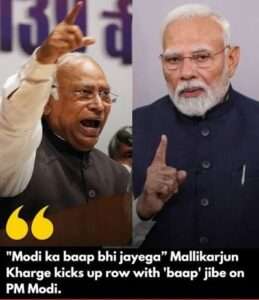
Mallikarjun Kharge’s “Modi ka baap bhi jayega” remark is more than an unsavoury political barb. Coming from a septuagenarian Congress president, it is an indictment of the political culture of a party that once claimed to set the standards of parliamentary democracy. When a leader of his stature descends to such language against Prime Minister Narendra Modi, it raises a fundamental question: has the Congress run out of arguments and resorted to abuse as its last political weapon? Decency, decorum and disagreement are indispensable to democratic politics. The Congress of Mahatma Gandhi, Sardar Patel and Jawaharlal Nehru, whatever its shortcomings, produced leaders who understood that political opponents were not personal enemies. Atal Bihari Vajpayee exemplified the same tradition in the Opposition. Even Indira Gandhi, Rajiv Gandhi and Manmohan Singh operated within a political culture in which Parliament was expected to be a forum for argument, not a battleground for personal insults. That tradition is fast disappearing from the Congress. Kharge’s remark is not an isolated lapse but part of a disturbing pattern of rhetoric that has repeatedly damaged the party’s credibility. The Congress briefly appeared to regain political ground in the 2024 Lok Sabha elections, increasing its tally from 52 seats in 2019 to 99. Its campaign, amplified by Rahul Gandhi, sought to portray the BJP as a threat to the Constitution and reservations. But the electoral gains failed to translate into a sustained political revival. Subsequent setbacks in state elections exposed the limits of a strategy built more on attacking Modi than presenting a compelling alternative. Internal factionalism and the collapse of Congress governments in Madhya Pradesh and Rajasthan further underlined the party’s organisational weaknesses. Instead of introspection, the leadership appears to have chosen confrontation. The 56-year-old Rahul Gandhi—hardly a political novice after years in public life—continues to dominate the party’s narrative, yet has struggled to establish himself as a credible alternative to Modi. The Prime Minister’s sarcastic observation that Rahul had been launched and relaunched more often than ISRO’s missions captured the frustration surrounding this seemingly endless political experiment. Kharge’s outburst fits this larger pattern. When the party president himself sets such a tone, it is hardly surprising that other leaders follow suit, mistaking invective for political courage and personal abuse for mass appeal. The Congress seems to have forgotten that voters elect governments to address their concerns, not to witness a daily exchange of insults.
This culture did not begin with Kharge. Mani Shankar Aiyar’s description of Modi as neech during the 2017 Gujarat election campaign, accompanied by the disparaging reference to his humble origins as a tea seller, became a political liability for the Congress. Sonia Gandhi’s “maut ka saudagar” jibe against Modi in 2007 similarly backfired. Other Congress leaders have made objectionable remarks about Modi’s family and background. Rahul Gandhi, too, has faced legal consequences over his own remarks, including the loss of his Lok Sabha membership before the Supreme Court stayed his conviction in the defamation case. These episodes should have served as warnings. Instead, the pattern persists. The larger problem is the Congress leadership’s apparent inability to distinguish legitimate criticism from reckless rhetoric. A democracy requires a robust Opposition, not a submissive one. But an Opposition that cannot challenge the government without resorting to personal abuse risks becoming irrelevant. Constitutional institutions, including the judiciary and the Election Commission, must be scrutinised where warranted, but their legitimacy cannot be dismissed merely because their actions do not suit a party’s political interests. Nor can the Congress expect to win public confidence by treating every electoral defeat as evidence of institutional conspiracy or every political disagreement as a personal vendetta against Modi. Allegations of questionable political dealings must be established through evidence, not rhetoric. The same standard applies to claims about foreign interference or political understandings with hostile neighbours. Modi’s popularity at home and his growing international profile may frustrate the Opposition, but neither fact makes him immune to scrutiny. The Congress is entitled—indeed, obliged—to question his policies. What it cannot do is substitute insults for arguments and expect the electorate to reward it. With crucial Assembly elections approaching, the party would do well to remember that voters are concerned about jobs, prices, development, welfare and governance—not the verbal excesses of political leaders. Kharge’s remark may excite partisan audiences, but it offers no answer to these concerns. The Congress once helped shape Bharat’s political destiny. Today, it risks shrinking its own relevance through a politics of resentment, dynastic dependence and personal abuse. If Kharge believes that invoking Modi’s father will weaken the Prime Minister, he may discover that the only political institution being diminished is his own party. A party that cannot reinvent itself, restrain its rhetoric or move beyond one family’s leadership cannot blame its opponents for its decline. By digging political graves for its rivals, the Congress may well be digging its own kabar.

