

India’s refining capabilities are attracting renewed international attention, with the country’s sophisticated oil-processing infrastructure emerging as a strategic asset amid shifting global energy supplies. The spotlight is now on Gujarat’s Jamnagar refinery complex, whose technological capabilities could help India process some of the world’s most difficult crude grades, including Venezuela’s heavy, sulphur-rich oil.
US Secretary of State Marco Rubio recently described India as a “refining superpower” and urged greater processing of Venezuelan crude by Reliance Industries. His remarks underline an important reality: India is not merely a major consumer of imported petroleum but also a global refining centre with the capacity to convert diverse crude grades into commercially valuable fuels.
A global refining giant
India ranks as the world’s fourth-largest refining nation, behind the United States, China and Russia. According to the Centre for High Technology, the country’s installed refining capacity stood at approximately 258.1 million tonnes per annum (mtpa) as of April 2025, equivalent to roughly five million barrels per day. Subsequent industry estimates put capacity at around 5.6 million barrels per day, depending on the reporting period and conversion assumptions.
This infrastructure has an economic purpose beyond meeting domestic demand. Indian refineries produce petrol, diesel, aviation turbine fuel, LPG and petrochemical feedstocks, while exports of refined products generate foreign exchange and support India’s position in international energy markets.
The country’s refining capacity has expanded substantially over the past two decades, supported by investment in large-scale facilities, modern processing technology and integrated petrochemical operations. The government has also outlined plans to raise capacity to approximately 310 mtpa by 2030.
Jamnagar’s technological advantage
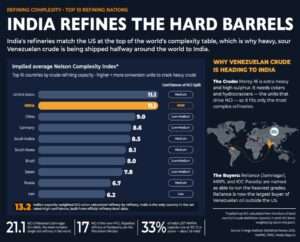
At the centre of this capability is Reliance Industries’ Jamnagar complex, the world’s largest single-location refining complex. Its two refineries have a combined crude-processing capacity of approximately 1.4 million barrels per day, while its Nelson Complexity Index (NCI) stands at an exceptional 21.1. Reliance has reported processing more than 240 different crude grades.
The NCI measures the relative complexity of a refinery by assessing the sophistication and investment intensity of its processing units compared with basic crude distillation. A higher score generally indicates greater capability to convert heavier residual fractions into higher-value products.
This matters because crude oil is not a uniform commodity. Heavy crude contains a greater proportion of dense, difficult-to-process material, while high sulphur content requires additional treatment. Advanced units such as cokers, hydrocrackers and desulphurisation facilities help convert these challenging feedstocks into usable fuels and other products.
Venezuela: opportunity and limitations
Venezuela possesses enormous petroleum resources, particularly in the Orinoco Belt, but much of its oil is heavy or extra-heavy. Its Merey export blend typically has an API gravity of around 15–18 degrees and sulphur content of approximately 2–3 per cent, making it more demanding to process than lighter crude grades.
Jamnagar’s configuration gives Reliance a technical advantage in processing such oil. However, technological capability alone does not guarantee commercially attractive imports. Freight costs, insurance, payment arrangements, supply reliability and the price discount offered by sellers all influence the final economics.
India must also assess Venezuelan supplies alongside crude available from Russia and West Asia, where shorter shipping distances can offer substantial logistical advantages.
Refining strength as strategic leverage
India’s refining prowess offers an opportunity to diversify crude sourcing, strengthen exports and enhance its importance in global energy trade. Yet energy security requires more than sophisticated plants: it depends on competitive procurement, reliable supply chains and commercially sound decisions.
Jamnagar demonstrates how advanced industrial infrastructure can become an instrument of economic and strategic influence. The challenge for India is to use that advantage to secure affordable energy, maximise domestic value addition and retain flexibility in an increasingly unpredictable global oil market.