



अपर्याप्तं तदस्माकं बलं भीष्माभिरक्षितम्।
पर्याप्तं त्विदमेतेषां बलं भीमाभिरक्षितम्॥
Duryodhana said:
“Our army, protected by Bhishma, is vast and seemingly immeasurable; whereas their army, protected by Bhima, appears limited and therefore easier to comprehend.”
The words of Duryodhana occur at a decisive moment in the Bhagavad Gita, when the armies of the Kauravas and Pandavas have assembled on the sacred field of Kurukshetra. On the surface, his statement appears to be a straightforward assessment of military strength. Yet, when viewed in the larger narrative of the Mahabharata, these words reveal much more than a calculation of numbers. They expose Duryodhana’s anxiety, his dependence upon outward strength, and his inability to perceive the deeper forces that determine the course of dharma.
The Kaurava army was indeed formidable. It contained renowned warriors of extraordinary ability—Bhishma, Drona, Karna, Kripacharya, Ashvatthama, Shalya and many other masters of warfare. The Pandava army, by comparison, was smaller. Yet the Mahabharata repeatedly demonstrates that the magnitude of an army cannot by itself determine the outcome of a conflict. Numbers provide physical strength; they do not necessarily provide moral authority, unity of purpose, or clarity of mind. The war of Kurukshetra was therefore not merely a contest between two military formations. It was a confrontation between competing visions of duty, justice, power and human responsibility.
Duryodhana’s description of Bhishma as the protector of his army is particularly significant. Bhishma was not merely a commander. He was the great patriarch of the Kuru dynasty, a man whose life had been shaped by extraordinary vows and unparalleled sacrifice. His personal power, discipline and mastery of weapons were unquestionable. His presence at the head of the Kaurava forces gave the army enormous confidence. Yet Bhishma’s position contained a profound tragedy: although he recognized the righteousness of the Pandavas in important respects, his vow of loyalty to the throne of Hastinapura bound him to fight on the Kaurava side.
This distinction between personal knowledge and obligatory action lies at the heart of the Mahabharata. A person may understand what is right and yet become entangled in obligations, relationships, vows, institutions and circumstances that make action exceedingly difficult. Bhishma represents this tragic complexity. His greatness as an individual did not eliminate the moral contradictions surrounding his allegiance. His presence therefore symbolized both the immense strength and the underlying weakness of the Kaurava position.
Duryodhana’s reference to Bhima as the protector of the Pandava army is equally revealing. Bhima represented a very different kind of power. He was physically immense, fearless and fiercely determined. His anger had been intensified by the humiliation of Draupadi, the injustice committed against the Pandavas, and the long years of suffering imposed upon them. His strength was not merely physical; it was also the strength of an unresolved vow. He had sworn to punish those responsible for the wrongs committed against his family, and that determination became one of the powerful emotional currents driving the war.
Yet the contrast between Bhishma and Bhima cannot simply be reduced to a comparison between two warriors. Bhishma represents disciplined power rooted in an ancient vow, while Bhima represents force energized by personal suffering and a demand for retribution. Both are formidable, but their inner motivations are different. The Mahabharata constantly reminds us that the external appearance of strength can conceal very different psychological and moral realities.
Duryodhana’s statement also contains an important contradiction. He declares that his own army is aparyaptam—vast or immeasurable—while describing the Pandava army as paryaptam—limited or adequately contained. At one level, this is military confidence. At another, it may be read as an attempt to reassure himself. A ruler who possesses overwhelming material power should not need to emphasize it repeatedly. His very insistence upon numerical superiority suggests that he understands the significance of the opposing army beyond mere numbers.
The presence of Krishna on the Pandava side makes this distinction even more profound. Krishna does not take up weapons in the war. He chooses instead to serve as Arjuna’s charioteer. In worldly calculations, an unarmed Krishna may appear less significant than a large battalion of soldiers. Yet the Gita teaches precisely the opposite lesson: wisdom and right discernment can possess a power that cannot be measured by weapons, wealth or numbers.
This is one of the great philosophical movements of the Mahabharata. Human beings frequently measure power through visible instruments—armies, wealth, authority, position and physical strength. The epic repeatedly questions such measurements. Ravana possesses enormous power but falls because of arrogance and unrighteous desire. Duryodhana possesses a vast kingdom and an immense army, yet his inability to distinguish possession from righteousness ultimately becomes his weakness. Conversely, the Pandavas endure exile, humiliation and deprivation, yet they retain a deeper connection with duty and legitimacy.
The battlefield therefore becomes a symbolic field of human consciousness. Every warrior carries not only weapons but also motives, memories, loyalties, fears and responsibilities. Before the first great movement of battle begins, the Gita turns the attention of humanity from the external battlefield to the inner battlefield. Arjuna’s crisis is not caused by a lack of military knowledge. He is overwhelmed by the moral consequences of action. Krishna’s teaching begins precisely there.
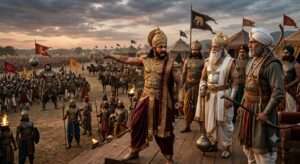
Duryodhana sees armies. Krishna sees human beings and the laws of dharma. Duryodhana measures strength through numbers and prominent warriors. Krishna teaches Arjuna to understand action through knowledge, discipline, detachment and duty. This contrast gives the opening verses of the Gita their enduring significance. The battlefield may belong to ancient India, but the dilemma belongs to every generation.
The statement about Bhishma and Bhima also invites a deeper reflection on the nature of leadership. A commander-in-chief may possess extraordinary authority, but an army ultimately depends upon the collective consciousness of those who follow him. Leadership can organize physical strength, but it cannot manufacture conviction indefinitely. An army may be large and still internally divided. A smaller force may possess greater unity of purpose. Thus, numerical superiority and effective strength are not always identical.
The Mahabharata makes this principle visible through its characters. Bhishma, Drona and Kripa are bound by their obligations to the Kuru establishment. Karna is bound by gratitude and loyalty to Duryodhana. The Pandavas are bound by their understanding of justice and familial duty, while Krishna operates from a larger vision of dharma. Every major character stands within a network of obligations. The war is therefore as much about conflicting duties as it is about weapons.
The verse can consequently be understood as a profound lesson in perception. What appears immense may not necessarily be enduring, and what appears limited may contain immeasurable potential. The Kaurava army possessed numbers, wealth, established authority and many celebrated warriors. The Pandavas possessed fewer resources, but their cause was supported by Krishna’s guidance and by a powerful sense of purpose. The epic does not reduce this distinction to a simplistic formula; rather, it invites us to examine the relationship between external strength and inner truth.
Bhishma himself becomes one of the most poignant illustrations of this principle. He is invincible in battle for a time, yet he is unable to prevent the destruction of the very dynasty he spent his life protecting. His story demonstrates that personal power has limits when the larger structure within which that power operates has become morally fractured. A great warrior can protect an institution from an enemy, but he cannot permanently protect an unjust order from the consequences of its own actions.
Bhima, on the other hand, embodies the raw force of determination. Yet even his strength must ultimately operate within the larger framework of Krishna’s wisdom and Yudhishthira’s understanding of dharma. The Mahabharata therefore does not teach that strength alone produces victory. It teaches that strength becomes meaningful only when governed by discernment and directed toward a legitimate purpose.
Duryodhana’s words thus carry an unintended irony. He believes that he is describing the superiority of his army, but the narrative gradually reveals the limitations of the very power he celebrates. His army is enormous, yet its greatness cannot resolve the moral crisis at the center of the Kuru kingdom. Bhishma is powerful, yet bound by conflicting duties. Drona is a master of warfare, yet emotionally connected to both sides. Karna is immensely capable, yet trapped by loyalty, identity and circumstance. The Kaurava strength is therefore extraordinary but internally complicated.
The Pandavas too are not presented as flawless human beings. They make mistakes, experience anger, suffer humiliation and confront difficult moral choices. The greatness of the Mahabharata lies precisely in this complexity. It does not divide humanity into perfectly pure and perfectly evil individuals. Instead, it shows how human beings become entangled in dharma, desire, attachment, pride, loyalty and consequence. Krishna’s teaching emerges within this complicated human world rather than outside it.
The eternal truth of the Gita is therefore not simply that one army was larger and another smaller. Its deeper message is that the true measure of human strength cannot be found merely in external possessions. A person may possess enormous resources and still be governed by fear, attachment and confusion. Another may possess very little outward power yet remain inwardly steady because of knowledge, discipline and faith in dharma.
Kurukshetra consequently becomes more than a historical battlefield. It becomes an image of the human condition. Within every individual, there are competing forces—ambition and conscience, attachment and duty, fear and courage, desire and wisdom. The question is not merely which force is larger, but which force is guided by truth.
Duryodhana looks at the battlefield and sees the size of armies. Arjuna looks at the battlefield and sees relationships. Krishna looks beyond both and reveals dharma. That movement—from external measurement to inner understanding—is the spiritual journey at the heart of the Bhagavad Gita. The verse beginning with “Aparyaptam” therefore opens a window into one of the epic’s deepest teachings: power may be counted, armies may be measured, and weapons may be compared, but truth, righteousness and awakened consciousness cannot be measured by numbers.

