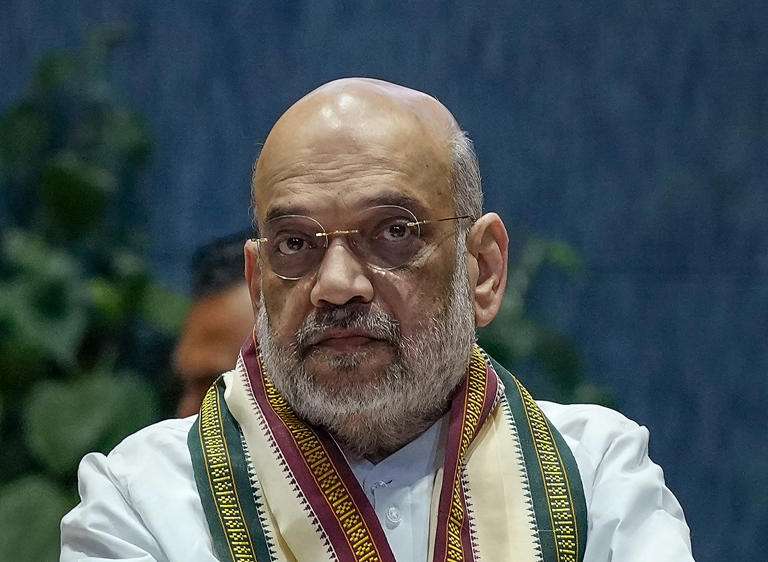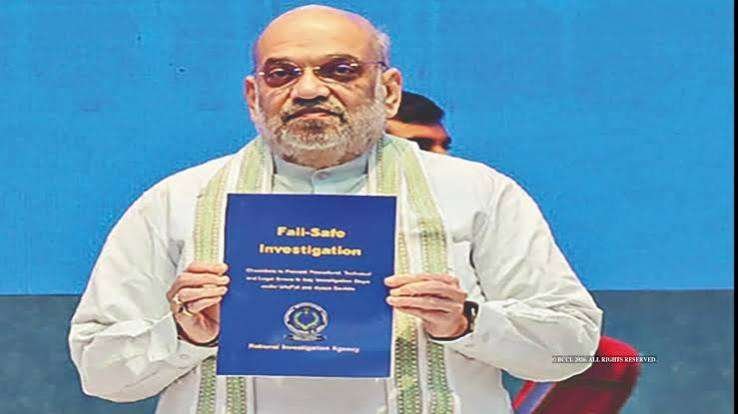
New Delhi: In a “major milestone” in the fight against terrorism, Kashmir is free from India-born terrorists after 35 years, Union Home Minister Amit Shah said on Thursday and stressed the need to strengthen “proactive action” in the country’s counter-terrorism policy.
Addressing the annual anti-terror conference here, he said that the entire terrorist network must be investigated and its capabilities dismantled in a coordinated manner.
“We will not achieve success unless we strike at the entire terrorist network in a coordinated and comprehensive manner,” the minister said.
He said the government, under the leadership of Prime Minister Narendra Modi, had adopted a policy of zero tolerance towards terrorism and was achieving positive results through sustained efforts.
Shah said India was moving towards establishing a uniform counter-terrorism strategy across the country, ensuring coordinated action from the national level down to every police station.
He noted that although police forces in different states had undertaken several operations against terrorism over the years, a lack of coordination had remained a major challenge. Successive governments had made efforts to address these shortcomings, he said.
The Home Minister said the hallmark of a successful security agency was its ability to identify and apprehend terrorists before they could execute attacks, urging state police forces to study and implement such preventive models.
Highlighting action against terror networks, Shah said the Shahzad Bhatti network had been designated a terrorist organisation under the Unlawful Activities (Prevention) Act (UAPA). More than 40 of its modules had been dismantled across the country, while over 100 cases had been registered and more than 271 people arrested.
Referring to the government’s efforts to bring fugitives back to India, Shah said 303 fugitives had been brought back from 36 countries since 2019 through coordinated efforts by the Ministry of Home Affairs, the Central Bureau of Investigation (CBI) and intelligence agencies.
He said bringing back criminals and masterminds hiding abroad was essential to completely eliminate terrorism, organised crime and drug-related activities.
Shah said the government had undertaken several institutional and legal reforms to strengthen the country’s counter-terrorism framework.
He said the National Investigation Agency (NIA) Act was amended on August 2, 2019, bringing additional offences under the agency’s jurisdiction and expanding its powers. The UAPA was subsequently amended on August 14, 2019, empowering the NIA to seize properties belonging to terrorists and enabling individuals to be designated as terrorists.
He said a unified action plan to counter radicalisation was prepared in September 2019 and finalised in December that year following consultations with various ministries.
Shah described the September 2022 operation against the Popular Front of India (PFI) as a significant example of coordinated action by police forces across the country.
He said police forces from 11 states, along with central agencies, carried out simultaneous operations in a single night, dismantling the PFI network and breaking its backbone. He said the operation had become a case study of coordinated counter-terrorism action.
The Home Minister said the functioning of the Multi-Agency Centre (MAC) had been reorganised, bringing cyber security, narcotics, organised crime networks and emerging radicalisation hotspots under its purview.
He said the MAC’s operational methodology was restructured in 2023 using advanced technology, while a National Memory Bank was established to strengthen the centralised database and intelligence-sharing mechanism.
Shah said the national presence of the NIA had also been expanded, with approval granted for 16 new branch offices and two zonal offices. The agency had additionally been empowered to investigate cases aimed at protecting the interests of Indians residing abroad.
He said a ban had been imposed on the glorification of terrorism and a 25-point integrated action plan had been formulated to control terror financing, which was being monitored effectively.
The Home Minister said NIA officers were being provided international exposure through training, while 70 new NIA special courts had been established across the country.
He said peace had been established in three major terrorism-affected hotspots and networks such as PFI and Shahzad Bhatti had been dismantled. He also referred to a new mechanism for bringing fugitives back from abroad, a comprehensive approach to border security, removal of illegal religious structures along borders and improved coordination among agencies to strengthen economic security.
He said better coordination was required between counter-terrorism agencies and financial investigation agencies to break the complete chain of terror financing.
“We will not achieve success unless we strike at the entire terrorist network in a coordinated and comprehensive manner,” he said.
Shah stressed that the fight against terrorism required shared objectives and clearly defined accountability at every stage, adding that the two-day conference should be outcome-oriented.
He called for strengthening a proactive and offensive approach to counter-terrorism, with greater emphasis on improving the structural and operational capabilities of security agencies.
He said investigations should continue until the entire network behind a terrorist incident was dismantled, adding that Anti-Terrorism Squads (ATS) had a crucial role in identifying and eliminating wider networks.
The Home Minister said every state’s ATS should strengthen its cyber expert units as terrorists were increasingly using technology to carry out their activities.