



India’s Economic Ascent: The Road to Global Leadership
India’s economic rise is increasingly becoming a defining feature of the emerging global order. From being the world’s tenth-largest economy in 2015, India has climbed the global rankings and is projected to become the third-largest economy by 2031, according to the projections cited from the International Monetary Fund (IMF). This anticipated transformation is not merely a statistical milestone; it reflects the growing economic weight, strategic relevance, and international influence of Bharat.
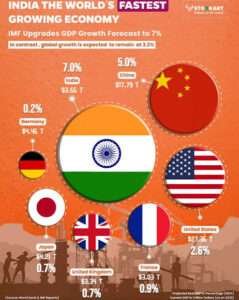
The significance of this journey becomes clearer when economic size is examined alongside growth momentum. While the United States and China continue to occupy the top positions in the global economic hierarchy, India’s sustained expansion offers a compelling contrast to the slower growth confronting several advanced economies.
Growth Amid Global Uncertainty
The Asian Development Bank’s (ADB) September 2026 outlook projects India’s economy to grow by 7% in the financial year 2026–27, supported by resilient consumption, healthy investment and strong services exports. The IMF’s April 2026 World Economic Outlook, meanwhile, projects India’s real GDP growth at 6.5% for calendar year 2026. These estimates use different reporting periods and methodologies, but both underline the economy’s continued resilience.
India’s performance assumes greater significance against the backdrop of an uncertain international environment. Geopolitical conflicts, elevated energy costs, financial-market volatility and trade-policy uncertainty are complicating the global economic outlook. The ADB has also identified the possibility of a severe El Niño event as a downside risk to regional growth.
Yet, India’s large domestic market, expanding services sector, infrastructure investment and growing digital economy provide important buffers against external shocks. The country’s ability to sustain demand at home while expanding its engagement with global markets is a significant source of strength.
Asia’s Changing Economic Landscape
Asia remains central to global economic expansion, with the region expected to account for approximately 59% of worldwide growth in 2026, according to the estimates cited in the global economic outlook. However, the sources of this momentum differ considerably.
Guyana’s projected growth of 16.2% is driven largely by its offshore oil boom, while Taiwan’s estimated 11% expansion reflects surging semiconductor demand and investment associated with artificial intelligence (AI). Kyrgyzstan and Vietnam are also expected to record strong growth, supported by investment, manufacturing, exports and domestic demand.
These examples demonstrate that exceptional growth rates can arise from particular resource advantages or technology-driven opportunities. India’s challenge is different: it must sustain high growth across a vast and diverse economy while creating productive employment for its enormous population.
India’s position as one of the fastest-growing major economies is therefore more consequential than a comparison of headline percentages alone. Sustaining expansion at this scale can reshape global trade, investment flows and the international distribution of economic influence.
From Economic Size to Economic Strength
However, becoming the world’s third-largest economy must not become an end in itself. Aggregate GDP rankings do not automatically translate into higher per capita incomes, improved living standards or equitable development. India must ensure that economic expansion generates quality employment, raises household purchasing power and improves access to education, healthcare and essential services.
Manufacturing deserves particular attention. While services exports remain an important growth engine, a stronger manufacturing base can expand employment, deepen domestic supply chains, improve export competitiveness and reduce excessive dependence on imported goods. Investment in research, advanced technology, semiconductor capabilities and artificial intelligence will also be crucial to moving up the value chain.
Equally important are agricultural productivity, energy security and the development of resilient infrastructure. Higher energy prices can raise production costs and inflation, while an unfavourable monsoon can affect rural incomes and consumption. Fiscal discipline, predictable policies and a stable financial environment will be essential to sustaining investor confidence.
The Strategic Dividend
Economic strength increasingly determines a nation’s strategic autonomy. A larger and more productive economy gives India greater capacity to invest in defence, scientific research, infrastructure and technological capabilities. It also strengthens Bharat’s voice in multilateral institutions and its ability to contribute to the stability of the Indo-Pacific and the wider international order.
Nevertheless, the road ahead will demand consistency rather than complacency. Global conflicts, protectionist policies, climate-related disruptions and technological competition could all alter the growth trajectory.
India’s projected ascent to the third position in the global economic rankings by 2031 is an ambitious and credible objective, but it remains a projection rather than a guaranteed outcome. The decisive test will be whether the country can convert its demographic scale, investment momentum and entrepreneurial energy into sustained productivity gains and broad-based prosperity.
The ultimate measure of Bharat’s economic success will not simply be the size of its GDP, but the strength of its productive capacity, the opportunities it creates for its citizens and the confidence it inspires across the world. A rising India can become a consequential global economic power—but enduring leadership must be built on inclusive growth, technological capability and institutional resilience.

