Lakshmanrao Upadhyayula
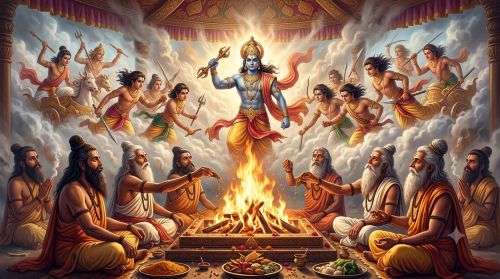
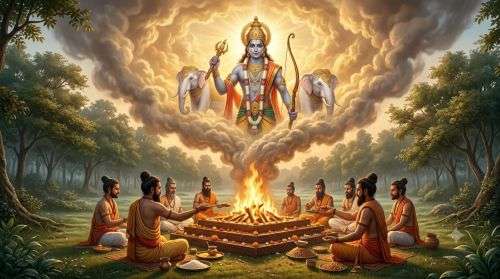
In the sacred tradition of the Rugveda, the revered sage Vishwamitra invokes Indra through the majestic rhythms of the Jagati, Tristubh, and Gayatri chandas, weaving together devotion, wisdom, and sacrificial discipline. These hymns are not merely poetic compositions but living expressions of a profound relationship between humanity and the divine. Every mantra carries the aspiration that righteous effort, sincere worship, and harmonious living attract divine grace. The morning sacrifice symbolizes the awakening of consciousness, reminding the worshipper that each new dawn offers an opportunity to renew one’s covenant with truth, virtue, and sacred duty.
The priests declare that the Soma has been carefully prepared with barley, curd, clarified butter, and purified according to the sacred injunctions of the Vedic ritual. Every ingredient reflects a deeper symbolism. Barley represents agricultural prosperity and the fruits of disciplined labor, curd signifies nourishment and vitality, clarified butter embodies purity and illumination, while Soma represents divine inspiration and immortal bliss. Their careful preparation demonstrates that the external offering mirrors the inner purification of the sacrificer. Such rituals also reveal an early scientific temperament, where precision in measurement, cleanliness, timing, and systematic procedure were considered essential for maintaining harmony between the natural and spiritual worlds.
The freshly prepared sacred cakes are lovingly offered to Indra as symbols of gratitude rather than mere food. The worshippers invite the mighty deity to accept these offerings with joy and to bless the community with strength, protection, prosperity, and abundant harvests. The Vedic sacrifice teaches that true offerings arise from hearts filled with sincerity, humility, and selfless devotion. The external ritual becomes meaningful only when accompanied by purity of intention and righteous conduct.
The sages pray that Indra may delight in their flawless hymns just as a compassionate mother delights in her beloved child. This beautiful comparison illustrates the intimate bond envisioned between the divine and humanity. In Vedic thought, correctly recited mantras are not simply spoken words but vibrational expressions of cosmic order. Their precise pronunciation, rhythm, and meter preserve the harmony of sound, demonstrating the remarkable linguistic science developed by the Vedic seers, who understood the transformative power of sacred speech upon the human mind and environment.
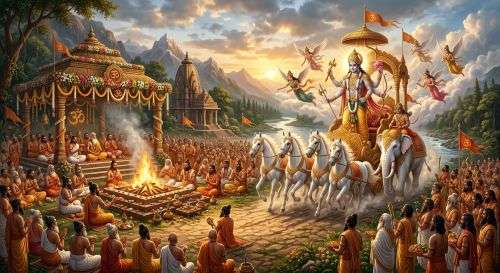
Indra is praised as the ancient and ever-glorious protector whose fame extends from the earliest ages of creation. The worshippers invite Him to enter the sanctified precincts of the yajna, where every altar, offering, and chant has been consecrated according to eternal principles. His presence is believed to sanctify both the home and the community, transforming ordinary space into a sacred dwelling where divine blessings descend upon those who uphold righteousness.
The hymns also honor Indra as the inspirer of sacred knowledge and the guardian of noble aspirations. He is attended by the skilled Ribhus, the celestial artisans whose creative excellence symbolizes disciplined craftsmanship and divine intelligence. The worshippers seek not merely material abundance but virtuous descendants, righteous prosperity, and enduring wisdom. Through continuous chanting of mantras and faithful offerings, they aspire to cultivate lives rooted in moral excellence, social harmony, and spiritual advancement.
Indra is glorified as the heroic slayer of the serpent Vritra, whose defeat represents the triumph of light over darkness, order over chaos, and life-giving rains over destructive drought. His victory symbolizes the removal of every obstacle that restrains human progress and spiritual awakening. At the same time, He is revered as a wise and discerning protector who fulfills worthy desires, much like the nourishing care associated with Pushan. Thus, courage and wisdom are united within His divine character, teaching that true strength must always be guided by righteous understanding.
The nourishing preparation mixed with curd and the carefully prepared barley offerings express the gratitude of a community sustained by the gifts of nature. Indra, the lord of the radiant Hari horses, is invited to partake of these offerings alongside the Maruts, whose dynamic energies represent the life-giving forces of wind, atmosphere, and renewal. The Adityas also participate in this cosmic fellowship by presenting roasted barley, revealing the Vedic vision of harmonious cooperation among divine powers that sustain the universe through balance and mutual order.
The worship concludes with the unwavering confidence that daily recitation of sacred hymns will continually inspire Indra to accept the Soma offerings within the spacious, sanctified halls of the yajna. He is celebrated as the supreme leader who defeats hostile forces, removes humiliation from the righteous, and establishes justice among humanity. These ancient hymns reveal that the Vedic sacrifice was never merely a ceremonial observance but a comprehensive discipline integrating devotion, ethical living, ecological awareness, intellectual precision, and spiritual realization. Through such sacred worship, the seeker aligns personal life with the eternal rhythm of the cosmos, recognizing that divine blessings naturally flow where truth, purity, gratitude, and disciplined action are faithfully preserved.