



For a seventy-year-old, going to Goa with his wife is, according to a circle of naughty friends, almost a sort of blasphemy. But circumstances, and the compulsions of middle-class life, where we give priority to everything except pleasure, holidays and, more particularly, a holiday of the Goa variety, make such a trip almost unthinkable.
I nevertheless kept Goa on my bucket list, determined to visit it at least once in the final innings of my life. There were two reasons for putting it on the list in the first place. As I belong to the printing fraternity, I owe my deepest respect to a profession that gave me my bread and butter. Goa has a special place in the history of printing in India, as the Portuguese established the first printing press here. Having visited the mecca of printing in Germany — Düsseldorf, to be precise — for DRUPA, the four-yearly international printing exhibition, I felt it would be inexcusable not to visit the place where printing took root in India.
The second reason was more personal: to visit a relative who had settled in Goa after retirement and fulfil a promise I had made to him.
This piece, however, is about an experience my wife and I had during our return journey from Goa to Secunderabad — an experience in which we were saved, in a manner of speaking, by the good Samaritans of the Konkan Railway.
After a week-long trip, we began our return journey from Vasco da Gama station at around 8.30 am. As the train zoomed ahead, my wife suddenly developed severe, unbearable abdominal pain, accompanied by almost unending motions. Never in all our umpteen journeys had I seen her so restless and helpless, unable to sit, lie down or even walk comfortably.
The SOS medicines we had carried with us brought no relief. Her agony, however, did not go unnoticed. The lady TTE who came to check our tickets immediately realised that something was seriously wrong and volunteered to ask whether we needed a doctor.
I wondered if there was a doctor on board.
There wasn’t.
But she told us she could send a message ahead and arrange for a doctor to attend to my wife at the next station, Castle Rock. It was a pleasant surprise to learn that such a facility existed for passengers during a train journey.
The scenic beauty outside, not to speak of the magnificent Doodh Sagar waterfalls, could provide no diversion from the pain and discomfort. Every minute seemed like an hour.
But as the train reached Castle Rock, a doctor, accompanied by an attendant and a couple of RPF personnel, came to our coach and attended to my wife. The doctor’s arrival was nothing short of a godsend. He examined her, gave her a couple of pills and confidently told us that she should be normal within a couple of hours. If that did not happen, he assured us that further help would be arranged at Bellary, a larger station with facilities to take her to a hospital.
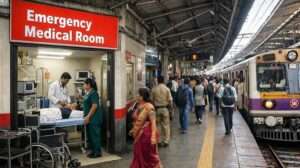
Slowly but surely, the pain began to subside. Within two hours, everything returned to normal — so much so that it was difficult to believe she had been in such agony only a short while earlier.
The TTE continued checking on her and even helped us get some simple, healthy food — curd rice and bananas — by instructing the catering staff to make sure we were looked after.
When you are in the middle of a crisis, such kindness can feel almost unreal. What initially looks like a nightmare suddenly begins to resemble a well-coordinated rescue operation.
The purpose of narrating this experience is simple: to give credit where credit is due.
Most of my articles are critical of the government whenever people suffer. But how often do we, as writers, call a spade a spade when something works? Criticism comes naturally; praise, rather reluctantly. And when something goes wrong on the railways, we are quick to blame the Railway Minister or even the Prime Minister, arguing that the buck ultimately stops at the top.
So, can I give credit to the two people who, in different capacities, man the Railway Ministry and the country — Ashwini Vaishnaw and Narendra Modi?
In this particular instance, yes.
The empathy of the TTE, her immediate response, the coordination with the railway staff, the doctor and the RPF personnel, and the arrangements made at the next station were impressive. I could not help wondering whether such seamless assistance would necessarily be available even in some developed countries.
Would there be such coordination between a TTE, ground staff, a doctor and security personnel, all working in tandem to respond to a passenger’s medical emergency?
This is precisely why good work deserves acknowledgement.
But what is the use of praising Ashwini Vaishnaw and Modi without expecting something in return?
Now that we have experienced first-hand what the Railways can do for passengers in distress, senior citizens are still waiting for the restoration of the railway fare concession they once enjoyed.
In fact, if there was one birthday gift that could have delighted millions of senior citizens, perhaps the restoration of the concession would have been it. Prime Minister Modi celebrated his birthday on September 17. Such an announcement would have been a fitting return gift — encouraging senior citizens to spend some of their retirement years travelling, rather than merely travelling between home, doctors and hospitals.
After all, at seventy, Go Goa Go! should not sound like blasphemy.
It should sound like a right we have earned.


good experience.. TTEs and staff shoud be trained to extend emergency services to the needy in all trains…. fare concession to senior citizens is very important and essential..