



At times, one really does not know whether to laugh or worry when listening to Telangana Chief Minister A. Revanth Reddy speak about history. For a man occupying the highest elected office in a State whose very identity is inseparable from the traumatic events of 1947–48, a little more familiarity with history would surely not hurt.
Google, after all, is freely available. So are history books, government archives and even the official records of the Indian Armed Forces.
Yet the Chief Minister occasionally speaks as though history is something that can be rewritten according to the political requirements of the day.
His remarks on the Nizam-era legacy have therefore raised legitimate questions. In the Assembly on September 16, he reportedly described the Nizam as one of the better rulers and spoke of the infrastructure and other legacies of his regime. The following day, while addressing the State’s Praja Palana Dinotsavam, he did acknowledge the atrocities of the Razakars and the suffering caused by feudal oppression.
But therein lies the contradiction.
One cannot selectively admire the Nizam’s administration while treating the political and social circumstances surrounding the final years of his rule as a historical footnote.
The Hyderabad State did not simply drift peacefully into the Indian Union. After Independence, the Nizam sought to maintain Hyderabad’s separate status. The Razakars, associated with the Majlis-e-Ittehadul Muslimeen and led by Kasim Razvi, became an armed force supporting that political position. The Ministry of External Affairs’ historical account records that the Razakars were responsible for political murders and communal terrorism and that the Nizam’s government ultimately capitulated following India’s Police Action.
The Indian government’s own historical material on Operation Polo records the military operation that began on September 13, 1948. Hyderabad capitulated on September 18, bringing the princely State into the Indian Union.
This is not some “WhatsApp history” manufactured yesterday by political parties.
It is part of the documented history of independent India.
The Razakar chapter is particularly important. They were not a cultural association distributing sweets and organising blood-donation camps. They were an armed militia operating in a deeply disturbed political environment. Historical accounts document violence, intimidation and atrocities against sections of the population. The Indian government’s own publications describe the Razakars as a militant force whose activities contributed to the crisis that preceded Operation Polo.
For anyone who grew up in Telangana, these are not merely dates in a textbook. The memory of that period survives in families and villages across the region.
The tragedy, therefore, is not that Revanth Reddy wants Telangana to remember the Nizam-era development of Hyderabad. History should indeed record the good, the bad and the ugly. The problem begins when selective admiration risks sanitising a political order whose final phase was marked by repression, armed violence and resistance to integration with India.
There is also an unmistakable political dimension to the Chief Minister’s rhetoric. Revanth Reddy has openly spoken of the political equation between Muslims and the Congress, even saying that he would not mind being called “Revuddin” instead of Revanth Reddy. Such statements may be intended as political outreach, but they inevitably raise a larger question: where does electoral calculation end and historical responsibility begin?
The Congress, after all, is fighting to retain power in the few major States where it remains in government, particularly Telangana and Karnataka. Its traditional Muslim support has also faced competition from regional parties in several parts of India. Against that backdrop, the Congress has obvious political reasons to consolidate every segment of its existing support base.
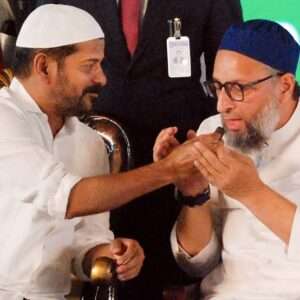
The AIMIM’s political journey, too, cannot simply be separated from the history of the old Majlis and the Razakar era. The present-day party traces its organisational lineage to the Majlis-e-Ittehadul Muslimeen founded in 1927, while the Razakars emerged later under Qasim Razvi during the final phase of the Nizam’s rule. The political history is therefore more complicated than convenient modern-day narratives often suggest.
The AIMIM has also entered into political understandings with different parties at different times. Its association with the TRS, later BRS, during the K. Chandrashekar Rao era was an important feature of Telangana politics, while its present relationship with the Congress reflects the shifting calculations of contemporary State politics. Political alliances can change; historical facts cannot.
That is precisely why the Chief Minister does not have the luxury of being historically casual.
He may be a politician. He may indulge in political rhetoric. He may attempt to score points against his opponents. But when he speaks about the history of Telangana, he speaks from an office that carries institutional responsibility.
The Chief Minister is therefore entitled to praise Hyderabad’s development under the Nizam. He is entitled to acknowledge its architectural, educational and administrative contributions. But he cannot selectively celebrate the legacy while allowing the darker chapters of the same period to disappear from the public narrative.
History is not a political buffet from which leaders can pick only what suits the moment.
Telangana deserves the whole story.
Perhaps the Chief Minister should take a small break from political theatrics and open a few history books.
Better still, perhaps he should read the official history of Operation Polo. The Indian government itself lists it among the official histories of the post-Independence Indian Armed Forces.
And if that sounds too laborious, there is always Google.
The irony is delicious: in the age of artificial intelligence, the Telangana Chief Minister seems occasionally determined to demonstrate the natural limits of political intelligence.
September 17 is not merely a date for competing political narratives. It represents the end of Hyderabad’s princely isolation and its integration into the Indian Union. Whether one calls it Liberation Day, Integration Day or Praja Palana Dinotsavam, the historical facts cannot be altered by changing the name of the celebration.
Governments may rename an event.
They cannot rename history.
And certainly, they cannot expect Telangana’s people to forget it.

